Chapter: 4
Performance on the Ephemeral Stage 2.0
Performance on the Ephemeral Stage 2.0
This project uses a new Unity codebase to make an argument about arenas in the Roman Republic.
Performance on the Ephemeral Stage 2.0 Tour
Chapter 4
RomeLab: An Introduction
This digital version of the city of Rome, ca. 160 BCE functions as a laboratory, and was constructed and designed as such. Built to interrogate spatial relationships, and not to be presented as a stand-alone museum artifact or as a magical window that enables the reader to step backward through digital time, this Forum is a three-dimensional map or, to borrow terminology from Willard McCarty, a \"tinker toy model\
Typology and Representation
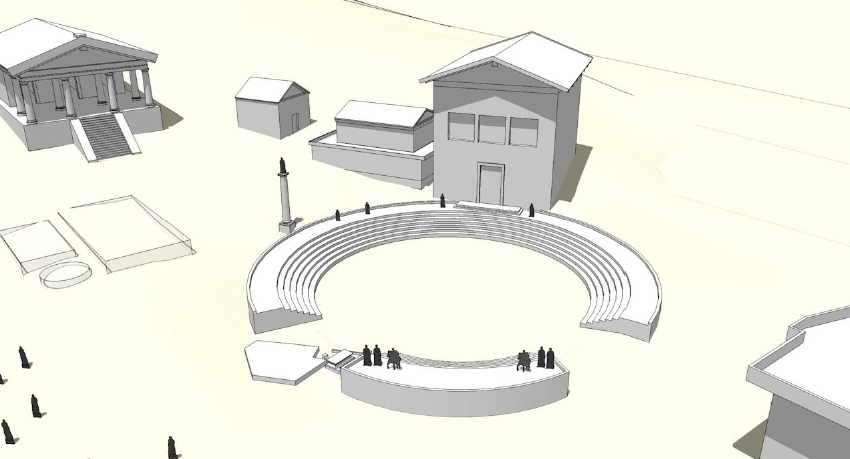
Buildings are typological constructs that approximate what might have been. Grown procedurally from a GIS core, versions of the city are rapidly generated to address specific research questions. For the purposes of this investigation, one centered on sightlines and viewsheds, texture, color, atmospheric effects and the like have been removed. Instead, this laboratory contains an abstraction, one where, for the most part, every line matters.
The Roman Arena in the 2nd Century BCE
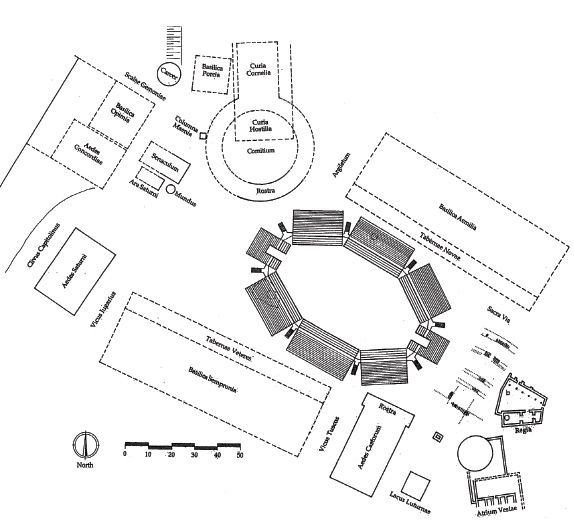
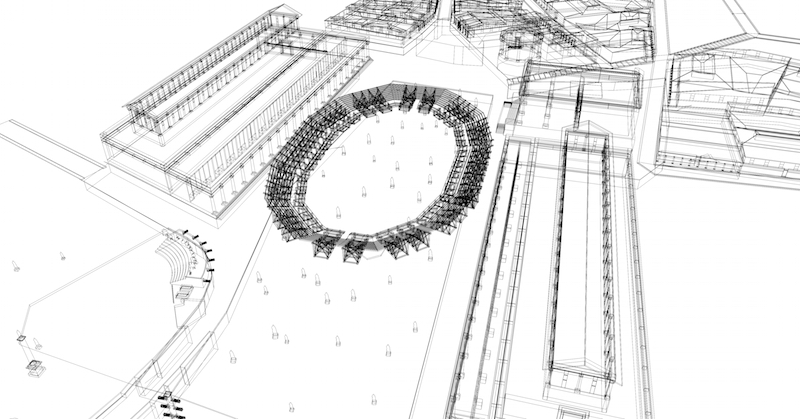
Communis opinio holds that gladiatorial games at Rome in the 3rd and 2nd centuries BCE were performed in temporary structures, constructed of wood, set up within the Roman Forum, the civic, religious, and juridical center of the Eternal city. (The Roman arena of the 2nd century BCE as proposed by Welch (2007) 51 fig. 22.)
Two-dimensional, Visual Argumentation
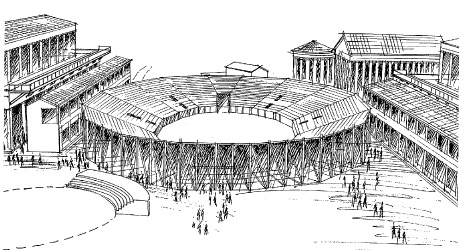
Arguments such as these are rooted in three-dimensional space, but are still, too often, made through juxtaposition of plan, section and hypothetical drawing. The conclusion is all too quickly digested without a rich undertanding of the spatial context by the reader. The problem is exacerbated when imagery forms the bulk of the argument. (Hypothetical view of wooden arena, Welch (2007) 55 fig. 26.)
The Vivid Image
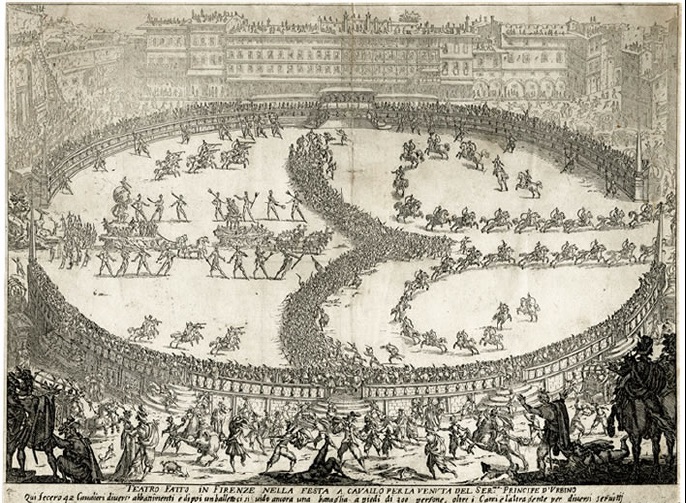
Coupled with detailed hypothetical drawings, convincing Renaissance analogs are adduced, ranging from the Palio at Siena to equestrian shows and military parades in Florence. Like works of Hellenistic history, vividness should not be confused with accuracy. (Piazza Santa Croce, 17th Century, Florence.)
The Arena in 3D
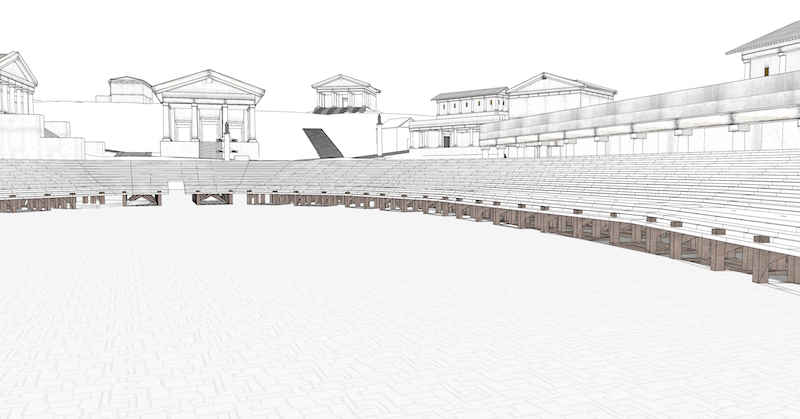
The length and width of this temporary amphitheater are constrained by the surrounding space, the height, by that of the surrounding balconies of the adjacent basilica. These balconies, known as Maeniana, a name that would later be transformed into technical vocabulary to describe rows of seating in the monumental amphitheater, are explictly described as viewing spaces (spectacula) for gladiatorial games.
A Caesarian Retrojection?
Even today, Caesar's Rome gets in the way. Rome of the 2nd century BCE was radically different from that of the first. The Forum was filled with competitive imagery. By 158 BCE, there were so many statues in the Forum that the Senate ordered all those unapproved to be removed. (Plin. HN 34.30) Caesar removed an altar in the Lacus Curtius for the last games he sponsored in the Forum.
“ara inde (sc. the Lacus Curtius) sublata gladiatorio munere divi Iuli quod novissme pugnavit in Foro.”
“An altar was removed from [the Lacus Curtius] in the gladiatorial munus of the divine Julius, the last one he staged in the Forum.”
--Plin. HN 15.20.78.
Might this be the first occasion where significant alterations were made to the built form of the Forum to accommodate the games?
(The Forum with Statuary)
The Textual Evidence
(123 BCE) The people were getting ready to watch gladiatorial combats in the Forum, and most of the magistrates, after they had set up bleachers in a circle, were charging a fee for their use. Gaius ordered them to tear down the stands so that the poor could watch from their places without paying. But when no one obeyed, he waited until the night before the show, took with him as many contractors as there were from the skilled workmen, and tore down the stands. On the next day he showed forth a vacated space for the people.*
--Plut. C. Gracch. 12.3.
*NB Until the mid first century CE, gladiatorial games were only held within the context of a Roman aristocratic funeral. One wonders what the family of the deceased thought of this magisterial manipulation and Gracchus’ intervention. Cf. Edmondson (1996) 87n78, who observes that it had to be the deceased’s family, not the magistrates, who were blocking the view of the poor. “Plut. C. Gr. anachronistically claims that it was “the magistrates” who had set up the temporary seating.”
On Forum Planning
\"The Greeks build square fora with broad, double porticoes, and they decorate these fora with thick columns and stone or marble architraves. Above, they make walkways on the second story. In fact, it is not done with the same reasoning by the cities of Italy, because the custom handed down by the ancestors is that gladiatoria munera are given in the Forum. Therefore, wider intercolumniations are distributed circum spectacula, and all around the banks and shops are located in the porticoes, and maeniana are placed on the longer axes, which are arranged for general use or profit. … The width should be defined in such a way that, when the length is divided into three parts, two parts of these comprise the width. For its form will thus be oblong and fit for the arrangement (ratio) of the spectacula.\"
--Vitruvius 5.1
Clearly these wider intercolumniations are intended to let the audience access the surrounding shops and view the spectacle taking place within the forum. Portico and Forum plaza are meant to be inextricably intertwined.
Forum as Privileged Performance Space"
Perhaps most interesting but least often mentioned is that Vitruvius' pronouncment on the ratio of design for Roman Fora was made well after the the oldest surviving monumental amphitheater at Pompeii was constructed. In other words, Pompeii had an amphitheater, yet the Forum remained a viable venue for staged gladiatorial games.
Next we must ask why this could possibly be so.
A Dramatic Entrance
Testimony from the first century BCE helps to clarify the situation. It's a commonplace that the crowd passes judgement in the arena, not only of the performers, but, more often, of the rest of the audience and the prominent political leaders in attendance. Cicero highlights this concept when he cites P. Sestius' reception as he entered the arena
\"[P. Sestius tribunus plebis] venit, ut scitis, a columna Maenia: tantus est ex omnibus spectaculis usque a Capitolio, tantus ex fori cancellis plausus excitatus, ut numquam maior consensio aut apertior populi Romani universi fuisse ulla in causa diceretur.\"
\"[Publius Sestius, tribune of the plebs,] came, as you know, from the Maenian Column: the applause from all the viewing locations right up to the Capitoline and down to the barriers of the Forum was so great that never could it have been said that there was a greate and more open agreement of all the Roman people on any subject matter.\" --Cic. Sest. 124
(The Maenian Column.)
Sightlines from the Capitoline
With the construction of these massive bleacher facilities, Sestius' entrance next to the Maenian Column would have gone unnoticed by those within the grandstands. Likewise, those who were gathered on the Capitoline would have had poor views into the arena, unless, as is hinted in the passage above, cancelli, or stanchions, were all that was needed to stage the games.
To See and Be Seen
Being seen mattered at these events for so many reason. In fact, in 43 BCE Cicero suggests that Servius Sulpicius Rufus, who had died on embassy to Marc Antony, be awarded a particularly spectacular distinction.
\t\t\t\t \"Quas ob res ita censeo … senatui placere Ser. Sulpicio statuam pedestrem
\t\t\t\t aeneam in rostris ex huius ordinis sententia statui circumque eam statuam
\t\t\t\t locum ludis gladiatoribusque liberos posterosque eius quoquo versus pedes
\t\t\t\t quinque habere.\"
\"Therefore, I recommend that the Senate decree to set up a bronze pedestrian statue for Servius Sulpicius on the Rostra, and his children and descendants would also have a place, five feet surrounding that statue, for games and gladiators.\" --Cic. Phil. 9.15–16.
The Rostra was said to be the most visible place within the Forum. (poni iussit [statuam] oculatissimo loco, eaque est in rostris. --Plin. HN 34.24) Though it is an obvious point, it merits reassertion: in general one did not ascend the Rostra merely for the view, but rather to be viewed.
\t\t\t\t (The Rostra)
A New Model
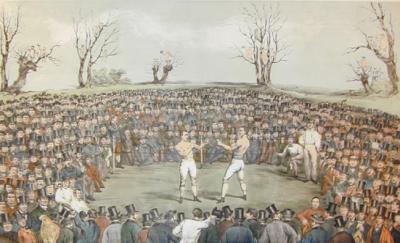
In effect, an amphitheater of this sort interferes with the very elements that make holding an event in the Forum so useful and so powerful: the interplay between the performance, the audience, and the surrouning space. Why retroject a Renaissance concept, or at the very least, a 1st century BCE concept, one that may best be traced to an excavated, rather than built-up form, when there are other models?
\t\t\t\t\t (Tom Sayers v. John Heenan “The Benicia Boy”)
Bare-knuckle fighting shared many characteristics with that of gladiatorial combat during the 2nd C BCE. Since bare-knuckle brawling was illegal, the arena needed to be put up and taken down quickly. In fact, the crowd needed to be able to gather and disperse with almost the same quickness. Therefore, no bleachers were allowed. Instead, and here a crucial difference, the bare-knucklers needed to fight alongside a river and county line, should the authorities arrive to break up the display. Nonetheless, the fight may have drawn 15,000 attendees, many of whom came in order to mingle and be seen just as much as to watch the fight. To wit, photography was employed during the match, but not to document the fighters, rather, portraits were used to help the artist enhance individual faces of the members of the audiences attending.
Cancelli
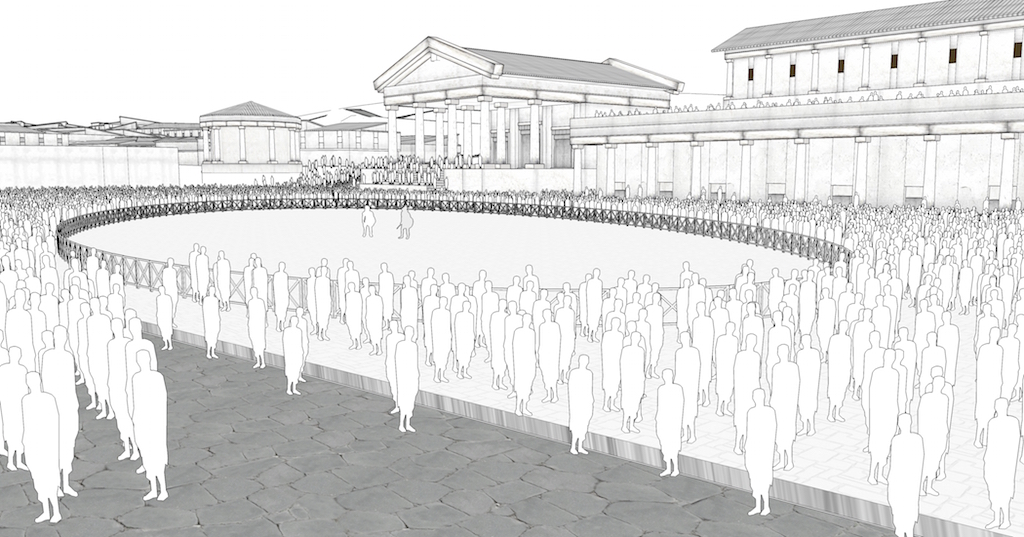
A simple ring of cancelli would suffice to support the games. In size, it will have been closer to that of an orchestra of a Greco-Roman theater, which would of course later be used for gladiatorial combat. This small ring would be efficient to install. It could adapt to the constricted nature of the Forum. It could fit between existing statuary, and it could enable the various, potent sight lines for the audience. (An arena bounded only by Cancelli.)
Further Practical Concerns: The Cloaca
Twenty-four years prior, in 184 BCE, limited evidence emerges to reveal possible locations for staging these earlier games. If we can trust our interpretation of a somewhat fraught passage of Plautus' Curculio, the Cloaca Maxima was an uncovered stream, bisecting the Forum, and clearly defining two potential performance zones.
Basilica and Maeniana
The introduction and replication of the basilica form suggests a possible location for the games of the 2nd century BCE. Since it seems relatively secure that maeniana were used as privileged spectacula from the beginning, then one might simply follow the seats to find the spectacle itself. When the Rostra is included as another privileged audience space, the arena settles in an area somewhere close to the natural slope between the Forum and the Arx, flanked by the Rostra and the oldest basilica in Rome on one side, and the podia of at least one temple on the other.
Place Matters
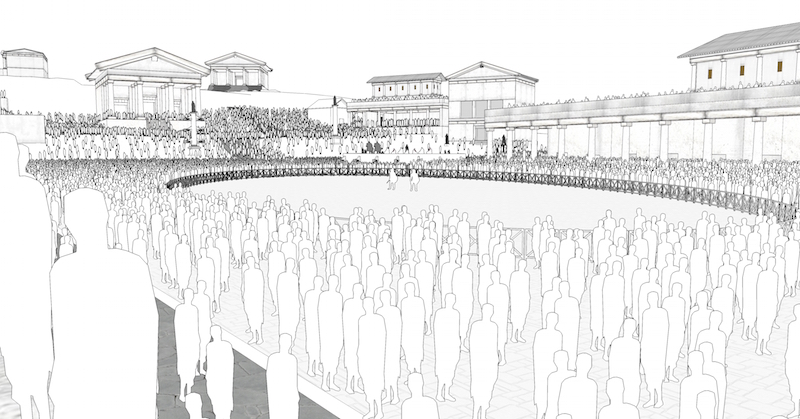
These games, very different than what we would see but 200 years later, celebrated the power of one particular place. Bleachers would eventually come, but only when the nature of the Forum had changed from an arena for open political and familiar competition to a closed system beholden to a form of dictatorial rule. In Rome of the 2nd century BCE, games were held in the Forum for a clear reason, because the place itself, imbued with meaning, visible to and experienced by all who attended was the integral component for a system that could never have been about the performance alone. (A Populated Forum with Arena Ringed by Cancelli)

This digital version of the city of Rome, ca. 160 BCE functions as a laboratory, and was constructed and designed as such. Built to interrogate spatial relationships, and not to be presented as a stand-alone museum artifact or as a magical window that enables the reader to step backward through digital time, this Forum is a three-dimensional map or, to borrow terminology from Willard McCarty, a \"tinker toy model\
Typology and Representation
Buildings are typological constructs that approximate what might have been. Grown procedurally from a GIS core, versions of the city are rapidly generated to address specific research questions. For the purposes of this investigation, one centered on sightlines and viewsheds, texture, color, atmospheric effects and the like have been removed. Instead, this laboratory contains an abstraction, one where, for the most part, every line matters.
The Roman Arena in the 2nd Century BCE
Communis opinio holds that gladiatorial games at Rome in the 3rd and 2nd centuries BCE were performed in temporary structures, constructed of wood, set up within the Roman Forum, the civic, religious, and juridical center of the Eternal city. (The Roman arena of the 2nd century BCE as proposed by Welch (2007) 51 fig. 22.)
Two-dimensional, Visual Argumentation
Arguments such as these are rooted in three-dimensional space, but are still, too often, made through juxtaposition of plan, section and hypothetical drawing. The conclusion is all too quickly digested without a rich undertanding of the spatial context by the reader. The problem is exacerbated when imagery forms the bulk of the argument. (Hypothetical view of wooden arena, Welch (2007) 55 fig. 26.)
The Vivid Image
Coupled with detailed hypothetical drawings, convincing Renaissance analogs are adduced, ranging from the Palio at Siena to equestrian shows and military parades in Florence. Like works of Hellenistic history, vividness should not be confused with accuracy. (Piazza Santa Croce, 17th Century, Florence.)
The Arena in 3D
The length and width of this temporary amphitheater are constrained by the surrounding space, the height, by that of the surrounding balconies of the adjacent basilica. These balconies, known as Maeniana, a name that would later be transformed into technical vocabulary to describe rows of seating in the monumental amphitheater, are explictly described as viewing spaces (spectacula) for gladiatorial games.
A Caesarian Retrojection?
Even today, Caesar's Rome gets in the way. Rome of the 2nd century BCE was radically different from that of the first. The Forum was filled with competitive imagery. By 158 BCE, there were so many statues in the Forum that the Senate ordered all those unapproved to be removed. (Plin. HN 34.30) Caesar removed an altar in the Lacus Curtius for the last games he sponsored in the Forum.
“ara inde (sc. the Lacus Curtius) sublata gladiatorio munere divi Iuli quod novissme pugnavit in Foro.”
“An altar was removed from [the Lacus Curtius] in the gladiatorial munus of the divine Julius, the last one he staged in the Forum.”
--Plin. HN 15.20.78.
Might this be the first occasion where significant alterations were made to the built form of the Forum to accommodate the games?
(The Forum with Statuary)
The Textual Evidence
(123 BCE) The people were getting ready to watch gladiatorial combats in the Forum, and most of the magistrates, after they had set up bleachers in a circle, were charging a fee for their use. Gaius ordered them to tear down the stands so that the poor could watch from their places without paying. But when no one obeyed, he waited until the night before the show, took with him as many contractors as there were from the skilled workmen, and tore down the stands. On the next day he showed forth a vacated space for the people.*
--Plut. C. Gracch. 12.3.
*NB Until the mid first century CE, gladiatorial games were only held within the context of a Roman aristocratic funeral. One wonders what the family of the deceased thought of this magisterial manipulation and Gracchus’ intervention. Cf. Edmondson (1996) 87n78, who observes that it had to be the deceased’s family, not the magistrates, who were blocking the view of the poor. “Plut. C. Gr. anachronistically claims that it was “the magistrates” who had set up the temporary seating.”
On Forum Planning
\"The Greeks build square fora with broad, double porticoes, and they decorate these fora with thick columns and stone or marble architraves. Above, they make walkways on the second story. In fact, it is not done with the same reasoning by the cities of Italy, because the custom handed down by the ancestors is that gladiatoria munera are given in the Forum. Therefore, wider intercolumniations are distributed circum spectacula, and all around the banks and shops are located in the porticoes, and maeniana are placed on the longer axes, which are arranged for general use or profit. … The width should be defined in such a way that, when the length is divided into three parts, two parts of these comprise the width. For its form will thus be oblong and fit for the arrangement (ratio) of the spectacula.\"
--Vitruvius 5.1
Clearly these wider intercolumniations are intended to let the audience access the surrounding shops and view the spectacle taking place within the forum. Portico and Forum plaza are meant to be inextricably intertwined.
Forum as Privileged Performance Space"
Perhaps most interesting but least often mentioned is that Vitruvius' pronouncment on the ratio of design for Roman Fora was made well after the the oldest surviving monumental amphitheater at Pompeii was constructed. In other words, Pompeii had an amphitheater, yet the Forum remained a viable venue for staged gladiatorial games.
Next we must ask why this could possibly be so.
A Dramatic Entrance
Testimony from the first century BCE helps to clarify the situation. It's a commonplace that the crowd passes judgement in the arena, not only of the performers, but, more often, of the rest of the audience and the prominent political leaders in attendance. Cicero highlights this concept when he cites P. Sestius' reception as he entered the arena
\"[P. Sestius tribunus plebis] venit, ut scitis, a columna Maenia: tantus est ex omnibus spectaculis usque a Capitolio, tantus ex fori cancellis plausus excitatus, ut numquam maior consensio aut apertior populi Romani universi fuisse ulla in causa diceretur.\"
\"[Publius Sestius, tribune of the plebs,] came, as you know, from the Maenian Column: the applause from all the viewing locations right up to the Capitoline and down to the barriers of the Forum was so great that never could it have been said that there was a greate and more open agreement of all the Roman people on any subject matter.\" --Cic. Sest. 124
(The Maenian Column.)
Sightlines from the Capitoline
With the construction of these massive bleacher facilities, Sestius' entrance next to the Maenian Column would have gone unnoticed by those within the grandstands. Likewise, those who were gathered on the Capitoline would have had poor views into the arena, unless, as is hinted in the passage above, cancelli, or stanchions, were all that was needed to stage the games.
To See and Be Seen
Being seen mattered at these events for so many reason. In fact, in 43 BCE Cicero suggests that Servius Sulpicius Rufus, who had died on embassy to Marc Antony, be awarded a particularly spectacular distinction.
\t\t\t\t \"Quas ob res ita censeo … senatui placere Ser. Sulpicio statuam pedestrem
\t\t\t\t aeneam in rostris ex huius ordinis sententia statui circumque eam statuam
\t\t\t\t locum ludis gladiatoribusque liberos posterosque eius quoquo versus pedes
\t\t\t\t quinque habere.\"
\"Therefore, I recommend that the Senate decree to set up a bronze pedestrian statue for Servius Sulpicius on the Rostra, and his children and descendants would also have a place, five feet surrounding that statue, for games and gladiators.\" --Cic. Phil. 9.15–16.
The Rostra was said to be the most visible place within the Forum. (poni iussit [statuam] oculatissimo loco, eaque est in rostris. --Plin. HN 34.24) Though it is an obvious point, it merits reassertion: in general one did not ascend the Rostra merely for the view, but rather to be viewed.
\t\t\t\t (The Rostra)
A New Model
In effect, an amphitheater of this sort interferes with the very elements that make holding an event in the Forum so useful and so powerful: the interplay between the performance, the audience, and the surrouning space. Why retroject a Renaissance concept, or at the very least, a 1st century BCE concept, one that may best be traced to an excavated, rather than built-up form, when there are other models?
\t\t\t\t\t (Tom Sayers v. John Heenan “The Benicia Boy”)
Bare-knuckle fighting shared many characteristics with that of gladiatorial combat during the 2nd C BCE. Since bare-knuckle brawling was illegal, the arena needed to be put up and taken down quickly. In fact, the crowd needed to be able to gather and disperse with almost the same quickness. Therefore, no bleachers were allowed. Instead, and here a crucial difference, the bare-knucklers needed to fight alongside a river and county line, should the authorities arrive to break up the display. Nonetheless, the fight may have drawn 15,000 attendees, many of whom came in order to mingle and be seen just as much as to watch the fight. To wit, photography was employed during the match, but not to document the fighters, rather, portraits were used to help the artist enhance individual faces of the members of the audiences attending.
Cancelli
A simple ring of cancelli would suffice to support the games. In size, it will have been closer to that of an orchestra of a Greco-Roman theater, which would of course later be used for gladiatorial combat. This small ring would be efficient to install. It could adapt to the constricted nature of the Forum. It could fit between existing statuary, and it could enable the various, potent sight lines for the audience. (An arena bounded only by Cancelli.)
Further Practical Concerns: The Cloaca
Twenty-four years prior, in 184 BCE, limited evidence emerges to reveal possible locations for staging these earlier games. If we can trust our interpretation of a somewhat fraught passage of Plautus' Curculio, the Cloaca Maxima was an uncovered stream, bisecting the Forum, and clearly defining two potential performance zones.
Basilica and Maeniana
The introduction and replication of the basilica form suggests a possible location for the games of the 2nd century BCE. Since it seems relatively secure that maeniana were used as privileged spectacula from the beginning, then one might simply follow the seats to find the spectacle itself. When the Rostra is included as another privileged audience space, the arena settles in an area somewhere close to the natural slope between the Forum and the Arx, flanked by the Rostra and the oldest basilica in Rome on one side, and the podia of at least one temple on the other.
Place Matters
These games, very different than what we would see but 200 years later, celebrated the power of one particular place. Bleachers would eventually come, but only when the nature of the Forum had changed from an arena for open political and familiar competition to a closed system beholden to a form of dictatorial rule. In Rome of the 2nd century BCE, games were held in the Forum for a clear reason, because the place itself, imbued with meaning, visible to and experienced by all who attended was the integral component for a system that could never have been about the performance alone. (A Populated Forum with Arena Ringed by Cancelli)
Buildings are typological constructs that approximate what might have been. Grown procedurally from a GIS core, versions of the city are rapidly generated to address specific research questions. For the purposes of this investigation, one centered on sightlines and viewsheds, texture, color, atmospheric effects and the like have been removed. Instead, this laboratory contains an abstraction, one where, for the most part, every line matters.
The Roman Arena in the 2nd Century BCE
Communis opinio holds that gladiatorial games at Rome in the 3rd and 2nd centuries BCE were performed in temporary structures, constructed of wood, set up within the Roman Forum, the civic, religious, and juridical center of the Eternal city. (The Roman arena of the 2nd century BCE as proposed by Welch (2007) 51 fig. 22.)
Two-dimensional, Visual Argumentation
Arguments such as these are rooted in three-dimensional space, but are still, too often, made through juxtaposition of plan, section and hypothetical drawing. The conclusion is all too quickly digested without a rich undertanding of the spatial context by the reader. The problem is exacerbated when imagery forms the bulk of the argument. (Hypothetical view of wooden arena, Welch (2007) 55 fig. 26.)
The Vivid Image
Coupled with detailed hypothetical drawings, convincing Renaissance analogs are adduced, ranging from the Palio at Siena to equestrian shows and military parades in Florence. Like works of Hellenistic history, vividness should not be confused with accuracy. (Piazza Santa Croce, 17th Century, Florence.)
The Arena in 3D
The length and width of this temporary amphitheater are constrained by the surrounding space, the height, by that of the surrounding balconies of the adjacent basilica. These balconies, known as Maeniana, a name that would later be transformed into technical vocabulary to describe rows of seating in the monumental amphitheater, are explictly described as viewing spaces (spectacula) for gladiatorial games.
A Caesarian Retrojection?
Even today, Caesar's Rome gets in the way. Rome of the 2nd century BCE was radically different from that of the first. The Forum was filled with competitive imagery. By 158 BCE, there were so many statues in the Forum that the Senate ordered all those unapproved to be removed. (Plin. HN 34.30) Caesar removed an altar in the Lacus Curtius for the last games he sponsored in the Forum.
“ara inde (sc. the Lacus Curtius) sublata gladiatorio munere divi Iuli quod novissme pugnavit in Foro.”
“An altar was removed from [the Lacus Curtius] in the gladiatorial munus of the divine Julius, the last one he staged in the Forum.”
--Plin. HN 15.20.78.
Might this be the first occasion where significant alterations were made to the built form of the Forum to accommodate the games?
(The Forum with Statuary)
The Textual Evidence
(123 BCE) The people were getting ready to watch gladiatorial combats in the Forum, and most of the magistrates, after they had set up bleachers in a circle, were charging a fee for their use. Gaius ordered them to tear down the stands so that the poor could watch from their places without paying. But when no one obeyed, he waited until the night before the show, took with him as many contractors as there were from the skilled workmen, and tore down the stands. On the next day he showed forth a vacated space for the people.*
--Plut. C. Gracch. 12.3.
*NB Until the mid first century CE, gladiatorial games were only held within the context of a Roman aristocratic funeral. One wonders what the family of the deceased thought of this magisterial manipulation and Gracchus’ intervention. Cf. Edmondson (1996) 87n78, who observes that it had to be the deceased’s family, not the magistrates, who were blocking the view of the poor. “Plut. C. Gr. anachronistically claims that it was “the magistrates” who had set up the temporary seating.”
On Forum Planning
\"The Greeks build square fora with broad, double porticoes, and they decorate these fora with thick columns and stone or marble architraves. Above, they make walkways on the second story. In fact, it is not done with the same reasoning by the cities of Italy, because the custom handed down by the ancestors is that gladiatoria munera are given in the Forum. Therefore, wider intercolumniations are distributed circum spectacula, and all around the banks and shops are located in the porticoes, and maeniana are placed on the longer axes, which are arranged for general use or profit. … The width should be defined in such a way that, when the length is divided into three parts, two parts of these comprise the width. For its form will thus be oblong and fit for the arrangement (ratio) of the spectacula.\"
--Vitruvius 5.1
Clearly these wider intercolumniations are intended to let the audience access the surrounding shops and view the spectacle taking place within the forum. Portico and Forum plaza are meant to be inextricably intertwined.
Forum as Privileged Performance Space"
Perhaps most interesting but least often mentioned is that Vitruvius' pronouncment on the ratio of design for Roman Fora was made well after the the oldest surviving monumental amphitheater at Pompeii was constructed. In other words, Pompeii had an amphitheater, yet the Forum remained a viable venue for staged gladiatorial games.
Next we must ask why this could possibly be so.
A Dramatic Entrance
Testimony from the first century BCE helps to clarify the situation. It's a commonplace that the crowd passes judgement in the arena, not only of the performers, but, more often, of the rest of the audience and the prominent political leaders in attendance. Cicero highlights this concept when he cites P. Sestius' reception as he entered the arena
\"[P. Sestius tribunus plebis] venit, ut scitis, a columna Maenia: tantus est ex omnibus spectaculis usque a Capitolio, tantus ex fori cancellis plausus excitatus, ut numquam maior consensio aut apertior populi Romani universi fuisse ulla in causa diceretur.\"
\"[Publius Sestius, tribune of the plebs,] came, as you know, from the Maenian Column: the applause from all the viewing locations right up to the Capitoline and down to the barriers of the Forum was so great that never could it have been said that there was a greate and more open agreement of all the Roman people on any subject matter.\" --Cic. Sest. 124
(The Maenian Column.)
Sightlines from the Capitoline
With the construction of these massive bleacher facilities, Sestius' entrance next to the Maenian Column would have gone unnoticed by those within the grandstands. Likewise, those who were gathered on the Capitoline would have had poor views into the arena, unless, as is hinted in the passage above, cancelli, or stanchions, were all that was needed to stage the games.
To See and Be Seen
Being seen mattered at these events for so many reason. In fact, in 43 BCE Cicero suggests that Servius Sulpicius Rufus, who had died on embassy to Marc Antony, be awarded a particularly spectacular distinction.
\t\t\t\t \"Quas ob res ita censeo … senatui placere Ser. Sulpicio statuam pedestrem
\t\t\t\t aeneam in rostris ex huius ordinis sententia statui circumque eam statuam
\t\t\t\t locum ludis gladiatoribusque liberos posterosque eius quoquo versus pedes
\t\t\t\t quinque habere.\"
\"Therefore, I recommend that the Senate decree to set up a bronze pedestrian statue for Servius Sulpicius on the Rostra, and his children and descendants would also have a place, five feet surrounding that statue, for games and gladiators.\" --Cic. Phil. 9.15–16.
The Rostra was said to be the most visible place within the Forum. (poni iussit [statuam] oculatissimo loco, eaque est in rostris. --Plin. HN 34.24) Though it is an obvious point, it merits reassertion: in general one did not ascend the Rostra merely for the view, but rather to be viewed.
\t\t\t\t (The Rostra)
A New Model
In effect, an amphitheater of this sort interferes with the very elements that make holding an event in the Forum so useful and so powerful: the interplay between the performance, the audience, and the surrouning space. Why retroject a Renaissance concept, or at the very least, a 1st century BCE concept, one that may best be traced to an excavated, rather than built-up form, when there are other models?
\t\t\t\t\t (Tom Sayers v. John Heenan “The Benicia Boy”)
Bare-knuckle fighting shared many characteristics with that of gladiatorial combat during the 2nd C BCE. Since bare-knuckle brawling was illegal, the arena needed to be put up and taken down quickly. In fact, the crowd needed to be able to gather and disperse with almost the same quickness. Therefore, no bleachers were allowed. Instead, and here a crucial difference, the bare-knucklers needed to fight alongside a river and county line, should the authorities arrive to break up the display. Nonetheless, the fight may have drawn 15,000 attendees, many of whom came in order to mingle and be seen just as much as to watch the fight. To wit, photography was employed during the match, but not to document the fighters, rather, portraits were used to help the artist enhance individual faces of the members of the audiences attending.
Cancelli
A simple ring of cancelli would suffice to support the games. In size, it will have been closer to that of an orchestra of a Greco-Roman theater, which would of course later be used for gladiatorial combat. This small ring would be efficient to install. It could adapt to the constricted nature of the Forum. It could fit between existing statuary, and it could enable the various, potent sight lines for the audience. (An arena bounded only by Cancelli.)
Further Practical Concerns: The Cloaca
Twenty-four years prior, in 184 BCE, limited evidence emerges to reveal possible locations for staging these earlier games. If we can trust our interpretation of a somewhat fraught passage of Plautus' Curculio, the Cloaca Maxima was an uncovered stream, bisecting the Forum, and clearly defining two potential performance zones.
Basilica and Maeniana
The introduction and replication of the basilica form suggests a possible location for the games of the 2nd century BCE. Since it seems relatively secure that maeniana were used as privileged spectacula from the beginning, then one might simply follow the seats to find the spectacle itself. When the Rostra is included as another privileged audience space, the arena settles in an area somewhere close to the natural slope between the Forum and the Arx, flanked by the Rostra and the oldest basilica in Rome on one side, and the podia of at least one temple on the other.
Place Matters
These games, very different than what we would see but 200 years later, celebrated the power of one particular place. Bleachers would eventually come, but only when the nature of the Forum had changed from an arena for open political and familiar competition to a closed system beholden to a form of dictatorial rule. In Rome of the 2nd century BCE, games were held in the Forum for a clear reason, because the place itself, imbued with meaning, visible to and experienced by all who attended was the integral component for a system that could never have been about the performance alone. (A Populated Forum with Arena Ringed by Cancelli)
Communis opinio holds that gladiatorial games at Rome in the 3rd and 2nd centuries BCE were performed in temporary structures, constructed of wood, set up within the Roman Forum, the civic, religious, and juridical center of the Eternal city. (The Roman arena of the 2nd century BCE as proposed by Welch (2007) 51 fig. 22.)
Two-dimensional, Visual Argumentation
Arguments such as these are rooted in three-dimensional space, but are still, too often, made through juxtaposition of plan, section and hypothetical drawing. The conclusion is all too quickly digested without a rich undertanding of the spatial context by the reader. The problem is exacerbated when imagery forms the bulk of the argument. (Hypothetical view of wooden arena, Welch (2007) 55 fig. 26.)
The Vivid Image
Coupled with detailed hypothetical drawings, convincing Renaissance analogs are adduced, ranging from the Palio at Siena to equestrian shows and military parades in Florence. Like works of Hellenistic history, vividness should not be confused with accuracy. (Piazza Santa Croce, 17th Century, Florence.)
The Arena in 3D
The length and width of this temporary amphitheater are constrained by the surrounding space, the height, by that of the surrounding balconies of the adjacent basilica. These balconies, known as Maeniana, a name that would later be transformed into technical vocabulary to describe rows of seating in the monumental amphitheater, are explictly described as viewing spaces (spectacula) for gladiatorial games.
A Caesarian Retrojection?
Even today, Caesar's Rome gets in the way. Rome of the 2nd century BCE was radically different from that of the first. The Forum was filled with competitive imagery. By 158 BCE, there were so many statues in the Forum that the Senate ordered all those unapproved to be removed. (Plin. HN 34.30) Caesar removed an altar in the Lacus Curtius for the last games he sponsored in the Forum.
“ara inde (sc. the Lacus Curtius) sublata gladiatorio munere divi Iuli quod novissme pugnavit in Foro.”
“An altar was removed from [the Lacus Curtius] in the gladiatorial munus of the divine Julius, the last one he staged in the Forum.”
--Plin. HN 15.20.78.
Might this be the first occasion where significant alterations were made to the built form of the Forum to accommodate the games?
(The Forum with Statuary)
The Textual Evidence
(123 BCE) The people were getting ready to watch gladiatorial combats in the Forum, and most of the magistrates, after they had set up bleachers in a circle, were charging a fee for their use. Gaius ordered them to tear down the stands so that the poor could watch from their places without paying. But when no one obeyed, he waited until the night before the show, took with him as many contractors as there were from the skilled workmen, and tore down the stands. On the next day he showed forth a vacated space for the people.*
--Plut. C. Gracch. 12.3.
*NB Until the mid first century CE, gladiatorial games were only held within the context of a Roman aristocratic funeral. One wonders what the family of the deceased thought of this magisterial manipulation and Gracchus’ intervention. Cf. Edmondson (1996) 87n78, who observes that it had to be the deceased’s family, not the magistrates, who were blocking the view of the poor. “Plut. C. Gr. anachronistically claims that it was “the magistrates” who had set up the temporary seating.”
On Forum Planning
\"The Greeks build square fora with broad, double porticoes, and they decorate these fora with thick columns and stone or marble architraves. Above, they make walkways on the second story. In fact, it is not done with the same reasoning by the cities of Italy, because the custom handed down by the ancestors is that gladiatoria munera are given in the Forum. Therefore, wider intercolumniations are distributed circum spectacula, and all around the banks and shops are located in the porticoes, and maeniana are placed on the longer axes, which are arranged for general use or profit. … The width should be defined in such a way that, when the length is divided into three parts, two parts of these comprise the width. For its form will thus be oblong and fit for the arrangement (ratio) of the spectacula.\"
--Vitruvius 5.1
Clearly these wider intercolumniations are intended to let the audience access the surrounding shops and view the spectacle taking place within the forum. Portico and Forum plaza are meant to be inextricably intertwined.
Forum as Privileged Performance Space"
Perhaps most interesting but least often mentioned is that Vitruvius' pronouncment on the ratio of design for Roman Fora was made well after the the oldest surviving monumental amphitheater at Pompeii was constructed. In other words, Pompeii had an amphitheater, yet the Forum remained a viable venue for staged gladiatorial games.
Next we must ask why this could possibly be so.
A Dramatic Entrance
Testimony from the first century BCE helps to clarify the situation. It's a commonplace that the crowd passes judgement in the arena, not only of the performers, but, more often, of the rest of the audience and the prominent political leaders in attendance. Cicero highlights this concept when he cites P. Sestius' reception as he entered the arena
\"[P. Sestius tribunus plebis] venit, ut scitis, a columna Maenia: tantus est ex omnibus spectaculis usque a Capitolio, tantus ex fori cancellis plausus excitatus, ut numquam maior consensio aut apertior populi Romani universi fuisse ulla in causa diceretur.\"
\"[Publius Sestius, tribune of the plebs,] came, as you know, from the Maenian Column: the applause from all the viewing locations right up to the Capitoline and down to the barriers of the Forum was so great that never could it have been said that there was a greate and more open agreement of all the Roman people on any subject matter.\" --Cic. Sest. 124
(The Maenian Column.)
Sightlines from the Capitoline
With the construction of these massive bleacher facilities, Sestius' entrance next to the Maenian Column would have gone unnoticed by those within the grandstands. Likewise, those who were gathered on the Capitoline would have had poor views into the arena, unless, as is hinted in the passage above, cancelli, or stanchions, were all that was needed to stage the games.
To See and Be Seen
Being seen mattered at these events for so many reason. In fact, in 43 BCE Cicero suggests that Servius Sulpicius Rufus, who had died on embassy to Marc Antony, be awarded a particularly spectacular distinction.
\t\t\t\t \"Quas ob res ita censeo … senatui placere Ser. Sulpicio statuam pedestrem
\t\t\t\t aeneam in rostris ex huius ordinis sententia statui circumque eam statuam
\t\t\t\t locum ludis gladiatoribusque liberos posterosque eius quoquo versus pedes
\t\t\t\t quinque habere.\"
\"Therefore, I recommend that the Senate decree to set up a bronze pedestrian statue for Servius Sulpicius on the Rostra, and his children and descendants would also have a place, five feet surrounding that statue, for games and gladiators.\" --Cic. Phil. 9.15–16.
The Rostra was said to be the most visible place within the Forum. (poni iussit [statuam] oculatissimo loco, eaque est in rostris. --Plin. HN 34.24) Though it is an obvious point, it merits reassertion: in general one did not ascend the Rostra merely for the view, but rather to be viewed.
\t\t\t\t (The Rostra)
A New Model
In effect, an amphitheater of this sort interferes with the very elements that make holding an event in the Forum so useful and so powerful: the interplay between the performance, the audience, and the surrouning space. Why retroject a Renaissance concept, or at the very least, a 1st century BCE concept, one that may best be traced to an excavated, rather than built-up form, when there are other models?
\t\t\t\t\t (Tom Sayers v. John Heenan “The Benicia Boy”)
Bare-knuckle fighting shared many characteristics with that of gladiatorial combat during the 2nd C BCE. Since bare-knuckle brawling was illegal, the arena needed to be put up and taken down quickly. In fact, the crowd needed to be able to gather and disperse with almost the same quickness. Therefore, no bleachers were allowed. Instead, and here a crucial difference, the bare-knucklers needed to fight alongside a river and county line, should the authorities arrive to break up the display. Nonetheless, the fight may have drawn 15,000 attendees, many of whom came in order to mingle and be seen just as much as to watch the fight. To wit, photography was employed during the match, but not to document the fighters, rather, portraits were used to help the artist enhance individual faces of the members of the audiences attending.
Cancelli
A simple ring of cancelli would suffice to support the games. In size, it will have been closer to that of an orchestra of a Greco-Roman theater, which would of course later be used for gladiatorial combat. This small ring would be efficient to install. It could adapt to the constricted nature of the Forum. It could fit between existing statuary, and it could enable the various, potent sight lines for the audience. (An arena bounded only by Cancelli.)
Further Practical Concerns: The Cloaca
Twenty-four years prior, in 184 BCE, limited evidence emerges to reveal possible locations for staging these earlier games. If we can trust our interpretation of a somewhat fraught passage of Plautus' Curculio, the Cloaca Maxima was an uncovered stream, bisecting the Forum, and clearly defining two potential performance zones.
Basilica and Maeniana
The introduction and replication of the basilica form suggests a possible location for the games of the 2nd century BCE. Since it seems relatively secure that maeniana were used as privileged spectacula from the beginning, then one might simply follow the seats to find the spectacle itself. When the Rostra is included as another privileged audience space, the arena settles in an area somewhere close to the natural slope between the Forum and the Arx, flanked by the Rostra and the oldest basilica in Rome on one side, and the podia of at least one temple on the other.
Place Matters
These games, very different than what we would see but 200 years later, celebrated the power of one particular place. Bleachers would eventually come, but only when the nature of the Forum had changed from an arena for open political and familiar competition to a closed system beholden to a form of dictatorial rule. In Rome of the 2nd century BCE, games were held in the Forum for a clear reason, because the place itself, imbued with meaning, visible to and experienced by all who attended was the integral component for a system that could never have been about the performance alone. (A Populated Forum with Arena Ringed by Cancelli)
Arguments such as these are rooted in three-dimensional space, but are still, too often, made through juxtaposition of plan, section and hypothetical drawing. The conclusion is all too quickly digested without a rich undertanding of the spatial context by the reader. The problem is exacerbated when imagery forms the bulk of the argument. (Hypothetical view of wooden arena, Welch (2007) 55 fig. 26.)
The Vivid Image
Coupled with detailed hypothetical drawings, convincing Renaissance analogs are adduced, ranging from the Palio at Siena to equestrian shows and military parades in Florence. Like works of Hellenistic history, vividness should not be confused with accuracy. (Piazza Santa Croce, 17th Century, Florence.)
The Arena in 3D
The length and width of this temporary amphitheater are constrained by the surrounding space, the height, by that of the surrounding balconies of the adjacent basilica. These balconies, known as Maeniana, a name that would later be transformed into technical vocabulary to describe rows of seating in the monumental amphitheater, are explictly described as viewing spaces (spectacula) for gladiatorial games.
A Caesarian Retrojection?
Even today, Caesar's Rome gets in the way. Rome of the 2nd century BCE was radically different from that of the first. The Forum was filled with competitive imagery. By 158 BCE, there were so many statues in the Forum that the Senate ordered all those unapproved to be removed. (Plin. HN 34.30) Caesar removed an altar in the Lacus Curtius for the last games he sponsored in the Forum.
“ara inde (sc. the Lacus Curtius) sublata gladiatorio munere divi Iuli quod novissme pugnavit in Foro.”
“An altar was removed from [the Lacus Curtius] in the gladiatorial munus of the divine Julius, the last one he staged in the Forum.”
--Plin. HN 15.20.78.
Might this be the first occasion where significant alterations were made to the built form of the Forum to accommodate the games?
(The Forum with Statuary)
The Textual Evidence
(123 BCE) The people were getting ready to watch gladiatorial combats in the Forum, and most of the magistrates, after they had set up bleachers in a circle, were charging a fee for their use. Gaius ordered them to tear down the stands so that the poor could watch from their places without paying. But when no one obeyed, he waited until the night before the show, took with him as many contractors as there were from the skilled workmen, and tore down the stands. On the next day he showed forth a vacated space for the people.*
--Plut. C. Gracch. 12.3.
*NB Until the mid first century CE, gladiatorial games were only held within the context of a Roman aristocratic funeral. One wonders what the family of the deceased thought of this magisterial manipulation and Gracchus’ intervention. Cf. Edmondson (1996) 87n78, who observes that it had to be the deceased’s family, not the magistrates, who were blocking the view of the poor. “Plut. C. Gr. anachronistically claims that it was “the magistrates” who had set up the temporary seating.”
On Forum Planning
\"The Greeks build square fora with broad, double porticoes, and they decorate these fora with thick columns and stone or marble architraves. Above, they make walkways on the second story. In fact, it is not done with the same reasoning by the cities of Italy, because the custom handed down by the ancestors is that gladiatoria munera are given in the Forum. Therefore, wider intercolumniations are distributed circum spectacula, and all around the banks and shops are located in the porticoes, and maeniana are placed on the longer axes, which are arranged for general use or profit. … The width should be defined in such a way that, when the length is divided into three parts, two parts of these comprise the width. For its form will thus be oblong and fit for the arrangement (ratio) of the spectacula.\"
--Vitruvius 5.1
Clearly these wider intercolumniations are intended to let the audience access the surrounding shops and view the spectacle taking place within the forum. Portico and Forum plaza are meant to be inextricably intertwined.
Forum as Privileged Performance Space"
Perhaps most interesting but least often mentioned is that Vitruvius' pronouncment on the ratio of design for Roman Fora was made well after the the oldest surviving monumental amphitheater at Pompeii was constructed. In other words, Pompeii had an amphitheater, yet the Forum remained a viable venue for staged gladiatorial games.
Next we must ask why this could possibly be so.
A Dramatic Entrance
Testimony from the first century BCE helps to clarify the situation. It's a commonplace that the crowd passes judgement in the arena, not only of the performers, but, more often, of the rest of the audience and the prominent political leaders in attendance. Cicero highlights this concept when he cites P. Sestius' reception as he entered the arena
\"[P. Sestius tribunus plebis] venit, ut scitis, a columna Maenia: tantus est ex omnibus spectaculis usque a Capitolio, tantus ex fori cancellis plausus excitatus, ut numquam maior consensio aut apertior populi Romani universi fuisse ulla in causa diceretur.\"
\"[Publius Sestius, tribune of the plebs,] came, as you know, from the Maenian Column: the applause from all the viewing locations right up to the Capitoline and down to the barriers of the Forum was so great that never could it have been said that there was a greate and more open agreement of all the Roman people on any subject matter.\" --Cic. Sest. 124
(The Maenian Column.)
Sightlines from the Capitoline
With the construction of these massive bleacher facilities, Sestius' entrance next to the Maenian Column would have gone unnoticed by those within the grandstands. Likewise, those who were gathered on the Capitoline would have had poor views into the arena, unless, as is hinted in the passage above, cancelli, or stanchions, were all that was needed to stage the games.
To See and Be Seen
Being seen mattered at these events for so many reason. In fact, in 43 BCE Cicero suggests that Servius Sulpicius Rufus, who had died on embassy to Marc Antony, be awarded a particularly spectacular distinction.
\t\t\t\t \"Quas ob res ita censeo … senatui placere Ser. Sulpicio statuam pedestrem
\t\t\t\t aeneam in rostris ex huius ordinis sententia statui circumque eam statuam
\t\t\t\t locum ludis gladiatoribusque liberos posterosque eius quoquo versus pedes
\t\t\t\t quinque habere.\"
\"Therefore, I recommend that the Senate decree to set up a bronze pedestrian statue for Servius Sulpicius on the Rostra, and his children and descendants would also have a place, five feet surrounding that statue, for games and gladiators.\" --Cic. Phil. 9.15–16.
The Rostra was said to be the most visible place within the Forum. (poni iussit [statuam] oculatissimo loco, eaque est in rostris. --Plin. HN 34.24) Though it is an obvious point, it merits reassertion: in general one did not ascend the Rostra merely for the view, but rather to be viewed.
\t\t\t\t (The Rostra)
A New Model
In effect, an amphitheater of this sort interferes with the very elements that make holding an event in the Forum so useful and so powerful: the interplay between the performance, the audience, and the surrouning space. Why retroject a Renaissance concept, or at the very least, a 1st century BCE concept, one that may best be traced to an excavated, rather than built-up form, when there are other models?
\t\t\t\t\t (Tom Sayers v. John Heenan “The Benicia Boy”)
Bare-knuckle fighting shared many characteristics with that of gladiatorial combat during the 2nd C BCE. Since bare-knuckle brawling was illegal, the arena needed to be put up and taken down quickly. In fact, the crowd needed to be able to gather and disperse with almost the same quickness. Therefore, no bleachers were allowed. Instead, and here a crucial difference, the bare-knucklers needed to fight alongside a river and county line, should the authorities arrive to break up the display. Nonetheless, the fight may have drawn 15,000 attendees, many of whom came in order to mingle and be seen just as much as to watch the fight. To wit, photography was employed during the match, but not to document the fighters, rather, portraits were used to help the artist enhance individual faces of the members of the audiences attending.
Cancelli
A simple ring of cancelli would suffice to support the games. In size, it will have been closer to that of an orchestra of a Greco-Roman theater, which would of course later be used for gladiatorial combat. This small ring would be efficient to install. It could adapt to the constricted nature of the Forum. It could fit between existing statuary, and it could enable the various, potent sight lines for the audience. (An arena bounded only by Cancelli.)
Further Practical Concerns: The Cloaca
Twenty-four years prior, in 184 BCE, limited evidence emerges to reveal possible locations for staging these earlier games. If we can trust our interpretation of a somewhat fraught passage of Plautus' Curculio, the Cloaca Maxima was an uncovered stream, bisecting the Forum, and clearly defining two potential performance zones.
Basilica and Maeniana
The introduction and replication of the basilica form suggests a possible location for the games of the 2nd century BCE. Since it seems relatively secure that maeniana were used as privileged spectacula from the beginning, then one might simply follow the seats to find the spectacle itself. When the Rostra is included as another privileged audience space, the arena settles in an area somewhere close to the natural slope between the Forum and the Arx, flanked by the Rostra and the oldest basilica in Rome on one side, and the podia of at least one temple on the other.
Place Matters
These games, very different than what we would see but 200 years later, celebrated the power of one particular place. Bleachers would eventually come, but only when the nature of the Forum had changed from an arena for open political and familiar competition to a closed system beholden to a form of dictatorial rule. In Rome of the 2nd century BCE, games were held in the Forum for a clear reason, because the place itself, imbued with meaning, visible to and experienced by all who attended was the integral component for a system that could never have been about the performance alone. (A Populated Forum with Arena Ringed by Cancelli)
Coupled with detailed hypothetical drawings, convincing Renaissance analogs are adduced, ranging from the Palio at Siena to equestrian shows and military parades in Florence. Like works of Hellenistic history, vividness should not be confused with accuracy. (Piazza Santa Croce, 17th Century, Florence.)
The Arena in 3D
The length and width of this temporary amphitheater are constrained by the surrounding space, the height, by that of the surrounding balconies of the adjacent basilica. These balconies, known as Maeniana, a name that would later be transformed into technical vocabulary to describe rows of seating in the monumental amphitheater, are explictly described as viewing spaces (spectacula) for gladiatorial games.
A Caesarian Retrojection?
Even today, Caesar's Rome gets in the way. Rome of the 2nd century BCE was radically different from that of the first. The Forum was filled with competitive imagery. By 158 BCE, there were so many statues in the Forum that the Senate ordered all those unapproved to be removed. (Plin. HN 34.30) Caesar removed an altar in the Lacus Curtius for the last games he sponsored in the Forum.
“ara inde (sc. the Lacus Curtius) sublata gladiatorio munere divi Iuli quod novissme pugnavit in Foro.”
“An altar was removed from [the Lacus Curtius] in the gladiatorial munus of the divine Julius, the last one he staged in the Forum.”
--Plin. HN 15.20.78.
Might this be the first occasion where significant alterations were made to the built form of the Forum to accommodate the games?
(The Forum with Statuary)
The Textual Evidence
(123 BCE) The people were getting ready to watch gladiatorial combats in the Forum, and most of the magistrates, after they had set up bleachers in a circle, were charging a fee for their use. Gaius ordered them to tear down the stands so that the poor could watch from their places without paying. But when no one obeyed, he waited until the night before the show, took with him as many contractors as there were from the skilled workmen, and tore down the stands. On the next day he showed forth a vacated space for the people.*
--Plut. C. Gracch. 12.3.
*NB Until the mid first century CE, gladiatorial games were only held within the context of a Roman aristocratic funeral. One wonders what the family of the deceased thought of this magisterial manipulation and Gracchus’ intervention. Cf. Edmondson (1996) 87n78, who observes that it had to be the deceased’s family, not the magistrates, who were blocking the view of the poor. “Plut. C. Gr. anachronistically claims that it was “the magistrates” who had set up the temporary seating.”
On Forum Planning
\"The Greeks build square fora with broad, double porticoes, and they decorate these fora with thick columns and stone or marble architraves. Above, they make walkways on the second story. In fact, it is not done with the same reasoning by the cities of Italy, because the custom handed down by the ancestors is that gladiatoria munera are given in the Forum. Therefore, wider intercolumniations are distributed circum spectacula, and all around the banks and shops are located in the porticoes, and maeniana are placed on the longer axes, which are arranged for general use or profit. … The width should be defined in such a way that, when the length is divided into three parts, two parts of these comprise the width. For its form will thus be oblong and fit for the arrangement (ratio) of the spectacula.\"
--Vitruvius 5.1
Clearly these wider intercolumniations are intended to let the audience access the surrounding shops and view the spectacle taking place within the forum. Portico and Forum plaza are meant to be inextricably intertwined.
Forum as Privileged Performance Space"
Perhaps most interesting but least often mentioned is that Vitruvius' pronouncment on the ratio of design for Roman Fora was made well after the the oldest surviving monumental amphitheater at Pompeii was constructed. In other words, Pompeii had an amphitheater, yet the Forum remained a viable venue for staged gladiatorial games.
Next we must ask why this could possibly be so.
A Dramatic Entrance
Testimony from the first century BCE helps to clarify the situation. It's a commonplace that the crowd passes judgement in the arena, not only of the performers, but, more often, of the rest of the audience and the prominent political leaders in attendance. Cicero highlights this concept when he cites P. Sestius' reception as he entered the arena
\"[P. Sestius tribunus plebis] venit, ut scitis, a columna Maenia: tantus est ex omnibus spectaculis usque a Capitolio, tantus ex fori cancellis plausus excitatus, ut numquam maior consensio aut apertior populi Romani universi fuisse ulla in causa diceretur.\"
\"[Publius Sestius, tribune of the plebs,] came, as you know, from the Maenian Column: the applause from all the viewing locations right up to the Capitoline and down to the barriers of the Forum was so great that never could it have been said that there was a greate and more open agreement of all the Roman people on any subject matter.\" --Cic. Sest. 124
(The Maenian Column.)
Sightlines from the Capitoline
With the construction of these massive bleacher facilities, Sestius' entrance next to the Maenian Column would have gone unnoticed by those within the grandstands. Likewise, those who were gathered on the Capitoline would have had poor views into the arena, unless, as is hinted in the passage above, cancelli, or stanchions, were all that was needed to stage the games.
To See and Be Seen
Being seen mattered at these events for so many reason. In fact, in 43 BCE Cicero suggests that Servius Sulpicius Rufus, who had died on embassy to Marc Antony, be awarded a particularly spectacular distinction.
\t\t\t\t \"Quas ob res ita censeo … senatui placere Ser. Sulpicio statuam pedestrem
\t\t\t\t aeneam in rostris ex huius ordinis sententia statui circumque eam statuam
\t\t\t\t locum ludis gladiatoribusque liberos posterosque eius quoquo versus pedes
\t\t\t\t quinque habere.\"
\"Therefore, I recommend that the Senate decree to set up a bronze pedestrian statue for Servius Sulpicius on the Rostra, and his children and descendants would also have a place, five feet surrounding that statue, for games and gladiators.\" --Cic. Phil. 9.15–16.
The Rostra was said to be the most visible place within the Forum. (poni iussit [statuam] oculatissimo loco, eaque est in rostris. --Plin. HN 34.24) Though it is an obvious point, it merits reassertion: in general one did not ascend the Rostra merely for the view, but rather to be viewed.
\t\t\t\t (The Rostra)
A New Model
In effect, an amphitheater of this sort interferes with the very elements that make holding an event in the Forum so useful and so powerful: the interplay between the performance, the audience, and the surrouning space. Why retroject a Renaissance concept, or at the very least, a 1st century BCE concept, one that may best be traced to an excavated, rather than built-up form, when there are other models?
\t\t\t\t\t (Tom Sayers v. John Heenan “The Benicia Boy”)
Bare-knuckle fighting shared many characteristics with that of gladiatorial combat during the 2nd C BCE. Since bare-knuckle brawling was illegal, the arena needed to be put up and taken down quickly. In fact, the crowd needed to be able to gather and disperse with almost the same quickness. Therefore, no bleachers were allowed. Instead, and here a crucial difference, the bare-knucklers needed to fight alongside a river and county line, should the authorities arrive to break up the display. Nonetheless, the fight may have drawn 15,000 attendees, many of whom came in order to mingle and be seen just as much as to watch the fight. To wit, photography was employed during the match, but not to document the fighters, rather, portraits were used to help the artist enhance individual faces of the members of the audiences attending.
Cancelli
A simple ring of cancelli would suffice to support the games. In size, it will have been closer to that of an orchestra of a Greco-Roman theater, which would of course later be used for gladiatorial combat. This small ring would be efficient to install. It could adapt to the constricted nature of the Forum. It could fit between existing statuary, and it could enable the various, potent sight lines for the audience. (An arena bounded only by Cancelli.)
Further Practical Concerns: The Cloaca
Twenty-four years prior, in 184 BCE, limited evidence emerges to reveal possible locations for staging these earlier games. If we can trust our interpretation of a somewhat fraught passage of Plautus' Curculio, the Cloaca Maxima was an uncovered stream, bisecting the Forum, and clearly defining two potential performance zones.
Basilica and Maeniana
The introduction and replication of the basilica form suggests a possible location for the games of the 2nd century BCE. Since it seems relatively secure that maeniana were used as privileged spectacula from the beginning, then one might simply follow the seats to find the spectacle itself. When the Rostra is included as another privileged audience space, the arena settles in an area somewhere close to the natural slope between the Forum and the Arx, flanked by the Rostra and the oldest basilica in Rome on one side, and the podia of at least one temple on the other.
Place Matters
These games, very different than what we would see but 200 years later, celebrated the power of one particular place. Bleachers would eventually come, but only when the nature of the Forum had changed from an arena for open political and familiar competition to a closed system beholden to a form of dictatorial rule. In Rome of the 2nd century BCE, games were held in the Forum for a clear reason, because the place itself, imbued with meaning, visible to and experienced by all who attended was the integral component for a system that could never have been about the performance alone. (A Populated Forum with Arena Ringed by Cancelli)
The length and width of this temporary amphitheater are constrained by the surrounding space, the height, by that of the surrounding balconies of the adjacent basilica. These balconies, known as Maeniana, a name that would later be transformed into technical vocabulary to describe rows of seating in the monumental amphitheater, are explictly described as viewing spaces (spectacula) for gladiatorial games.
A Caesarian Retrojection?
Even today, Caesar's Rome gets in the way. Rome of the 2nd century BCE was radically different from that of the first. The Forum was filled with competitive imagery. By 158 BCE, there were so many statues in the Forum that the Senate ordered all those unapproved to be removed. (Plin. HN 34.30) Caesar removed an altar in the Lacus Curtius for the last games he sponsored in the Forum.
“ara inde (sc. the Lacus Curtius) sublata gladiatorio munere divi Iuli quod novissme pugnavit in Foro.”
“An altar was removed from [the Lacus Curtius] in the gladiatorial munus of the divine Julius, the last one he staged in the Forum.”
--Plin. HN 15.20.78.
Might this be the first occasion where significant alterations were made to the built form of the Forum to accommodate the games?
(The Forum with Statuary)
The Textual Evidence
(123 BCE) The people were getting ready to watch gladiatorial combats in the Forum, and most of the magistrates, after they had set up bleachers in a circle, were charging a fee for their use. Gaius ordered them to tear down the stands so that the poor could watch from their places without paying. But when no one obeyed, he waited until the night before the show, took with him as many contractors as there were from the skilled workmen, and tore down the stands. On the next day he showed forth a vacated space for the people.*
--Plut. C. Gracch. 12.3.
*NB Until the mid first century CE, gladiatorial games were only held within the context of a Roman aristocratic funeral. One wonders what the family of the deceased thought of this magisterial manipulation and Gracchus’ intervention. Cf. Edmondson (1996) 87n78, who observes that it had to be the deceased’s family, not the magistrates, who were blocking the view of the poor. “Plut. C. Gr. anachronistically claims that it was “the magistrates” who had set up the temporary seating.”
On Forum Planning
\"The Greeks build square fora with broad, double porticoes, and they decorate these fora with thick columns and stone or marble architraves. Above, they make walkways on the second story. In fact, it is not done with the same reasoning by the cities of Italy, because the custom handed down by the ancestors is that gladiatoria munera are given in the Forum. Therefore, wider intercolumniations are distributed circum spectacula, and all around the banks and shops are located in the porticoes, and maeniana are placed on the longer axes, which are arranged for general use or profit. … The width should be defined in such a way that, when the length is divided into three parts, two parts of these comprise the width. For its form will thus be oblong and fit for the arrangement (ratio) of the spectacula.\"
--Vitruvius 5.1
Clearly these wider intercolumniations are intended to let the audience access the surrounding shops and view the spectacle taking place within the forum. Portico and Forum plaza are meant to be inextricably intertwined.
Forum as Privileged Performance Space"
Perhaps most interesting but least often mentioned is that Vitruvius' pronouncment on the ratio of design for Roman Fora was made well after the the oldest surviving monumental amphitheater at Pompeii was constructed. In other words, Pompeii had an amphitheater, yet the Forum remained a viable venue for staged gladiatorial games.
Next we must ask why this could possibly be so.
A Dramatic Entrance
Testimony from the first century BCE helps to clarify the situation. It's a commonplace that the crowd passes judgement in the arena, not only of the performers, but, more often, of the rest of the audience and the prominent political leaders in attendance. Cicero highlights this concept when he cites P. Sestius' reception as he entered the arena
\"[P. Sestius tribunus plebis] venit, ut scitis, a columna Maenia: tantus est ex omnibus spectaculis usque a Capitolio, tantus ex fori cancellis plausus excitatus, ut numquam maior consensio aut apertior populi Romani universi fuisse ulla in causa diceretur.\"
\"[Publius Sestius, tribune of the plebs,] came, as you know, from the Maenian Column: the applause from all the viewing locations right up to the Capitoline and down to the barriers of the Forum was so great that never could it have been said that there was a greate and more open agreement of all the Roman people on any subject matter.\" --Cic. Sest. 124
(The Maenian Column.)
Sightlines from the Capitoline
With the construction of these massive bleacher facilities, Sestius' entrance next to the Maenian Column would have gone unnoticed by those within the grandstands. Likewise, those who were gathered on the Capitoline would have had poor views into the arena, unless, as is hinted in the passage above, cancelli, or stanchions, were all that was needed to stage the games.
To See and Be Seen
Being seen mattered at these events for so many reason. In fact, in 43 BCE Cicero suggests that Servius Sulpicius Rufus, who had died on embassy to Marc Antony, be awarded a particularly spectacular distinction.
\t\t\t\t \"Quas ob res ita censeo … senatui placere Ser. Sulpicio statuam pedestrem
\t\t\t\t aeneam in rostris ex huius ordinis sententia statui circumque eam statuam
\t\t\t\t locum ludis gladiatoribusque liberos posterosque eius quoquo versus pedes
\t\t\t\t quinque habere.\"
\"Therefore, I recommend that the Senate decree to set up a bronze pedestrian statue for Servius Sulpicius on the Rostra, and his children and descendants would also have a place, five feet surrounding that statue, for games and gladiators.\" --Cic. Phil. 9.15–16.
The Rostra was said to be the most visible place within the Forum. (poni iussit [statuam] oculatissimo loco, eaque est in rostris. --Plin. HN 34.24) Though it is an obvious point, it merits reassertion: in general one did not ascend the Rostra merely for the view, but rather to be viewed.
\t\t\t\t (The Rostra)
A New Model
In effect, an amphitheater of this sort interferes with the very elements that make holding an event in the Forum so useful and so powerful: the interplay between the performance, the audience, and the surrouning space. Why retroject a Renaissance concept, or at the very least, a 1st century BCE concept, one that may best be traced to an excavated, rather than built-up form, when there are other models?
\t\t\t\t\t (Tom Sayers v. John Heenan “The Benicia Boy”)
Bare-knuckle fighting shared many characteristics with that of gladiatorial combat during the 2nd C BCE. Since bare-knuckle brawling was illegal, the arena needed to be put up and taken down quickly. In fact, the crowd needed to be able to gather and disperse with almost the same quickness. Therefore, no bleachers were allowed. Instead, and here a crucial difference, the bare-knucklers needed to fight alongside a river and county line, should the authorities arrive to break up the display. Nonetheless, the fight may have drawn 15,000 attendees, many of whom came in order to mingle and be seen just as much as to watch the fight. To wit, photography was employed during the match, but not to document the fighters, rather, portraits were used to help the artist enhance individual faces of the members of the audiences attending.
Cancelli
A simple ring of cancelli would suffice to support the games. In size, it will have been closer to that of an orchestra of a Greco-Roman theater, which would of course later be used for gladiatorial combat. This small ring would be efficient to install. It could adapt to the constricted nature of the Forum. It could fit between existing statuary, and it could enable the various, potent sight lines for the audience. (An arena bounded only by Cancelli.)
Further Practical Concerns: The Cloaca
Twenty-four years prior, in 184 BCE, limited evidence emerges to reveal possible locations for staging these earlier games. If we can trust our interpretation of a somewhat fraught passage of Plautus' Curculio, the Cloaca Maxima was an uncovered stream, bisecting the Forum, and clearly defining two potential performance zones.
Basilica and Maeniana
The introduction and replication of the basilica form suggests a possible location for the games of the 2nd century BCE. Since it seems relatively secure that maeniana were used as privileged spectacula from the beginning, then one might simply follow the seats to find the spectacle itself. When the Rostra is included as another privileged audience space, the arena settles in an area somewhere close to the natural slope between the Forum and the Arx, flanked by the Rostra and the oldest basilica in Rome on one side, and the podia of at least one temple on the other.
Place Matters
These games, very different than what we would see but 200 years later, celebrated the power of one particular place. Bleachers would eventually come, but only when the nature of the Forum had changed from an arena for open political and familiar competition to a closed system beholden to a form of dictatorial rule. In Rome of the 2nd century BCE, games were held in the Forum for a clear reason, because the place itself, imbued with meaning, visible to and experienced by all who attended was the integral component for a system that could never have been about the performance alone. (A Populated Forum with Arena Ringed by Cancelli)
Even today, Caesar's Rome gets in the way. Rome of the 2nd century BCE was radically different from that of the first. The Forum was filled with competitive imagery. By 158 BCE, there were so many statues in the Forum that the Senate ordered all those unapproved to be removed. (Plin. HN 34.30) Caesar removed an altar in the Lacus Curtius for the last games he sponsored in the Forum.
“ara inde (sc. the Lacus Curtius) sublata gladiatorio munere divi Iuli quod novissme pugnavit in Foro.”
“An altar was removed from [the Lacus Curtius] in the gladiatorial munus of the divine Julius, the last one he staged in the Forum.”
--Plin. HN 15.20.78.
Might this be the first occasion where significant alterations were made to the built form of the Forum to accommodate the games?
(The Forum with Statuary)
The Textual Evidence
(123 BCE) The people were getting ready to watch gladiatorial combats in the Forum, and most of the magistrates, after they had set up bleachers in a circle, were charging a fee for their use. Gaius ordered them to tear down the stands so that the poor could watch from their places without paying. But when no one obeyed, he waited until the night before the show, took with him as many contractors as there were from the skilled workmen, and tore down the stands. On the next day he showed forth a vacated space for the people.*
--Plut. C. Gracch. 12.3.
*NB Until the mid first century CE, gladiatorial games were only held within the context of a Roman aristocratic funeral. One wonders what the family of the deceased thought of this magisterial manipulation and Gracchus’ intervention. Cf. Edmondson (1996) 87n78, who observes that it had to be the deceased’s family, not the magistrates, who were blocking the view of the poor. “Plut. C. Gr. anachronistically claims that it was “the magistrates” who had set up the temporary seating.”
On Forum Planning
\"The Greeks build square fora with broad, double porticoes, and they decorate these fora with thick columns and stone or marble architraves. Above, they make walkways on the second story. In fact, it is not done with the same reasoning by the cities of Italy, because the custom handed down by the ancestors is that gladiatoria munera are given in the Forum. Therefore, wider intercolumniations are distributed circum spectacula, and all around the banks and shops are located in the porticoes, and maeniana are placed on the longer axes, which are arranged for general use or profit. … The width should be defined in such a way that, when the length is divided into three parts, two parts of these comprise the width. For its form will thus be oblong and fit for the arrangement (ratio) of the spectacula.\"
--Vitruvius 5.1
Clearly these wider intercolumniations are intended to let the audience access the surrounding shops and view the spectacle taking place within the forum. Portico and Forum plaza are meant to be inextricably intertwined.
Forum as Privileged Performance Space"
Perhaps most interesting but least often mentioned is that Vitruvius' pronouncment on the ratio of design for Roman Fora was made well after the the oldest surviving monumental amphitheater at Pompeii was constructed. In other words, Pompeii had an amphitheater, yet the Forum remained a viable venue for staged gladiatorial games.
Next we must ask why this could possibly be so.
A Dramatic Entrance
Testimony from the first century BCE helps to clarify the situation. It's a commonplace that the crowd passes judgement in the arena, not only of the performers, but, more often, of the rest of the audience and the prominent political leaders in attendance. Cicero highlights this concept when he cites P. Sestius' reception as he entered the arena
\"[P. Sestius tribunus plebis] venit, ut scitis, a columna Maenia: tantus est ex omnibus spectaculis usque a Capitolio, tantus ex fori cancellis plausus excitatus, ut numquam maior consensio aut apertior populi Romani universi fuisse ulla in causa diceretur.\"
\"[Publius Sestius, tribune of the plebs,] came, as you know, from the Maenian Column: the applause from all the viewing locations right up to the Capitoline and down to the barriers of the Forum was so great that never could it have been said that there was a greate and more open agreement of all the Roman people on any subject matter.\" --Cic. Sest. 124
(The Maenian Column.)
Sightlines from the Capitoline
With the construction of these massive bleacher facilities, Sestius' entrance next to the Maenian Column would have gone unnoticed by those within the grandstands. Likewise, those who were gathered on the Capitoline would have had poor views into the arena, unless, as is hinted in the passage above, cancelli, or stanchions, were all that was needed to stage the games.
To See and Be Seen
Being seen mattered at these events for so many reason. In fact, in 43 BCE Cicero suggests that Servius Sulpicius Rufus, who had died on embassy to Marc Antony, be awarded a particularly spectacular distinction.
\t\t\t\t \"Quas ob res ita censeo … senatui placere Ser. Sulpicio statuam pedestrem
\t\t\t\t aeneam in rostris ex huius ordinis sententia statui circumque eam statuam
\t\t\t\t locum ludis gladiatoribusque liberos posterosque eius quoquo versus pedes
\t\t\t\t quinque habere.\"
\"Therefore, I recommend that the Senate decree to set up a bronze pedestrian statue for Servius Sulpicius on the Rostra, and his children and descendants would also have a place, five feet surrounding that statue, for games and gladiators.\" --Cic. Phil. 9.15–16.
The Rostra was said to be the most visible place within the Forum. (poni iussit [statuam] oculatissimo loco, eaque est in rostris. --Plin. HN 34.24) Though it is an obvious point, it merits reassertion: in general one did not ascend the Rostra merely for the view, but rather to be viewed.
\t\t\t\t (The Rostra)
A New Model
In effect, an amphitheater of this sort interferes with the very elements that make holding an event in the Forum so useful and so powerful: the interplay between the performance, the audience, and the surrouning space. Why retroject a Renaissance concept, or at the very least, a 1st century BCE concept, one that may best be traced to an excavated, rather than built-up form, when there are other models?
\t\t\t\t\t (Tom Sayers v. John Heenan “The Benicia Boy”)
Bare-knuckle fighting shared many characteristics with that of gladiatorial combat during the 2nd C BCE. Since bare-knuckle brawling was illegal, the arena needed to be put up and taken down quickly. In fact, the crowd needed to be able to gather and disperse with almost the same quickness. Therefore, no bleachers were allowed. Instead, and here a crucial difference, the bare-knucklers needed to fight alongside a river and county line, should the authorities arrive to break up the display. Nonetheless, the fight may have drawn 15,000 attendees, many of whom came in order to mingle and be seen just as much as to watch the fight. To wit, photography was employed during the match, but not to document the fighters, rather, portraits were used to help the artist enhance individual faces of the members of the audiences attending.
Cancelli
A simple ring of cancelli would suffice to support the games. In size, it will have been closer to that of an orchestra of a Greco-Roman theater, which would of course later be used for gladiatorial combat. This small ring would be efficient to install. It could adapt to the constricted nature of the Forum. It could fit between existing statuary, and it could enable the various, potent sight lines for the audience. (An arena bounded only by Cancelli.)
Further Practical Concerns: The Cloaca
Twenty-four years prior, in 184 BCE, limited evidence emerges to reveal possible locations for staging these earlier games. If we can trust our interpretation of a somewhat fraught passage of Plautus' Curculio, the Cloaca Maxima was an uncovered stream, bisecting the Forum, and clearly defining two potential performance zones.
Basilica and Maeniana
The introduction and replication of the basilica form suggests a possible location for the games of the 2nd century BCE. Since it seems relatively secure that maeniana were used as privileged spectacula from the beginning, then one might simply follow the seats to find the spectacle itself. When the Rostra is included as another privileged audience space, the arena settles in an area somewhere close to the natural slope between the Forum and the Arx, flanked by the Rostra and the oldest basilica in Rome on one side, and the podia of at least one temple on the other.
Place Matters
These games, very different than what we would see but 200 years later, celebrated the power of one particular place. Bleachers would eventually come, but only when the nature of the Forum had changed from an arena for open political and familiar competition to a closed system beholden to a form of dictatorial rule. In Rome of the 2nd century BCE, games were held in the Forum for a clear reason, because the place itself, imbued with meaning, visible to and experienced by all who attended was the integral component for a system that could never have been about the performance alone. (A Populated Forum with Arena Ringed by Cancelli)
(123 BCE) The people were getting ready to watch gladiatorial combats in the Forum, and most of the magistrates, after they had set up bleachers in a circle, were charging a fee for their use. Gaius ordered them to tear down the stands so that the poor could watch from their places without paying. But when no one obeyed, he waited until the night before the show, took with him as many contractors as there were from the skilled workmen, and tore down the stands. On the next day he showed forth a vacated space for the people.*
--Plut. C. Gracch. 12.3.
*NB Until the mid first century CE, gladiatorial games were only held within the context of a Roman aristocratic funeral. One wonders what the family of the deceased thought of this magisterial manipulation and Gracchus’ intervention. Cf. Edmondson (1996) 87n78, who observes that it had to be the deceased’s family, not the magistrates, who were blocking the view of the poor. “Plut. C. Gr. anachronistically claims that it was “the magistrates” who had set up the temporary seating.”
On Forum Planning
\"The Greeks build square fora with broad, double porticoes, and they decorate these fora with thick columns and stone or marble architraves. Above, they make walkways on the second story. In fact, it is not done with the same reasoning by the cities of Italy, because the custom handed down by the ancestors is that gladiatoria munera are given in the Forum. Therefore, wider intercolumniations are distributed circum spectacula, and all around the banks and shops are located in the porticoes, and maeniana are placed on the longer axes, which are arranged for general use or profit. … The width should be defined in such a way that, when the length is divided into three parts, two parts of these comprise the width. For its form will thus be oblong and fit for the arrangement (ratio) of the spectacula.\"
--Vitruvius 5.1
Clearly these wider intercolumniations are intended to let the audience access the surrounding shops and view the spectacle taking place within the forum. Portico and Forum plaza are meant to be inextricably intertwined.
Forum as Privileged Performance Space"
Perhaps most interesting but least often mentioned is that Vitruvius' pronouncment on the ratio of design for Roman Fora was made well after the the oldest surviving monumental amphitheater at Pompeii was constructed. In other words, Pompeii had an amphitheater, yet the Forum remained a viable venue for staged gladiatorial games.
Next we must ask why this could possibly be so.
A Dramatic Entrance
Testimony from the first century BCE helps to clarify the situation. It's a commonplace that the crowd passes judgement in the arena, not only of the performers, but, more often, of the rest of the audience and the prominent political leaders in attendance. Cicero highlights this concept when he cites P. Sestius' reception as he entered the arena
\"[P. Sestius tribunus plebis] venit, ut scitis, a columna Maenia: tantus est ex omnibus spectaculis usque a Capitolio, tantus ex fori cancellis plausus excitatus, ut numquam maior consensio aut apertior populi Romani universi fuisse ulla in causa diceretur.\"
\"[Publius Sestius, tribune of the plebs,] came, as you know, from the Maenian Column: the applause from all the viewing locations right up to the Capitoline and down to the barriers of the Forum was so great that never could it have been said that there was a greate and more open agreement of all the Roman people on any subject matter.\" --Cic. Sest. 124
(The Maenian Column.)
Sightlines from the Capitoline
With the construction of these massive bleacher facilities, Sestius' entrance next to the Maenian Column would have gone unnoticed by those within the grandstands. Likewise, those who were gathered on the Capitoline would have had poor views into the arena, unless, as is hinted in the passage above, cancelli, or stanchions, were all that was needed to stage the games.
To See and Be Seen
Being seen mattered at these events for so many reason. In fact, in 43 BCE Cicero suggests that Servius Sulpicius Rufus, who had died on embassy to Marc Antony, be awarded a particularly spectacular distinction.
\t\t\t\t \"Quas ob res ita censeo … senatui placere Ser. Sulpicio statuam pedestrem
\t\t\t\t aeneam in rostris ex huius ordinis sententia statui circumque eam statuam
\t\t\t\t locum ludis gladiatoribusque liberos posterosque eius quoquo versus pedes
\t\t\t\t quinque habere.\"
\"Therefore, I recommend that the Senate decree to set up a bronze pedestrian statue for Servius Sulpicius on the Rostra, and his children and descendants would also have a place, five feet surrounding that statue, for games and gladiators.\" --Cic. Phil. 9.15–16.
The Rostra was said to be the most visible place within the Forum. (poni iussit [statuam] oculatissimo loco, eaque est in rostris. --Plin. HN 34.24) Though it is an obvious point, it merits reassertion: in general one did not ascend the Rostra merely for the view, but rather to be viewed.
\t\t\t\t (The Rostra)
A New Model
In effect, an amphitheater of this sort interferes with the very elements that make holding an event in the Forum so useful and so powerful: the interplay between the performance, the audience, and the surrouning space. Why retroject a Renaissance concept, or at the very least, a 1st century BCE concept, one that may best be traced to an excavated, rather than built-up form, when there are other models?
\t\t\t\t\t (Tom Sayers v. John Heenan “The Benicia Boy”)
Bare-knuckle fighting shared many characteristics with that of gladiatorial combat during the 2nd C BCE. Since bare-knuckle brawling was illegal, the arena needed to be put up and taken down quickly. In fact, the crowd needed to be able to gather and disperse with almost the same quickness. Therefore, no bleachers were allowed. Instead, and here a crucial difference, the bare-knucklers needed to fight alongside a river and county line, should the authorities arrive to break up the display. Nonetheless, the fight may have drawn 15,000 attendees, many of whom came in order to mingle and be seen just as much as to watch the fight. To wit, photography was employed during the match, but not to document the fighters, rather, portraits were used to help the artist enhance individual faces of the members of the audiences attending.
Cancelli
A simple ring of cancelli would suffice to support the games. In size, it will have been closer to that of an orchestra of a Greco-Roman theater, which would of course later be used for gladiatorial combat. This small ring would be efficient to install. It could adapt to the constricted nature of the Forum. It could fit between existing statuary, and it could enable the various, potent sight lines for the audience. (An arena bounded only by Cancelli.)
Further Practical Concerns: The Cloaca
Twenty-four years prior, in 184 BCE, limited evidence emerges to reveal possible locations for staging these earlier games. If we can trust our interpretation of a somewhat fraught passage of Plautus' Curculio, the Cloaca Maxima was an uncovered stream, bisecting the Forum, and clearly defining two potential performance zones.
Basilica and Maeniana
The introduction and replication of the basilica form suggests a possible location for the games of the 2nd century BCE. Since it seems relatively secure that maeniana were used as privileged spectacula from the beginning, then one might simply follow the seats to find the spectacle itself. When the Rostra is included as another privileged audience space, the arena settles in an area somewhere close to the natural slope between the Forum and the Arx, flanked by the Rostra and the oldest basilica in Rome on one side, and the podia of at least one temple on the other.
Place Matters
These games, very different than what we would see but 200 years later, celebrated the power of one particular place. Bleachers would eventually come, but only when the nature of the Forum had changed from an arena for open political and familiar competition to a closed system beholden to a form of dictatorial rule. In Rome of the 2nd century BCE, games were held in the Forum for a clear reason, because the place itself, imbued with meaning, visible to and experienced by all who attended was the integral component for a system that could never have been about the performance alone. (A Populated Forum with Arena Ringed by Cancelli)
\"The Greeks build square fora with broad, double porticoes, and they decorate these fora with thick columns and stone or marble architraves. Above, they make walkways on the second story. In fact, it is not done with the same reasoning by the cities of Italy, because the custom handed down by the ancestors is that gladiatoria munera are given in the Forum. Therefore, wider intercolumniations are distributed circum spectacula, and all around the banks and shops are located in the porticoes, and maeniana are placed on the longer axes, which are arranged for general use or profit. … The width should be defined in such a way that, when the length is divided into three parts, two parts of these comprise the width. For its form will thus be oblong and fit for the arrangement (ratio) of the spectacula.\"
--Vitruvius 5.1
Clearly these wider intercolumniations are intended to let the audience access the surrounding shops and view the spectacle taking place within the forum. Portico and Forum plaza are meant to be inextricably intertwined.
Forum as Privileged Performance Space"
Perhaps most interesting but least often mentioned is that Vitruvius' pronouncment on the ratio of design for Roman Fora was made well after the the oldest surviving monumental amphitheater at Pompeii was constructed. In other words, Pompeii had an amphitheater, yet the Forum remained a viable venue for staged gladiatorial games.
Next we must ask why this could possibly be so.
A Dramatic Entrance
Testimony from the first century BCE helps to clarify the situation. It's a commonplace that the crowd passes judgement in the arena, not only of the performers, but, more often, of the rest of the audience and the prominent political leaders in attendance. Cicero highlights this concept when he cites P. Sestius' reception as he entered the arena
\"[P. Sestius tribunus plebis] venit, ut scitis, a columna Maenia: tantus est ex omnibus spectaculis usque a Capitolio, tantus ex fori cancellis plausus excitatus, ut numquam maior consensio aut apertior populi Romani universi fuisse ulla in causa diceretur.\"
\"[Publius Sestius, tribune of the plebs,] came, as you know, from the Maenian Column: the applause from all the viewing locations right up to the Capitoline and down to the barriers of the Forum was so great that never could it have been said that there was a greate and more open agreement of all the Roman people on any subject matter.\" --Cic. Sest. 124
(The Maenian Column.)
Sightlines from the Capitoline
With the construction of these massive bleacher facilities, Sestius' entrance next to the Maenian Column would have gone unnoticed by those within the grandstands. Likewise, those who were gathered on the Capitoline would have had poor views into the arena, unless, as is hinted in the passage above, cancelli, or stanchions, were all that was needed to stage the games.
To See and Be Seen
Being seen mattered at these events for so many reason. In fact, in 43 BCE Cicero suggests that Servius Sulpicius Rufus, who had died on embassy to Marc Antony, be awarded a particularly spectacular distinction.
\t\t\t\t \"Quas ob res ita censeo … senatui placere Ser. Sulpicio statuam pedestrem
\t\t\t\t aeneam in rostris ex huius ordinis sententia statui circumque eam statuam
\t\t\t\t locum ludis gladiatoribusque liberos posterosque eius quoquo versus pedes
\t\t\t\t quinque habere.\"
\"Therefore, I recommend that the Senate decree to set up a bronze pedestrian statue for Servius Sulpicius on the Rostra, and his children and descendants would also have a place, five feet surrounding that statue, for games and gladiators.\" --Cic. Phil. 9.15–16.
The Rostra was said to be the most visible place within the Forum. (poni iussit [statuam] oculatissimo loco, eaque est in rostris. --Plin. HN 34.24) Though it is an obvious point, it merits reassertion: in general one did not ascend the Rostra merely for the view, but rather to be viewed.
\t\t\t\t (The Rostra)
A New Model
In effect, an amphitheater of this sort interferes with the very elements that make holding an event in the Forum so useful and so powerful: the interplay between the performance, the audience, and the surrouning space. Why retroject a Renaissance concept, or at the very least, a 1st century BCE concept, one that may best be traced to an excavated, rather than built-up form, when there are other models?
\t\t\t\t\t (Tom Sayers v. John Heenan “The Benicia Boy”)
Bare-knuckle fighting shared many characteristics with that of gladiatorial combat during the 2nd C BCE. Since bare-knuckle brawling was illegal, the arena needed to be put up and taken down quickly. In fact, the crowd needed to be able to gather and disperse with almost the same quickness. Therefore, no bleachers were allowed. Instead, and here a crucial difference, the bare-knucklers needed to fight alongside a river and county line, should the authorities arrive to break up the display. Nonetheless, the fight may have drawn 15,000 attendees, many of whom came in order to mingle and be seen just as much as to watch the fight. To wit, photography was employed during the match, but not to document the fighters, rather, portraits were used to help the artist enhance individual faces of the members of the audiences attending.
Cancelli
A simple ring of cancelli would suffice to support the games. In size, it will have been closer to that of an orchestra of a Greco-Roman theater, which would of course later be used for gladiatorial combat. This small ring would be efficient to install. It could adapt to the constricted nature of the Forum. It could fit between existing statuary, and it could enable the various, potent sight lines for the audience. (An arena bounded only by Cancelli.)
Further Practical Concerns: The Cloaca
Twenty-four years prior, in 184 BCE, limited evidence emerges to reveal possible locations for staging these earlier games. If we can trust our interpretation of a somewhat fraught passage of Plautus' Curculio, the Cloaca Maxima was an uncovered stream, bisecting the Forum, and clearly defining two potential performance zones.
Basilica and Maeniana
The introduction and replication of the basilica form suggests a possible location for the games of the 2nd century BCE. Since it seems relatively secure that maeniana were used as privileged spectacula from the beginning, then one might simply follow the seats to find the spectacle itself. When the Rostra is included as another privileged audience space, the arena settles in an area somewhere close to the natural slope between the Forum and the Arx, flanked by the Rostra and the oldest basilica in Rome on one side, and the podia of at least one temple on the other.
Place Matters
These games, very different than what we would see but 200 years later, celebrated the power of one particular place. Bleachers would eventually come, but only when the nature of the Forum had changed from an arena for open political and familiar competition to a closed system beholden to a form of dictatorial rule. In Rome of the 2nd century BCE, games were held in the Forum for a clear reason, because the place itself, imbued with meaning, visible to and experienced by all who attended was the integral component for a system that could never have been about the performance alone. (A Populated Forum with Arena Ringed by Cancelli)
Perhaps most interesting but least often mentioned is that Vitruvius' pronouncment on the ratio of design for Roman Fora was made well after the the oldest surviving monumental amphitheater at Pompeii was constructed. In other words, Pompeii had an amphitheater, yet the Forum remained a viable venue for staged gladiatorial games.
Next we must ask why this could possibly be so.
A Dramatic Entrance
Testimony from the first century BCE helps to clarify the situation. It's a commonplace that the crowd passes judgement in the arena, not only of the performers, but, more often, of the rest of the audience and the prominent political leaders in attendance. Cicero highlights this concept when he cites P. Sestius' reception as he entered the arena
\"[P. Sestius tribunus plebis] venit, ut scitis, a columna Maenia: tantus est ex omnibus spectaculis usque a Capitolio, tantus ex fori cancellis plausus excitatus, ut numquam maior consensio aut apertior populi Romani universi fuisse ulla in causa diceretur.\"
\"[Publius Sestius, tribune of the plebs,] came, as you know, from the Maenian Column: the applause from all the viewing locations right up to the Capitoline and down to the barriers of the Forum was so great that never could it have been said that there was a greate and more open agreement of all the Roman people on any subject matter.\" --Cic. Sest. 124
(The Maenian Column.)
Sightlines from the Capitoline
With the construction of these massive bleacher facilities, Sestius' entrance next to the Maenian Column would have gone unnoticed by those within the grandstands. Likewise, those who were gathered on the Capitoline would have had poor views into the arena, unless, as is hinted in the passage above, cancelli, or stanchions, were all that was needed to stage the games.
To See and Be Seen
Being seen mattered at these events for so many reason. In fact, in 43 BCE Cicero suggests that Servius Sulpicius Rufus, who had died on embassy to Marc Antony, be awarded a particularly spectacular distinction.
\t\t\t\t \"Quas ob res ita censeo … senatui placere Ser. Sulpicio statuam pedestrem
\t\t\t\t aeneam in rostris ex huius ordinis sententia statui circumque eam statuam
\t\t\t\t locum ludis gladiatoribusque liberos posterosque eius quoquo versus pedes
\t\t\t\t quinque habere.\"
\"Therefore, I recommend that the Senate decree to set up a bronze pedestrian statue for Servius Sulpicius on the Rostra, and his children and descendants would also have a place, five feet surrounding that statue, for games and gladiators.\" --Cic. Phil. 9.15–16.
The Rostra was said to be the most visible place within the Forum. (poni iussit [statuam] oculatissimo loco, eaque est in rostris. --Plin. HN 34.24) Though it is an obvious point, it merits reassertion: in general one did not ascend the Rostra merely for the view, but rather to be viewed.
\t\t\t\t (The Rostra)
A New Model
In effect, an amphitheater of this sort interferes with the very elements that make holding an event in the Forum so useful and so powerful: the interplay between the performance, the audience, and the surrouning space. Why retroject a Renaissance concept, or at the very least, a 1st century BCE concept, one that may best be traced to an excavated, rather than built-up form, when there are other models?
\t\t\t\t\t (Tom Sayers v. John Heenan “The Benicia Boy”)
Bare-knuckle fighting shared many characteristics with that of gladiatorial combat during the 2nd C BCE. Since bare-knuckle brawling was illegal, the arena needed to be put up and taken down quickly. In fact, the crowd needed to be able to gather and disperse with almost the same quickness. Therefore, no bleachers were allowed. Instead, and here a crucial difference, the bare-knucklers needed to fight alongside a river and county line, should the authorities arrive to break up the display. Nonetheless, the fight may have drawn 15,000 attendees, many of whom came in order to mingle and be seen just as much as to watch the fight. To wit, photography was employed during the match, but not to document the fighters, rather, portraits were used to help the artist enhance individual faces of the members of the audiences attending.
Cancelli
A simple ring of cancelli would suffice to support the games. In size, it will have been closer to that of an orchestra of a Greco-Roman theater, which would of course later be used for gladiatorial combat. This small ring would be efficient to install. It could adapt to the constricted nature of the Forum. It could fit between existing statuary, and it could enable the various, potent sight lines for the audience. (An arena bounded only by Cancelli.)
Further Practical Concerns: The Cloaca
Twenty-four years prior, in 184 BCE, limited evidence emerges to reveal possible locations for staging these earlier games. If we can trust our interpretation of a somewhat fraught passage of Plautus' Curculio, the Cloaca Maxima was an uncovered stream, bisecting the Forum, and clearly defining two potential performance zones.
Basilica and Maeniana
The introduction and replication of the basilica form suggests a possible location for the games of the 2nd century BCE. Since it seems relatively secure that maeniana were used as privileged spectacula from the beginning, then one might simply follow the seats to find the spectacle itself. When the Rostra is included as another privileged audience space, the arena settles in an area somewhere close to the natural slope between the Forum and the Arx, flanked by the Rostra and the oldest basilica in Rome on one side, and the podia of at least one temple on the other.
Place Matters
These games, very different than what we would see but 200 years later, celebrated the power of one particular place. Bleachers would eventually come, but only when the nature of the Forum had changed from an arena for open political and familiar competition to a closed system beholden to a form of dictatorial rule. In Rome of the 2nd century BCE, games were held in the Forum for a clear reason, because the place itself, imbued with meaning, visible to and experienced by all who attended was the integral component for a system that could never have been about the performance alone. (A Populated Forum with Arena Ringed by Cancelli)
Testimony from the first century BCE helps to clarify the situation. It's a commonplace that the crowd passes judgement in the arena, not only of the performers, but, more often, of the rest of the audience and the prominent political leaders in attendance. Cicero highlights this concept when he cites P. Sestius' reception as he entered the arena
\"[P. Sestius tribunus plebis] venit, ut scitis, a columna Maenia: tantus est ex omnibus spectaculis usque a Capitolio, tantus ex fori cancellis plausus excitatus, ut numquam maior consensio aut apertior populi Romani universi fuisse ulla in causa diceretur.\"
\"[Publius Sestius, tribune of the plebs,] came, as you know, from the Maenian Column: the applause from all the viewing locations right up to the Capitoline and down to the barriers of the Forum was so great that never could it have been said that there was a greate and more open agreement of all the Roman people on any subject matter.\" --Cic. Sest. 124
(The Maenian Column.)
Sightlines from the Capitoline
With the construction of these massive bleacher facilities, Sestius' entrance next to the Maenian Column would have gone unnoticed by those within the grandstands. Likewise, those who were gathered on the Capitoline would have had poor views into the arena, unless, as is hinted in the passage above, cancelli, or stanchions, were all that was needed to stage the games.
To See and Be Seen
Being seen mattered at these events for so many reason. In fact, in 43 BCE Cicero suggests that Servius Sulpicius Rufus, who had died on embassy to Marc Antony, be awarded a particularly spectacular distinction.
\t\t\t\t \"Quas ob res ita censeo … senatui placere Ser. Sulpicio statuam pedestrem
\t\t\t\t aeneam in rostris ex huius ordinis sententia statui circumque eam statuam
\t\t\t\t locum ludis gladiatoribusque liberos posterosque eius quoquo versus pedes
\t\t\t\t quinque habere.\"
\"Therefore, I recommend that the Senate decree to set up a bronze pedestrian statue for Servius Sulpicius on the Rostra, and his children and descendants would also have a place, five feet surrounding that statue, for games and gladiators.\" --Cic. Phil. 9.15–16.
The Rostra was said to be the most visible place within the Forum. (poni iussit [statuam] oculatissimo loco, eaque est in rostris. --Plin. HN 34.24) Though it is an obvious point, it merits reassertion: in general one did not ascend the Rostra merely for the view, but rather to be viewed.
\t\t\t\t (The Rostra)
A New Model
In effect, an amphitheater of this sort interferes with the very elements that make holding an event in the Forum so useful and so powerful: the interplay between the performance, the audience, and the surrouning space. Why retroject a Renaissance concept, or at the very least, a 1st century BCE concept, one that may best be traced to an excavated, rather than built-up form, when there are other models?
\t\t\t\t\t (Tom Sayers v. John Heenan “The Benicia Boy”)
Bare-knuckle fighting shared many characteristics with that of gladiatorial combat during the 2nd C BCE. Since bare-knuckle brawling was illegal, the arena needed to be put up and taken down quickly. In fact, the crowd needed to be able to gather and disperse with almost the same quickness. Therefore, no bleachers were allowed. Instead, and here a crucial difference, the bare-knucklers needed to fight alongside a river and county line, should the authorities arrive to break up the display. Nonetheless, the fight may have drawn 15,000 attendees, many of whom came in order to mingle and be seen just as much as to watch the fight. To wit, photography was employed during the match, but not to document the fighters, rather, portraits were used to help the artist enhance individual faces of the members of the audiences attending.
Cancelli
A simple ring of cancelli would suffice to support the games. In size, it will have been closer to that of an orchestra of a Greco-Roman theater, which would of course later be used for gladiatorial combat. This small ring would be efficient to install. It could adapt to the constricted nature of the Forum. It could fit between existing statuary, and it could enable the various, potent sight lines for the audience. (An arena bounded only by Cancelli.)
Further Practical Concerns: The Cloaca
Twenty-four years prior, in 184 BCE, limited evidence emerges to reveal possible locations for staging these earlier games. If we can trust our interpretation of a somewhat fraught passage of Plautus' Curculio, the Cloaca Maxima was an uncovered stream, bisecting the Forum, and clearly defining two potential performance zones.
Basilica and Maeniana
The introduction and replication of the basilica form suggests a possible location for the games of the 2nd century BCE. Since it seems relatively secure that maeniana were used as privileged spectacula from the beginning, then one might simply follow the seats to find the spectacle itself. When the Rostra is included as another privileged audience space, the arena settles in an area somewhere close to the natural slope between the Forum and the Arx, flanked by the Rostra and the oldest basilica in Rome on one side, and the podia of at least one temple on the other.
Place Matters
These games, very different than what we would see but 200 years later, celebrated the power of one particular place. Bleachers would eventually come, but only when the nature of the Forum had changed from an arena for open political and familiar competition to a closed system beholden to a form of dictatorial rule. In Rome of the 2nd century BCE, games were held in the Forum for a clear reason, because the place itself, imbued with meaning, visible to and experienced by all who attended was the integral component for a system that could never have been about the performance alone. (A Populated Forum with Arena Ringed by Cancelli)
With the construction of these massive bleacher facilities, Sestius' entrance next to the Maenian Column would have gone unnoticed by those within the grandstands. Likewise, those who were gathered on the Capitoline would have had poor views into the arena, unless, as is hinted in the passage above, cancelli, or stanchions, were all that was needed to stage the games.
To See and Be Seen
Being seen mattered at these events for so many reason. In fact, in 43 BCE Cicero suggests that Servius Sulpicius Rufus, who had died on embassy to Marc Antony, be awarded a particularly spectacular distinction.
\t\t\t\t \"Quas ob res ita censeo … senatui placere Ser. Sulpicio statuam pedestrem
\t\t\t\t aeneam in rostris ex huius ordinis sententia statui circumque eam statuam
\t\t\t\t locum ludis gladiatoribusque liberos posterosque eius quoquo versus pedes
\t\t\t\t quinque habere.\"
\"Therefore, I recommend that the Senate decree to set up a bronze pedestrian statue for Servius Sulpicius on the Rostra, and his children and descendants would also have a place, five feet surrounding that statue, for games and gladiators.\" --Cic. Phil. 9.15–16.
The Rostra was said to be the most visible place within the Forum. (poni iussit [statuam] oculatissimo loco, eaque est in rostris. --Plin. HN 34.24) Though it is an obvious point, it merits reassertion: in general one did not ascend the Rostra merely for the view, but rather to be viewed.
\t\t\t\t (The Rostra)
A New Model
In effect, an amphitheater of this sort interferes with the very elements that make holding an event in the Forum so useful and so powerful: the interplay between the performance, the audience, and the surrouning space. Why retroject a Renaissance concept, or at the very least, a 1st century BCE concept, one that may best be traced to an excavated, rather than built-up form, when there are other models?
\t\t\t\t\t (Tom Sayers v. John Heenan “The Benicia Boy”)
Bare-knuckle fighting shared many characteristics with that of gladiatorial combat during the 2nd C BCE. Since bare-knuckle brawling was illegal, the arena needed to be put up and taken down quickly. In fact, the crowd needed to be able to gather and disperse with almost the same quickness. Therefore, no bleachers were allowed. Instead, and here a crucial difference, the bare-knucklers needed to fight alongside a river and county line, should the authorities arrive to break up the display. Nonetheless, the fight may have drawn 15,000 attendees, many of whom came in order to mingle and be seen just as much as to watch the fight. To wit, photography was employed during the match, but not to document the fighters, rather, portraits were used to help the artist enhance individual faces of the members of the audiences attending.
Cancelli
A simple ring of cancelli would suffice to support the games. In size, it will have been closer to that of an orchestra of a Greco-Roman theater, which would of course later be used for gladiatorial combat. This small ring would be efficient to install. It could adapt to the constricted nature of the Forum. It could fit between existing statuary, and it could enable the various, potent sight lines for the audience. (An arena bounded only by Cancelli.)
Further Practical Concerns: The Cloaca
Twenty-four years prior, in 184 BCE, limited evidence emerges to reveal possible locations for staging these earlier games. If we can trust our interpretation of a somewhat fraught passage of Plautus' Curculio, the Cloaca Maxima was an uncovered stream, bisecting the Forum, and clearly defining two potential performance zones.
Basilica and Maeniana
The introduction and replication of the basilica form suggests a possible location for the games of the 2nd century BCE. Since it seems relatively secure that maeniana were used as privileged spectacula from the beginning, then one might simply follow the seats to find the spectacle itself. When the Rostra is included as another privileged audience space, the arena settles in an area somewhere close to the natural slope between the Forum and the Arx, flanked by the Rostra and the oldest basilica in Rome on one side, and the podia of at least one temple on the other.
Place Matters
These games, very different than what we would see but 200 years later, celebrated the power of one particular place. Bleachers would eventually come, but only when the nature of the Forum had changed from an arena for open political and familiar competition to a closed system beholden to a form of dictatorial rule. In Rome of the 2nd century BCE, games were held in the Forum for a clear reason, because the place itself, imbued with meaning, visible to and experienced by all who attended was the integral component for a system that could never have been about the performance alone. (A Populated Forum with Arena Ringed by Cancelli)
Being seen mattered at these events for so many reason. In fact, in 43 BCE Cicero suggests that Servius Sulpicius Rufus, who had died on embassy to Marc Antony, be awarded a particularly spectacular distinction.
\t\t\t\t \"Quas ob res ita censeo … senatui placere Ser. Sulpicio statuam pedestrem
\t\t\t\t aeneam in rostris ex huius ordinis sententia statui circumque eam statuam
\t\t\t\t locum ludis gladiatoribusque liberos posterosque eius quoquo versus pedes
\t\t\t\t quinque habere.\"
\"Therefore, I recommend that the Senate decree to set up a bronze pedestrian statue for Servius Sulpicius on the Rostra, and his children and descendants would also have a place, five feet surrounding that statue, for games and gladiators.\" --Cic. Phil. 9.15–16.
The Rostra was said to be the most visible place within the Forum. (poni iussit [statuam] oculatissimo loco, eaque est in rostris. --Plin. HN 34.24) Though it is an obvious point, it merits reassertion: in general one did not ascend the Rostra merely for the view, but rather to be viewed.
\t\t\t\t (The Rostra)
A New Model
In effect, an amphitheater of this sort interferes with the very elements that make holding an event in the Forum so useful and so powerful: the interplay between the performance, the audience, and the surrouning space. Why retroject a Renaissance concept, or at the very least, a 1st century BCE concept, one that may best be traced to an excavated, rather than built-up form, when there are other models?
\t\t\t\t\t (Tom Sayers v. John Heenan “The Benicia Boy”)
Bare-knuckle fighting shared many characteristics with that of gladiatorial combat during the 2nd C BCE. Since bare-knuckle brawling was illegal, the arena needed to be put up and taken down quickly. In fact, the crowd needed to be able to gather and disperse with almost the same quickness. Therefore, no bleachers were allowed. Instead, and here a crucial difference, the bare-knucklers needed to fight alongside a river and county line, should the authorities arrive to break up the display. Nonetheless, the fight may have drawn 15,000 attendees, many of whom came in order to mingle and be seen just as much as to watch the fight. To wit, photography was employed during the match, but not to document the fighters, rather, portraits were used to help the artist enhance individual faces of the members of the audiences attending.
Cancelli
A simple ring of cancelli would suffice to support the games. In size, it will have been closer to that of an orchestra of a Greco-Roman theater, which would of course later be used for gladiatorial combat. This small ring would be efficient to install. It could adapt to the constricted nature of the Forum. It could fit between existing statuary, and it could enable the various, potent sight lines for the audience. (An arena bounded only by Cancelli.)
Further Practical Concerns: The Cloaca
Twenty-four years prior, in 184 BCE, limited evidence emerges to reveal possible locations for staging these earlier games. If we can trust our interpretation of a somewhat fraught passage of Plautus' Curculio, the Cloaca Maxima was an uncovered stream, bisecting the Forum, and clearly defining two potential performance zones.
Basilica and Maeniana
The introduction and replication of the basilica form suggests a possible location for the games of the 2nd century BCE. Since it seems relatively secure that maeniana were used as privileged spectacula from the beginning, then one might simply follow the seats to find the spectacle itself. When the Rostra is included as another privileged audience space, the arena settles in an area somewhere close to the natural slope between the Forum and the Arx, flanked by the Rostra and the oldest basilica in Rome on one side, and the podia of at least one temple on the other.
Place Matters
These games, very different than what we would see but 200 years later, celebrated the power of one particular place. Bleachers would eventually come, but only when the nature of the Forum had changed from an arena for open political and familiar competition to a closed system beholden to a form of dictatorial rule. In Rome of the 2nd century BCE, games were held in the Forum for a clear reason, because the place itself, imbued with meaning, visible to and experienced by all who attended was the integral component for a system that could never have been about the performance alone. (A Populated Forum with Arena Ringed by Cancelli)
In effect, an amphitheater of this sort interferes with the very elements that make holding an event in the Forum so useful and so powerful: the interplay between the performance, the audience, and the surrouning space. Why retroject a Renaissance concept, or at the very least, a 1st century BCE concept, one that may best be traced to an excavated, rather than built-up form, when there are other models?
\t\t\t\t\t (Tom Sayers v. John Heenan “The Benicia Boy”)
Bare-knuckle fighting shared many characteristics with that of gladiatorial combat during the 2nd C BCE. Since bare-knuckle brawling was illegal, the arena needed to be put up and taken down quickly. In fact, the crowd needed to be able to gather and disperse with almost the same quickness. Therefore, no bleachers were allowed. Instead, and here a crucial difference, the bare-knucklers needed to fight alongside a river and county line, should the authorities arrive to break up the display. Nonetheless, the fight may have drawn 15,000 attendees, many of whom came in order to mingle and be seen just as much as to watch the fight. To wit, photography was employed during the match, but not to document the fighters, rather, portraits were used to help the artist enhance individual faces of the members of the audiences attending.
Cancelli
A simple ring of cancelli would suffice to support the games. In size, it will have been closer to that of an orchestra of a Greco-Roman theater, which would of course later be used for gladiatorial combat. This small ring would be efficient to install. It could adapt to the constricted nature of the Forum. It could fit between existing statuary, and it could enable the various, potent sight lines for the audience. (An arena bounded only by Cancelli.)
Further Practical Concerns: The Cloaca
Twenty-four years prior, in 184 BCE, limited evidence emerges to reveal possible locations for staging these earlier games. If we can trust our interpretation of a somewhat fraught passage of Plautus' Curculio, the Cloaca Maxima was an uncovered stream, bisecting the Forum, and clearly defining two potential performance zones.
Basilica and Maeniana
The introduction and replication of the basilica form suggests a possible location for the games of the 2nd century BCE. Since it seems relatively secure that maeniana were used as privileged spectacula from the beginning, then one might simply follow the seats to find the spectacle itself. When the Rostra is included as another privileged audience space, the arena settles in an area somewhere close to the natural slope between the Forum and the Arx, flanked by the Rostra and the oldest basilica in Rome on one side, and the podia of at least one temple on the other.
Place Matters
These games, very different than what we would see but 200 years later, celebrated the power of one particular place. Bleachers would eventually come, but only when the nature of the Forum had changed from an arena for open political and familiar competition to a closed system beholden to a form of dictatorial rule. In Rome of the 2nd century BCE, games were held in the Forum for a clear reason, because the place itself, imbued with meaning, visible to and experienced by all who attended was the integral component for a system that could never have been about the performance alone. (A Populated Forum with Arena Ringed by Cancelli)
A simple ring of cancelli would suffice to support the games. In size, it will have been closer to that of an orchestra of a Greco-Roman theater, which would of course later be used for gladiatorial combat. This small ring would be efficient to install. It could adapt to the constricted nature of the Forum. It could fit between existing statuary, and it could enable the various, potent sight lines for the audience. (An arena bounded only by Cancelli.)
Further Practical Concerns: The Cloaca
Twenty-four years prior, in 184 BCE, limited evidence emerges to reveal possible locations for staging these earlier games. If we can trust our interpretation of a somewhat fraught passage of Plautus' Curculio, the Cloaca Maxima was an uncovered stream, bisecting the Forum, and clearly defining two potential performance zones.
Basilica and Maeniana
The introduction and replication of the basilica form suggests a possible location for the games of the 2nd century BCE. Since it seems relatively secure that maeniana were used as privileged spectacula from the beginning, then one might simply follow the seats to find the spectacle itself. When the Rostra is included as another privileged audience space, the arena settles in an area somewhere close to the natural slope between the Forum and the Arx, flanked by the Rostra and the oldest basilica in Rome on one side, and the podia of at least one temple on the other.
Place Matters
These games, very different than what we would see but 200 years later, celebrated the power of one particular place. Bleachers would eventually come, but only when the nature of the Forum had changed from an arena for open political and familiar competition to a closed system beholden to a form of dictatorial rule. In Rome of the 2nd century BCE, games were held in the Forum for a clear reason, because the place itself, imbued with meaning, visible to and experienced by all who attended was the integral component for a system that could never have been about the performance alone. (A Populated Forum with Arena Ringed by Cancelli)
Twenty-four years prior, in 184 BCE, limited evidence emerges to reveal possible locations for staging these earlier games. If we can trust our interpretation of a somewhat fraught passage of Plautus' Curculio, the Cloaca Maxima was an uncovered stream, bisecting the Forum, and clearly defining two potential performance zones.
Basilica and Maeniana
The introduction and replication of the basilica form suggests a possible location for the games of the 2nd century BCE. Since it seems relatively secure that maeniana were used as privileged spectacula from the beginning, then one might simply follow the seats to find the spectacle itself. When the Rostra is included as another privileged audience space, the arena settles in an area somewhere close to the natural slope between the Forum and the Arx, flanked by the Rostra and the oldest basilica in Rome on one side, and the podia of at least one temple on the other.
Place Matters
These games, very different than what we would see but 200 years later, celebrated the power of one particular place. Bleachers would eventually come, but only when the nature of the Forum had changed from an arena for open political and familiar competition to a closed system beholden to a form of dictatorial rule. In Rome of the 2nd century BCE, games were held in the Forum for a clear reason, because the place itself, imbued with meaning, visible to and experienced by all who attended was the integral component for a system that could never have been about the performance alone. (A Populated Forum with Arena Ringed by Cancelli)
The introduction and replication of the basilica form suggests a possible location for the games of the 2nd century BCE. Since it seems relatively secure that maeniana were used as privileged spectacula from the beginning, then one might simply follow the seats to find the spectacle itself. When the Rostra is included as another privileged audience space, the arena settles in an area somewhere close to the natural slope between the Forum and the Arx, flanked by the Rostra and the oldest basilica in Rome on one side, and the podia of at least one temple on the other.
Place Matters
These games, very different than what we would see but 200 years later, celebrated the power of one particular place. Bleachers would eventually come, but only when the nature of the Forum had changed from an arena for open political and familiar competition to a closed system beholden to a form of dictatorial rule. In Rome of the 2nd century BCE, games were held in the Forum for a clear reason, because the place itself, imbued with meaning, visible to and experienced by all who attended was the integral component for a system that could never have been about the performance alone. (A Populated Forum with Arena Ringed by Cancelli)
These games, very different than what we would see but 200 years later, celebrated the power of one particular place. Bleachers would eventually come, but only when the nature of the Forum had changed from an arena for open political and familiar competition to a closed system beholden to a form of dictatorial rule. In Rome of the 2nd century BCE, games were held in the Forum for a clear reason, because the place itself, imbued with meaning, visible to and experienced by all who attended was the integral component for a system that could never have been about the performance alone. (A Populated Forum with Arena Ringed by Cancelli)