Chapter: 3
Eternal City, Virtual Guide
Eternal City, Virtual Guide
A virtual world essay that explores one possible future of the 21st century library.
Eternal City, Virtual Guide Tour
Chapter 3
Introduction to the Virtual Guide Project
Our overall goal in this project, Virtual Guide: The Eternal City, is to interface with the special collections books and create augmented editions of physical archives. They provide the window into the ancient Roman city, but the importance of this collection is that it allows us to see how information and source material has come to us through the centuries. This experimental format is our attempt to make a 3D critical edition of these works. The map aspect of this project is just one example of the practical application of these Medieval and Early Modern scholarly source materials and the continuing usefulness of these texts. Hopefully, projects of this type will help to grow the accessibility and breadth of the library.
Introduction to Special Collections
UCLA’s Special Collections consists of rare and ancient books, manuscripts, photographs, audiovisual material, and primary sources, tucked away in a corner of the Young Research Library. Researchers (student, staff, and visitors alike) may access the collection online through the library catalog to find titles, to broaden understanding of a given subject through the perspectives of the past. Scholars with academic interests in the collection may be deterred by the location and process, and many may not know that the collection exists. This is partly due to the valuable nature of the collection, which makes it necessary to place restrictions on access. For this reason, “browsing” the collection in person is not possible, and one must register with an account on the Aeon system to reserve a book in the reading room. While this process does accommodate the search-and-find magic of a library, where one may run across books and authors that they previously did not know to exist, the careful turn of well-worn pages holds a certain charm of its own. We wished to put our experience with the Special Collections’ ancient Roman guidebooks online, to demonstrate the kinds of treasure that may be found within the collections. We were able to do so with help from the Special Collections staff, who worked with a tireless passion to assist us in this project.
Project Books List
1. Biondo, Flavio. Roma Instaurata. 2. Sadeler, Aegidius. Vestigi delle antichità di Roma. 3. Marliani, Bartolomeo. Urbis Romae topographia. 4. Palladio, Andrea. I quattro libri dell’architettura. 5. Serlio, Sebastiano. Il Primo-secondo libro dell’architettura. 6. Vitruvius Pollio. M. Vitruvius. 7. Vitruvius Pollio. De architectura libri dece. 8. Martinelli, Romano. Roma ricercata nel suo sito. 9. Roisecco, Niccola. Roma antica, e moderna, o sia Nuova descrizione di tutti gl'edifici, antichi e moderni, sacri, e profani, della città di Roma. Vol. 1. 10. Roisecco, Niccola. Roma antica, e moderna, o sia Nuova descrizione di tutti gl'edifici, antichi e moderni, sacri, e profani, della città di Roma. Vol. 2. 11. Roisecco, Niccola. Roma antica, e moderna, o sia Nuova descrizione di tutti gl'edifici, antichi e moderni, sacri, e profani, della città di Roma. Vol. 3. 12. De Rossi, Filippo. Ritratto di Roma antica. Vol. 1. 13. De Rossi, Filippo. Ritratto di Roma antica. Vol. 2. 14. Felini, Pietro Martire. Tratado nuevo de las cosas maravillosas de la alma ciudad de Roma. 15. Hollar, Wenceslaus. Ruinae aliquot, sive antiquitatis Romanae vestigia. 16. Fulvio, Andrea. L’antichità di Roma. 17. Gamucci, Bernardo. Libri quattro dell’antichità della città di Roma. 18. Scamozzi, Vincenzo. Discorsi sopra l'antichità di Roma. 19. Marliani, Bartolomeo. L’antichità di Roma. 20. Francini, Girolamo. Antiquitates Romanae Urbis Studio. 21. Mirabilia Roma. 22. Della Vaccheria, Lorenzo. I vestigi dell’antichità di Roma. 23. Barbault, Jean. Recueil de divers monumens anciens répandus en plusieurs endroits de l'Italie. 24. Barbault, Jean. Les plus beaux monuments de Rome ancienne.
The Core Texts of the Project
Our project began with 24 books, mostly in the Ahmanson-Murphy Collection of Early Italian Printing, which we then surveyed for the five most informative texts. These texts contain a range of information about the ancient city, but also have their own challenges in simply accessing the information. First off, each text is in archaic forms of French, Spanish, or Medieval Latin. But they also present physical challenges due to their age, including remaining under low lighting so not to yellow them prematurely.
In order to overcome these issues, we decided to create 3D renditions of these works. These serve two purposes--to introduce a wider range of patrons to the works and to synthesize, while bypassing, the physical limitations of working with such old materials. Now, with our prototype, anyone can look at these books, view the pages, and even understand how book snakes, foam cutouts, and plastic binding complicate access.
You may view these texts both closed and open to various pages while moving around the table.
Mirabilia Urbis Romae
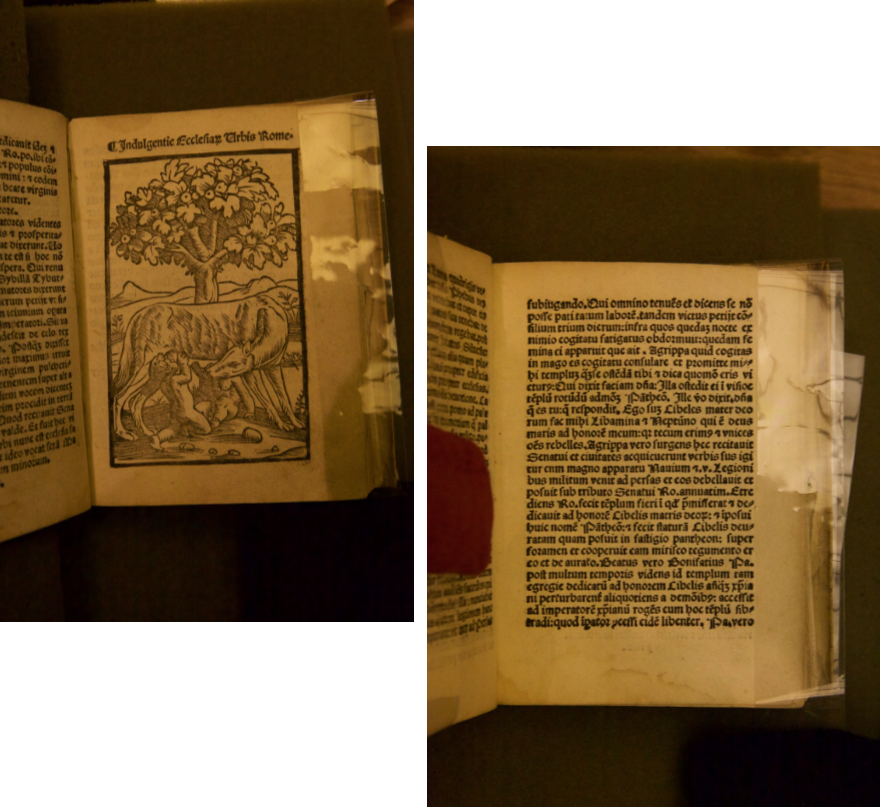
<p>Introduction:</p>\n<p> This text was published in 1516, but is based on an earlier copy which was first published in 1112. The <em>Mirabilia Romae </em>was the very first guidebook for visitors to Rome and almost exclusively focused on the Catholic Churches located in the city. While it does mention ancient sites, such as the Colosseum and the Temple of Vesta, they are only really used to give directions to other churches and move around the city. While this may not seem helpful to a modern tourist in Rome, it gives us an incredible look into the interests and priorities of the 12th century traveler. Further, many of the ruins which are of such interest to the modern tourist were buried or even confused with other monuments during this time. A prime example is of the Pantheon--here called the <em>Chiesa De Santa Maria Rotunda </em>or the Church of Saint Maria in the Round!</p>\n<p> </p>\n<p>Description:</p>\n<p> Written entirely in Medieval Latin and containing only one picture (a reimagining of the founding myth of Rome-the suckling of Romulus and Remus by a she-wolf), this text once this was one of hundreds of copies of nearly identical texts, printed over hundreds of years, meant to be used in Italy as guides. Many of these texts have been lost in the 500-800 years since their publication. Now, this is one of the last surviving copies of a religiously driven tour of the city. Written in Medieval Latin, the author is unknown and the binding, of goatskin and twine, can only provide hints at its place of publication.</p>\n<p> </p>\n<p>Link to Library Site: <a href=\"http://catalog.library.ucla.edu/vwebv/holdingsInfo?searchId=1469&recCount=50&recPointer=15&bibId=6894933\">http://catalog.library.ucla.edu/vwebv/holdingsInfo?searchId=1469&recCount=50&recPointer=15&bibId=6894933</a></p>\n<p> </p>\n
Working in Special Collections
<p>Working in Special Collections is not exactly like picking a book off of a shelf and reading. There are certain precautions that must be taken with books several hundred years old. As can be seen with the 3D model of the <em>Mirabilia, </em>book “snakes” are used to hold open pages and the entire book must be supported by foam cut outs so that little pressure is exerted upon the spine.</p>\n
Antiquitates Romanae Urbis Studio
Introduction:
A pictorial guidebook to Rome, which contains 383 woodcut illustrations, this book was created and sold by Girolamo Francini. It includes the many renovations and new constructions that had taken place in Rome under the reign of Pope Sixtus V from 1585-1590. This guidebook is very small and portable, which made it easy for travelers, pilgrims, and merchants to carry around during their trip. In addition, the illustrations were printed on only one side of the pages. This left room on the other side of the pages for the travelers to write their notes or observations. These travelers can then show their family and friends the places they have visited and any interesting experiences they had using the guidebook as a travel photo album or a journal.
Relationship to Mirabilia:
This book was designed as a companion piece to the Mirabilia Urbis Romae, as it follows the landmarks laid out in the older guide.
Link to Library Site: http://catalog.library.ucla.edu/vwebv/holdingsInfo?searchId=3297&recCount=50&recPointer=1&bibId=7182586&searchType=7
Roma Instaurata by Flavio Biondo
Roma Instaurata by Flavio Biondo
Introduction:
This text was published in 1482 but is based on an earlier copy which was published in 1439. Roma Instaurata (Rome Restored) was written by Flavio Biondo for two purposes: fixing the fact that even the most cultured men of his time knew little information about the buildings in the city of Rome, and to vie through written restorations of ruins with the splendor of the physical restorations paid for by his patron, Pope Eugene IV. Divided into three books, Roma Instaurata describes many major buildings and areas of the city, using numerous ancient literary sources as evidence, although not always quoted correctly. Biondo sometimes misinterpret these texts, as in the case of what he falsely identifies as a Temple of Vesta, but his comments are nevertheless often right.
Link to Library Site: http://catalog.library.ucla.edu/vwebv/holdingsInfo?bibId=730641
Roma Instaurata by Flavio Biondo: the Object
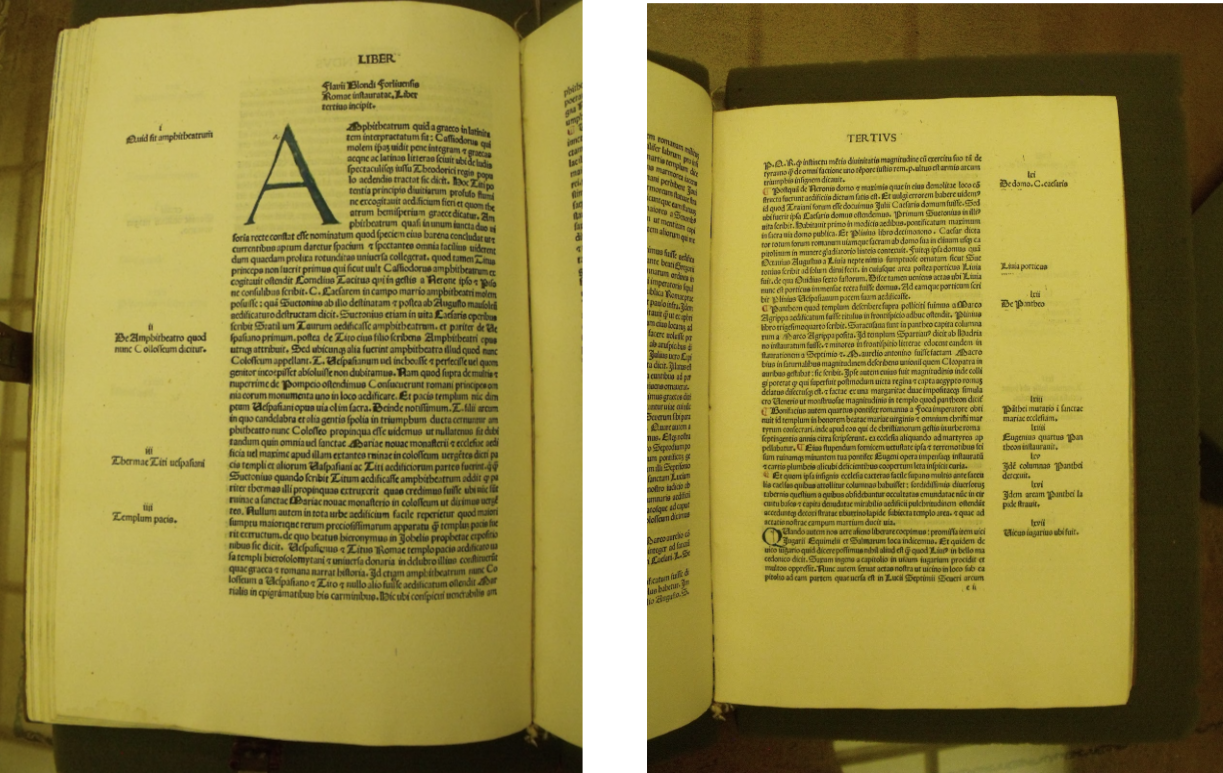
Description:
Written entirely in Medieval Latin with no pictures, this text uses color sparingly for section markers. The physical book has a vellum front with clasps and hatches on the sides. There are section titles in the margins. The box shows that this particular copy was part of the Bibliotheque Pillone (Pillone Library) and was printed in Verona. There are several other versions of the book in existence, each with a slightly different text, but the differences are generally minor.
Urbis Roma Topographia by Bartolomeo Francini
Introduction:
This text was published in 1544 as the first illustrated printing of a 1534 topographical guidebook to Rome. It contains architectural details of buildings in Rome, such as the Pantheon, including 9 plans of buildings and 12 drawings of statues. Of particular note is an index at the beginning of the book listing all of the buildings contained inside with the page numbers of their mentions. This book also contains 2 maps of Rome, one of which is a double-page map by the calligrapher Giovanni Battista Palatino.
Description:
Written in medieval Latin, this book has small golden floral designs in the corners with edges that have red and brown sprinkled throughout. There are a large number of annotations throughout the text. These serve primarily to mark subsections within the text, though sometimes there is more detail included. Each section starts with a single larger capital letter that fills two lines instead of one.
Link to Library Site: http://catalog.library.ucla.edu/vwebv/holdingsInfo?bibId=3754210
Le Plus Beaux Monuments
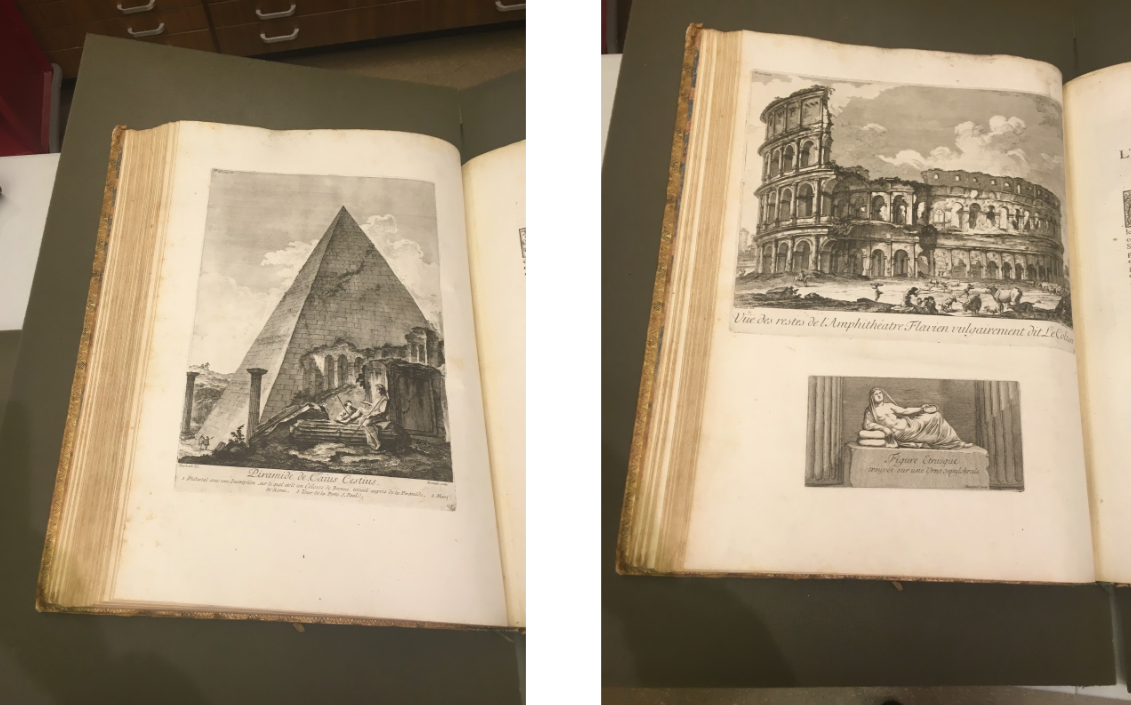
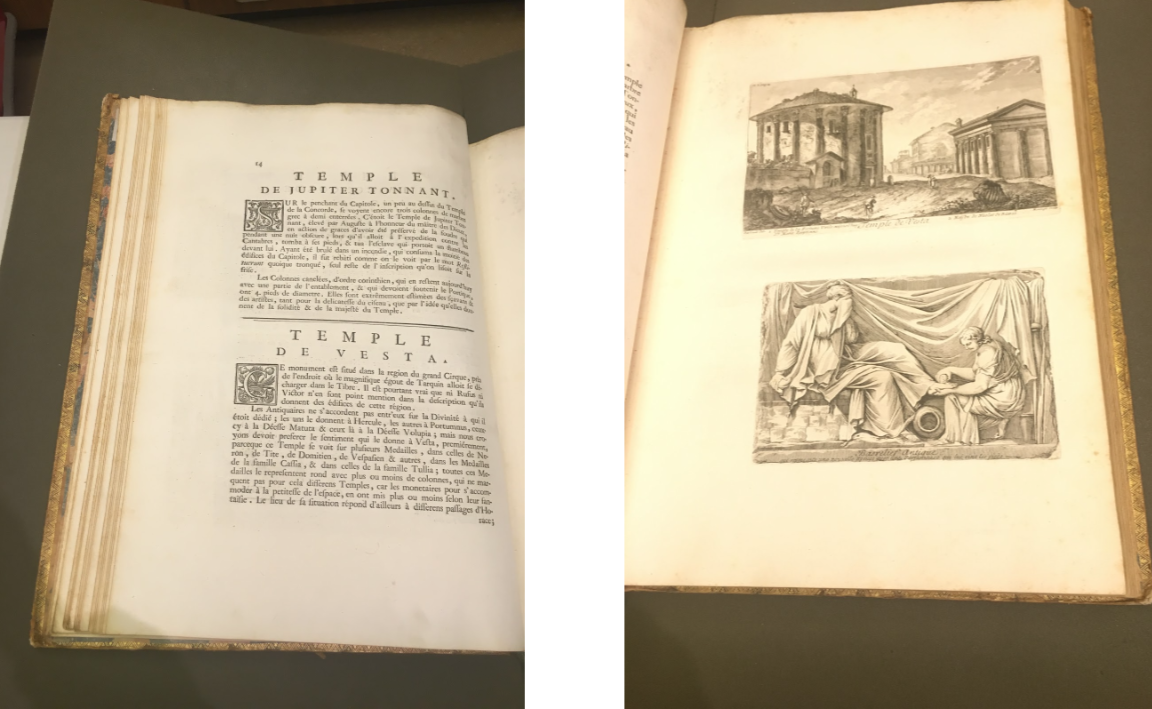
Les Plus Beaux Monuments contains engravings of Roman antiquities by French artist Jean Barbault. The book is divided into two sections: the first architecture; the second sculpture. The architectural section is organized by building type, including temples, triumphal arches, theaters, columns and obelisks, baths and aqueducts, and tombs and altars. According to Martha Pollak in \"The Mark J. Millard architectural collection,\" Barbault's engravings were notable for their \"tactile and appealing\" presentation and framing. Les Plus Beaux Monuments’ text references historians of Rome such as Pliny the Elder, Alessandro Donati, Bernard de Montfaucon, Famiano Nardini, Scipione Maffei, and Carlo Fontana.
Le Plus Beaux Monuments II
Tour Guide Map of Rome, the Eternal City
The purpose of this section of the prototype is to put the information contained in these texts into practical use. Rome is a magnificent city, especially because walking the ruins gives a visitor a deep appreciation for the ancient city. Special Collections is the center of information, but it comes alive when someone can see the beauty of these ruins as they read about their history.
Tour Stop #1: The Tomb of Cestius
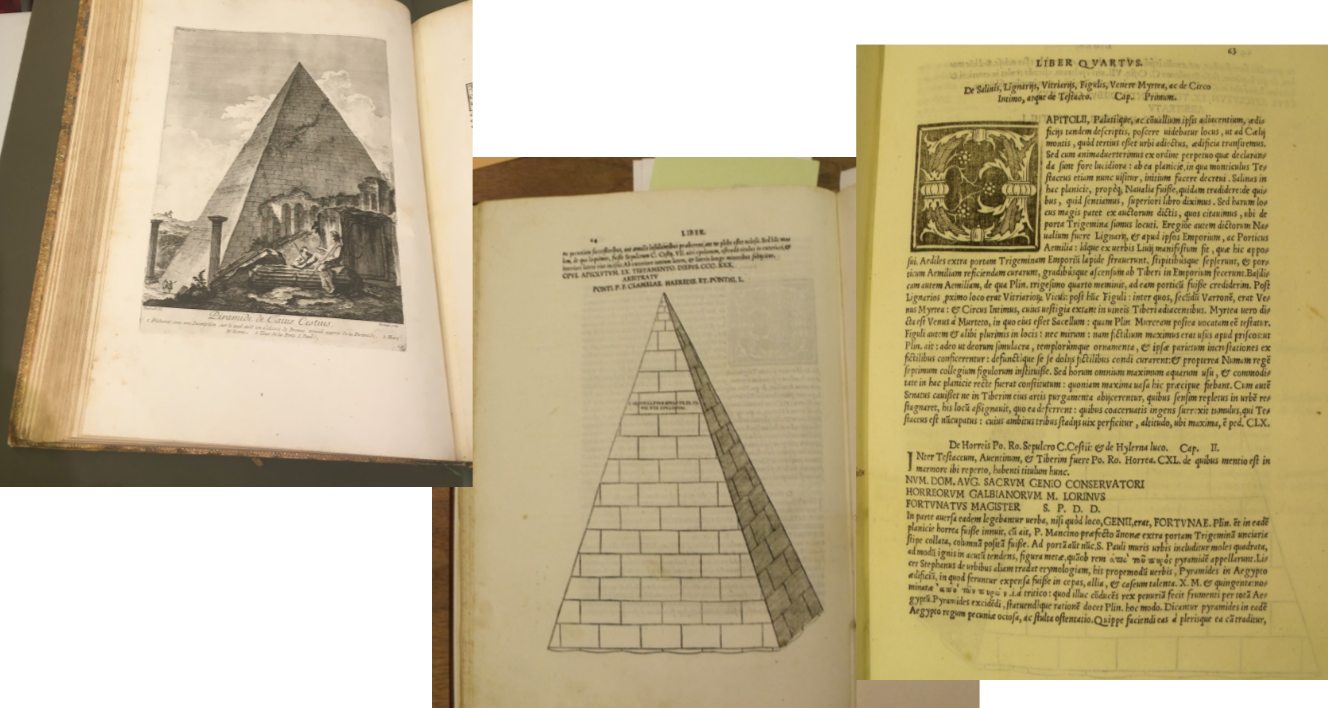
The Tomb of Cestius, often (incorrectly) called the Meta Remi, is a large rectangular pyramid that dates to the late 1st century BCE and serves as a funereal monument of Gaius Cestius. Two inscriptions are present on the monument, one giving the name, clan and titles of Cestius and the other showing who made it and how long they spent. It is found on the Via Ostia. This monument is not found in the Mirabilia Urbis Romae. It does not receive an entry in Flavio Biondo’s work either, though he may be referring to it in passing in giving the location of another monument.
The book Les Plus Beaux Monuments de Rome devotes a few pages to the pyramid, providing an elaborate drawing of it. This includes a lengthy section trying to guess the meaning of Epulo, one of Cestius’ titles; the book correctly states that an Epulo prepared feasts for the gods. It closes with a description of the interior of the pyramid, including some of the paintings contained therein.
Tour Stop #2: The Temple of Hercules, also known as The (False) Temple of Vesta
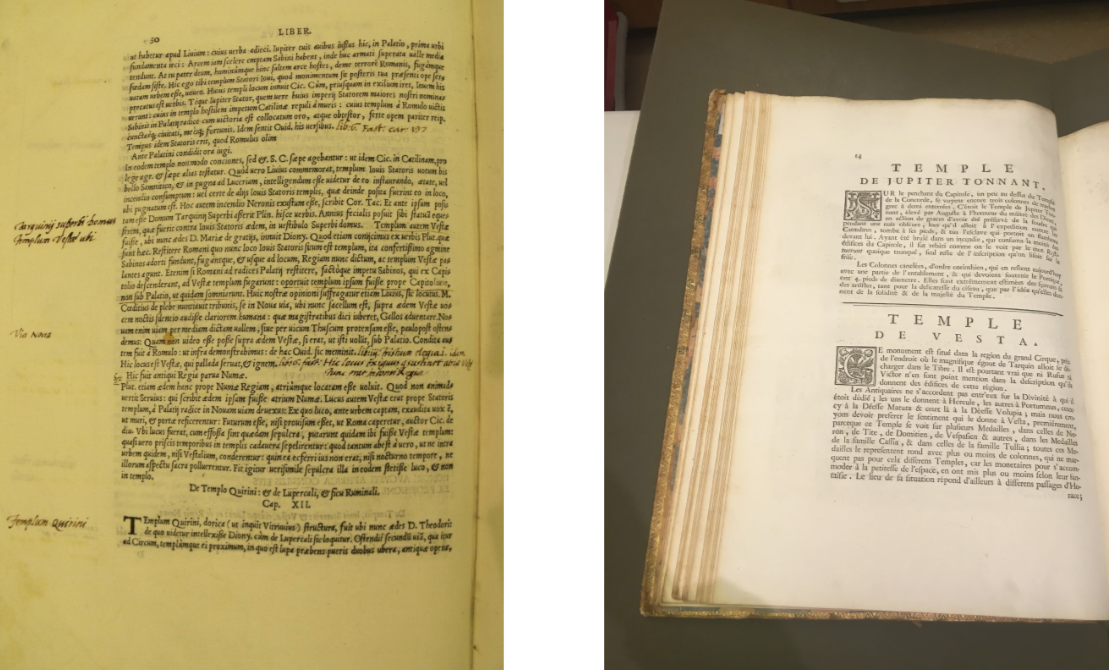
In antiquity, the Temple of Vesta was a round structure with a thatched roof and external columns, seen in depictions preserved on ancient coins. It was said to contain the sacred fire that Aeneas brought from the burning city of Troy, which the Vestal Virgins were tasked with keeping ablaze as the sacred hearth of the city.
The fifteenth century author Flavio Biondo identifies the Temple of Vesta by citing Ovid’s poem Fasti, in which he describes it as being on the spot where a Vestal Virgin named Silvia rested while she washed sacred objects by the Tiber River (Fasti 3.11-18). Biondo also quotes Horace, who wrote that the waves from the Tiber washed over “the monuments of kings and the temples of Vesta,” (Odes 1.2.13-20). Biondo draws the conclusion that “the Temple of Vesta was on the banks of the Tiber near the forum.” For this reason and due to architectural similarities, he and other scholars of this time period mislabeled the Temple of Hercules, which sat by the Tiber, as the Temple of Vesta, a mistake that has subsequently been corrected.
Tour Stop #3: The (Real) Temple of Vesta
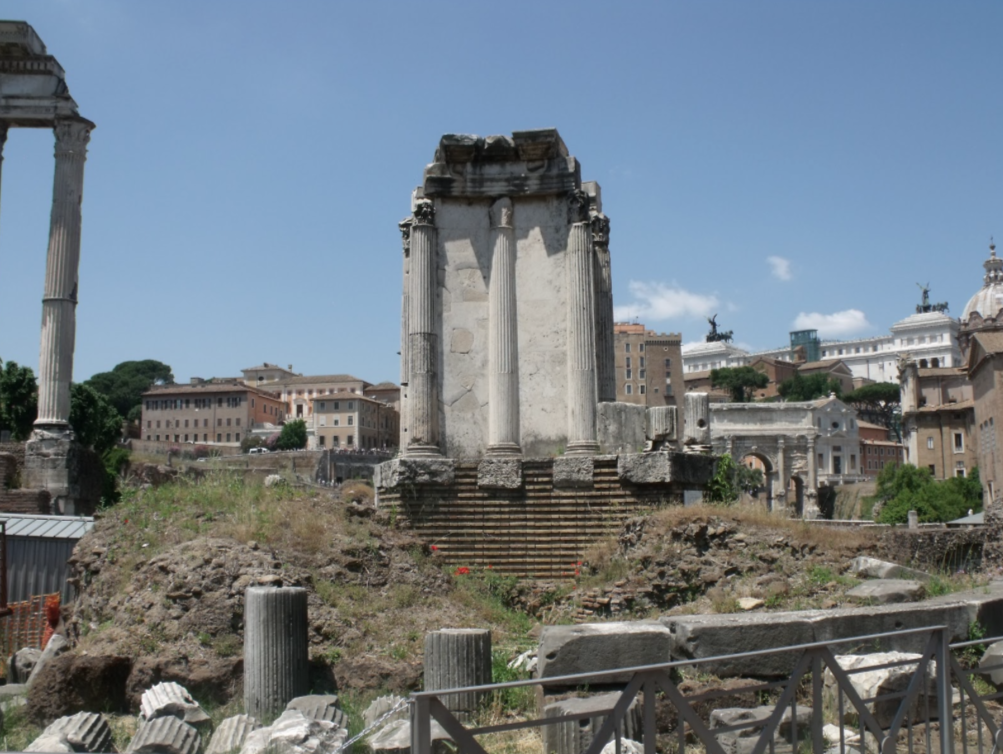
Archaeological research revealed that the temple was actually inside of the Forum Romanum, when its Augustan podium was excavated between 1883 and 1900. The temple was identified by its architecture, which matched the coin engravings (and does bear a striking resemblance to the Temple of Hercules). Today, the ruins of the Temple of Vesta consist of a small section of colonnaded wall rest on a reconstructed, white marble base.
The real temple, shown here, is not identified or mentioned in any of the Medieval or Renaissance texts, but shows the continuing evolution of the face of Rome.
Tour Stop #4: The Pantheon
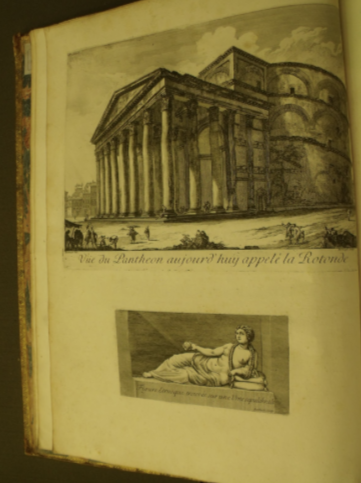
The Pantheon, as we can visit it today, is not the original temple. This famous building was constructed under the Roman Empire Hadrian, while General Marcus Agrippa designed the original temple in 27 AD. The Pantheon is well-known for its rounded ceiling with a hole in the center (called an oculus) and the inscription on the front “M AGRIPPA L F COS TERTIUM FECIT.” This is Latin for Marcus Agrippa, son of Lucius, having been consul three times, built it.” Even though this is not technically true, it shows the Roman dedication to their ancestors and the powerful men of the past.
This building is one of the only ancient structures to be mentioned directly in the Mirabilia Urbis Romae. But, it is not called the Pantheon! It has another name--the Church of Santa Maria Rotunda. Its name was changed in the 7th century AD. Flavio Biondo also makes note of this change in his work: “The Roman Pope Boniface IV obtained from Emperor Phocas this temple to be consecrated in honor of the Blessed Virgin Maria and of all the martyrs of Christ. Because of this, this church was sometimes called the Church to the Martyrs…” These changes show that the understanding of the Roman city evolved over time as different religions, ideas, and interests focused on different aspects of the city.
Tour Stop #5: The Curia Hostilia and Julia
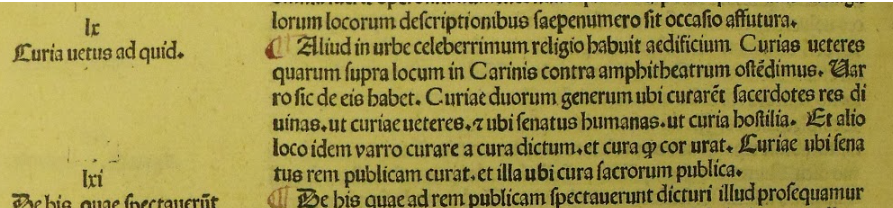
The Curia Julia, built in place of the Republican era Curia Hostilia in the mid to late 1st century BCE, was found in the Forum Romanum, the center of Roman political life. The Senate, the elite political body during the Roman Republic, met in the Curia. Julius Caesar started work on the Curia Julia before his assassination in 44 BCE. The Senate paused work on it for a few years, but Octavian Caesar, his son-in-law and the future emperor Augustus, completed work on it in 29 BCE. It was destroyed by fire in the late 3rd century CE but restored by the Emperor Diocletian.
The Curia is not mentioned in the Mirabilia Urbis Romae and receives only a brief mention in Flavio Biondo’s work. In a section about curiae in general, Biondo cites the Republican-era scholar Varro, who connects the word Curia with the Latin verb curare, to care. He says that some curiae are places where priests care for divine matters, while others, like the Curia Hostilia, are where the senators care for the people.
Tour Stop #6: The Arch of Titus
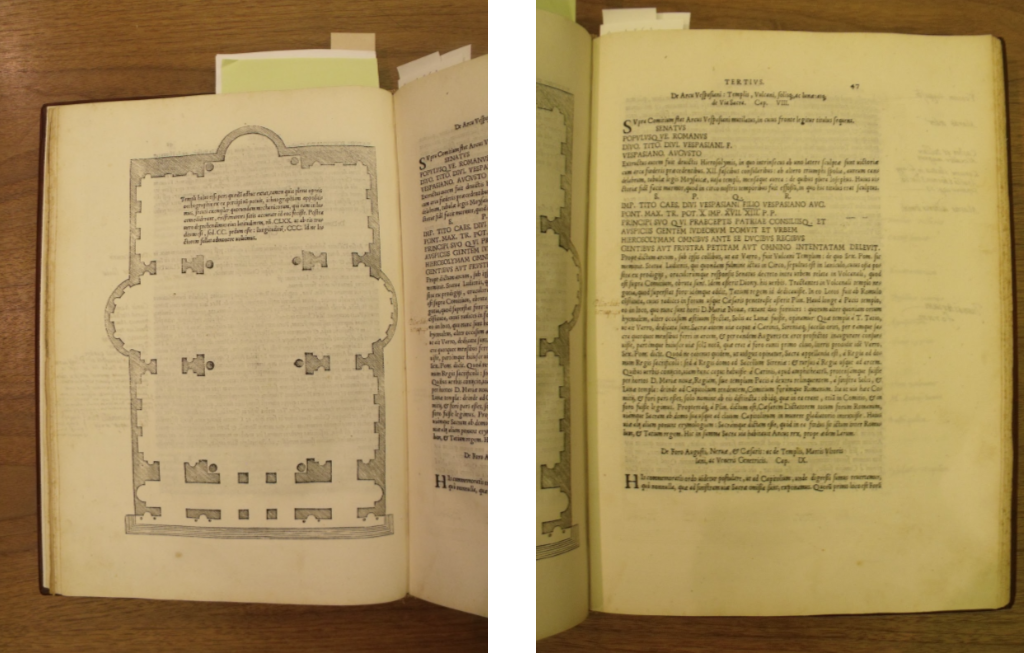
The Arch of Titus was also built with the spoils of the sack of Jerusalem, but it was Titus’ younger brother, Domitian who commissioned the arch in 82 AD. Titus died very young and Domitian, now Emperor of Rome, wanted to commemorate his brother’s victories. While not included in the Mirabilia Urbis Romae, this arch provided a model for many other victory monuments well into the 16th century. The most famous of these arches may well be the Arc de Triomphe in Paris.
Flavio Biondo recognized this arch as part of a much larger building project undertaken by the Flavian Emperors in order to make the area around the Roman Forum physically impressive. “...the leading Romans were accustomed to build all of their monuments in one place. And we see that the Temple of Peace, now destroyed, the work of Vespasian, once on the Sacra Via, then the very well-known arch of his son Titus, on which a candelabra and other spoils of the Jewish race were visible being led in a triumph, are near the Amphitheater, now called the Colosseum...and the greatest ruins that remain near it...the other structures of Vespasian and Titus.” While Biondo clearly had the identification of the arch’s builder wrong, he made great strides in understanding how Rome’s monumental structures were built and the goals of the Roman Emperors when they undertook such projects.
Final Tour Stop: The Colosseum
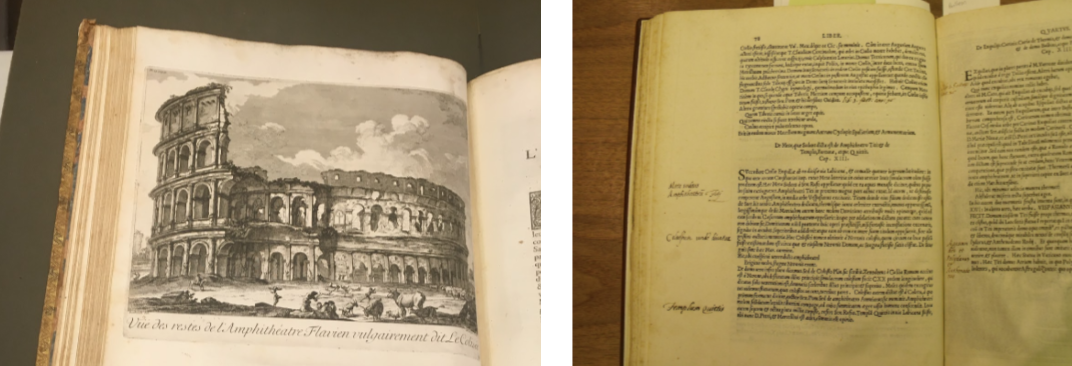
The Colosseum’s proper name is the Flavian Amphitheatre. This building was funded by the wealth taken from recaptured Jerusalem under the Emperor Vespasian and his son Titus, as part of the monumental building projects that many Roman emperors undertook in order to show their power. The Colosseum was used to host games, competitions, and gladiatorial combat. It was also used to re-enact battle scenes, including those on the sea. The sand and wooden floor underneath could be removed and the Colosseum would fill with water! Below the floor, visible today, exists an elaborate maze of chambers, hallways, and elevators.
Final Tour Stop: The Colosseum II
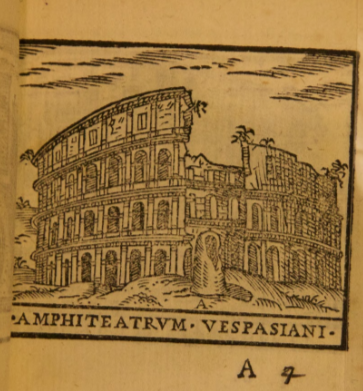
This building is barely mentioned in the Mirabilia Urbis Romae as it was largely out of use in the 12th century and held little attraction for Christian tourists. Flavio Biondo, however, gives great detail to the “sins” committed in the sand. “In the elliptical shape of the Amphitheatre, adultery, incest, and incitements of other debaucheries or emasculating games were conducted, but also examples of the greatest cruelty. Men who were excessively eager for death were thrown in to fight with beasts.” While Biondo may have exaggerated the events held in the ring, many Christian writers, such as Biondo, were haunted by stories of their martyrs thrown to the lions in the Colosseum.
Concluding Remarks
Thank you all for viewing the prototype of the Digital Humanities 199/299 Final Project. Our goal of this project is to help the Special Collections reach a broader audience through an augmented editions of the physical collection. Through such work, we hope to increase the accessibility of these rare texts.

Our overall goal in this project, Virtual Guide: The Eternal City, is to interface with the special collections books and create augmented editions of physical archives. They provide the window into the ancient Roman city, but the importance of this collection is that it allows us to see how information and source material has come to us through the centuries. This experimental format is our attempt to make a 3D critical edition of these works. The map aspect of this project is just one example of the practical application of these Medieval and Early Modern scholarly source materials and the continuing usefulness of these texts. Hopefully, projects of this type will help to grow the accessibility and breadth of the library.
Introduction to Special Collections
UCLA’s Special Collections consists of rare and ancient books, manuscripts, photographs, audiovisual material, and primary sources, tucked away in a corner of the Young Research Library. Researchers (student, staff, and visitors alike) may access the collection online through the library catalog to find titles, to broaden understanding of a given subject through the perspectives of the past. Scholars with academic interests in the collection may be deterred by the location and process, and many may not know that the collection exists. This is partly due to the valuable nature of the collection, which makes it necessary to place restrictions on access. For this reason, “browsing” the collection in person is not possible, and one must register with an account on the Aeon system to reserve a book in the reading room. While this process does accommodate the search-and-find magic of a library, where one may run across books and authors that they previously did not know to exist, the careful turn of well-worn pages holds a certain charm of its own. We wished to put our experience with the Special Collections’ ancient Roman guidebooks online, to demonstrate the kinds of treasure that may be found within the collections. We were able to do so with help from the Special Collections staff, who worked with a tireless passion to assist us in this project.
Project Books List
1. Biondo, Flavio. Roma Instaurata. 2. Sadeler, Aegidius. Vestigi delle antichità di Roma. 3. Marliani, Bartolomeo. Urbis Romae topographia. 4. Palladio, Andrea. I quattro libri dell’architettura. 5. Serlio, Sebastiano. Il Primo-secondo libro dell’architettura. 6. Vitruvius Pollio. M. Vitruvius. 7. Vitruvius Pollio. De architectura libri dece. 8. Martinelli, Romano. Roma ricercata nel suo sito. 9. Roisecco, Niccola. Roma antica, e moderna, o sia Nuova descrizione di tutti gl'edifici, antichi e moderni, sacri, e profani, della città di Roma. Vol. 1. 10. Roisecco, Niccola. Roma antica, e moderna, o sia Nuova descrizione di tutti gl'edifici, antichi e moderni, sacri, e profani, della città di Roma. Vol. 2. 11. Roisecco, Niccola. Roma antica, e moderna, o sia Nuova descrizione di tutti gl'edifici, antichi e moderni, sacri, e profani, della città di Roma. Vol. 3. 12. De Rossi, Filippo. Ritratto di Roma antica. Vol. 1. 13. De Rossi, Filippo. Ritratto di Roma antica. Vol. 2. 14. Felini, Pietro Martire. Tratado nuevo de las cosas maravillosas de la alma ciudad de Roma. 15. Hollar, Wenceslaus. Ruinae aliquot, sive antiquitatis Romanae vestigia. 16. Fulvio, Andrea. L’antichità di Roma. 17. Gamucci, Bernardo. Libri quattro dell’antichità della città di Roma. 18. Scamozzi, Vincenzo. Discorsi sopra l'antichità di Roma. 19. Marliani, Bartolomeo. L’antichità di Roma. 20. Francini, Girolamo. Antiquitates Romanae Urbis Studio. 21. Mirabilia Roma. 22. Della Vaccheria, Lorenzo. I vestigi dell’antichità di Roma. 23. Barbault, Jean. Recueil de divers monumens anciens répandus en plusieurs endroits de l'Italie. 24. Barbault, Jean. Les plus beaux monuments de Rome ancienne.
The Core Texts of the Project
Our project began with 24 books, mostly in the Ahmanson-Murphy Collection of Early Italian Printing, which we then surveyed for the five most informative texts. These texts contain a range of information about the ancient city, but also have their own challenges in simply accessing the information. First off, each text is in archaic forms of French, Spanish, or Medieval Latin. But they also present physical challenges due to their age, including remaining under low lighting so not to yellow them prematurely.
In order to overcome these issues, we decided to create 3D renditions of these works. These serve two purposes--to introduce a wider range of patrons to the works and to synthesize, while bypassing, the physical limitations of working with such old materials. Now, with our prototype, anyone can look at these books, view the pages, and even understand how book snakes, foam cutouts, and plastic binding complicate access.
You may view these texts both closed and open to various pages while moving around the table.
Mirabilia Urbis Romae
<p>Introduction:</p>\n<p> This text was published in 1516, but is based on an earlier copy which was first published in 1112. The <em>Mirabilia Romae </em>was the very first guidebook for visitors to Rome and almost exclusively focused on the Catholic Churches located in the city. While it does mention ancient sites, such as the Colosseum and the Temple of Vesta, they are only really used to give directions to other churches and move around the city. While this may not seem helpful to a modern tourist in Rome, it gives us an incredible look into the interests and priorities of the 12th century traveler. Further, many of the ruins which are of such interest to the modern tourist were buried or even confused with other monuments during this time. A prime example is of the Pantheon--here called the <em>Chiesa De Santa Maria Rotunda </em>or the Church of Saint Maria in the Round!</p>\n<p> </p>\n<p>Description:</p>\n<p> Written entirely in Medieval Latin and containing only one picture (a reimagining of the founding myth of Rome-the suckling of Romulus and Remus by a she-wolf), this text once this was one of hundreds of copies of nearly identical texts, printed over hundreds of years, meant to be used in Italy as guides. Many of these texts have been lost in the 500-800 years since their publication. Now, this is one of the last surviving copies of a religiously driven tour of the city. Written in Medieval Latin, the author is unknown and the binding, of goatskin and twine, can only provide hints at its place of publication.</p>\n<p> </p>\n<p>Link to Library Site: <a href=\"http://catalog.library.ucla.edu/vwebv/holdingsInfo?searchId=1469&recCount=50&recPointer=15&bibId=6894933\">http://catalog.library.ucla.edu/vwebv/holdingsInfo?searchId=1469&recCount=50&recPointer=15&bibId=6894933</a></p>\n<p> </p>\n
Working in Special Collections
<p>Working in Special Collections is not exactly like picking a book off of a shelf and reading. There are certain precautions that must be taken with books several hundred years old. As can be seen with the 3D model of the <em>Mirabilia, </em>book “snakes” are used to hold open pages and the entire book must be supported by foam cut outs so that little pressure is exerted upon the spine.</p>\n
Antiquitates Romanae Urbis Studio
Introduction:
A pictorial guidebook to Rome, which contains 383 woodcut illustrations, this book was created and sold by Girolamo Francini. It includes the many renovations and new constructions that had taken place in Rome under the reign of Pope Sixtus V from 1585-1590. This guidebook is very small and portable, which made it easy for travelers, pilgrims, and merchants to carry around during their trip. In addition, the illustrations were printed on only one side of the pages. This left room on the other side of the pages for the travelers to write their notes or observations. These travelers can then show their family and friends the places they have visited and any interesting experiences they had using the guidebook as a travel photo album or a journal.
Relationship to Mirabilia:
This book was designed as a companion piece to the Mirabilia Urbis Romae, as it follows the landmarks laid out in the older guide.
Link to Library Site: http://catalog.library.ucla.edu/vwebv/holdingsInfo?searchId=3297&recCount=50&recPointer=1&bibId=7182586&searchType=7
Roma Instaurata by Flavio Biondo
Roma Instaurata by Flavio Biondo
Introduction:
This text was published in 1482 but is based on an earlier copy which was published in 1439. Roma Instaurata (Rome Restored) was written by Flavio Biondo for two purposes: fixing the fact that even the most cultured men of his time knew little information about the buildings in the city of Rome, and to vie through written restorations of ruins with the splendor of the physical restorations paid for by his patron, Pope Eugene IV. Divided into three books, Roma Instaurata describes many major buildings and areas of the city, using numerous ancient literary sources as evidence, although not always quoted correctly. Biondo sometimes misinterpret these texts, as in the case of what he falsely identifies as a Temple of Vesta, but his comments are nevertheless often right.
Link to Library Site: http://catalog.library.ucla.edu/vwebv/holdingsInfo?bibId=730641
Roma Instaurata by Flavio Biondo: the Object
Description:
Written entirely in Medieval Latin with no pictures, this text uses color sparingly for section markers. The physical book has a vellum front with clasps and hatches on the sides. There are section titles in the margins. The box shows that this particular copy was part of the Bibliotheque Pillone (Pillone Library) and was printed in Verona. There are several other versions of the book in existence, each with a slightly different text, but the differences are generally minor.
Urbis Roma Topographia by Bartolomeo Francini
Introduction:
This text was published in 1544 as the first illustrated printing of a 1534 topographical guidebook to Rome. It contains architectural details of buildings in Rome, such as the Pantheon, including 9 plans of buildings and 12 drawings of statues. Of particular note is an index at the beginning of the book listing all of the buildings contained inside with the page numbers of their mentions. This book also contains 2 maps of Rome, one of which is a double-page map by the calligrapher Giovanni Battista Palatino.
Description:
Written in medieval Latin, this book has small golden floral designs in the corners with edges that have red and brown sprinkled throughout. There are a large number of annotations throughout the text. These serve primarily to mark subsections within the text, though sometimes there is more detail included. Each section starts with a single larger capital letter that fills two lines instead of one.
Link to Library Site: http://catalog.library.ucla.edu/vwebv/holdingsInfo?bibId=3754210
Le Plus Beaux Monuments
Les Plus Beaux Monuments contains engravings of Roman antiquities by French artist Jean Barbault. The book is divided into two sections: the first architecture; the second sculpture. The architectural section is organized by building type, including temples, triumphal arches, theaters, columns and obelisks, baths and aqueducts, and tombs and altars. According to Martha Pollak in \"The Mark J. Millard architectural collection,\" Barbault's engravings were notable for their \"tactile and appealing\" presentation and framing. Les Plus Beaux Monuments’ text references historians of Rome such as Pliny the Elder, Alessandro Donati, Bernard de Montfaucon, Famiano Nardini, Scipione Maffei, and Carlo Fontana.
Le Plus Beaux Monuments II
Tour Guide Map of Rome, the Eternal City
The purpose of this section of the prototype is to put the information contained in these texts into practical use. Rome is a magnificent city, especially because walking the ruins gives a visitor a deep appreciation for the ancient city. Special Collections is the center of information, but it comes alive when someone can see the beauty of these ruins as they read about their history.
Tour Stop #1: The Tomb of Cestius
The Tomb of Cestius, often (incorrectly) called the Meta Remi, is a large rectangular pyramid that dates to the late 1st century BCE and serves as a funereal monument of Gaius Cestius. Two inscriptions are present on the monument, one giving the name, clan and titles of Cestius and the other showing who made it and how long they spent. It is found on the Via Ostia. This monument is not found in the Mirabilia Urbis Romae. It does not receive an entry in Flavio Biondo’s work either, though he may be referring to it in passing in giving the location of another monument.
The book Les Plus Beaux Monuments de Rome devotes a few pages to the pyramid, providing an elaborate drawing of it. This includes a lengthy section trying to guess the meaning of Epulo, one of Cestius’ titles; the book correctly states that an Epulo prepared feasts for the gods. It closes with a description of the interior of the pyramid, including some of the paintings contained therein.
Tour Stop #2: The Temple of Hercules, also known as The (False) Temple of Vesta
In antiquity, the Temple of Vesta was a round structure with a thatched roof and external columns, seen in depictions preserved on ancient coins. It was said to contain the sacred fire that Aeneas brought from the burning city of Troy, which the Vestal Virgins were tasked with keeping ablaze as the sacred hearth of the city.
The fifteenth century author Flavio Biondo identifies the Temple of Vesta by citing Ovid’s poem Fasti, in which he describes it as being on the spot where a Vestal Virgin named Silvia rested while she washed sacred objects by the Tiber River (Fasti 3.11-18). Biondo also quotes Horace, who wrote that the waves from the Tiber washed over “the monuments of kings and the temples of Vesta,” (Odes 1.2.13-20). Biondo draws the conclusion that “the Temple of Vesta was on the banks of the Tiber near the forum.” For this reason and due to architectural similarities, he and other scholars of this time period mislabeled the Temple of Hercules, which sat by the Tiber, as the Temple of Vesta, a mistake that has subsequently been corrected.
Tour Stop #3: The (Real) Temple of Vesta
Archaeological research revealed that the temple was actually inside of the Forum Romanum, when its Augustan podium was excavated between 1883 and 1900. The temple was identified by its architecture, which matched the coin engravings (and does bear a striking resemblance to the Temple of Hercules). Today, the ruins of the Temple of Vesta consist of a small section of colonnaded wall rest on a reconstructed, white marble base.
The real temple, shown here, is not identified or mentioned in any of the Medieval or Renaissance texts, but shows the continuing evolution of the face of Rome.
Tour Stop #4: The Pantheon
The Pantheon, as we can visit it today, is not the original temple. This famous building was constructed under the Roman Empire Hadrian, while General Marcus Agrippa designed the original temple in 27 AD. The Pantheon is well-known for its rounded ceiling with a hole in the center (called an oculus) and the inscription on the front “M AGRIPPA L F COS TERTIUM FECIT.” This is Latin for Marcus Agrippa, son of Lucius, having been consul three times, built it.” Even though this is not technically true, it shows the Roman dedication to their ancestors and the powerful men of the past.
This building is one of the only ancient structures to be mentioned directly in the Mirabilia Urbis Romae. But, it is not called the Pantheon! It has another name--the Church of Santa Maria Rotunda. Its name was changed in the 7th century AD. Flavio Biondo also makes note of this change in his work: “The Roman Pope Boniface IV obtained from Emperor Phocas this temple to be consecrated in honor of the Blessed Virgin Maria and of all the martyrs of Christ. Because of this, this church was sometimes called the Church to the Martyrs…” These changes show that the understanding of the Roman city evolved over time as different religions, ideas, and interests focused on different aspects of the city.
Tour Stop #5: The Curia Hostilia and Julia
The Curia Julia, built in place of the Republican era Curia Hostilia in the mid to late 1st century BCE, was found in the Forum Romanum, the center of Roman political life. The Senate, the elite political body during the Roman Republic, met in the Curia. Julius Caesar started work on the Curia Julia before his assassination in 44 BCE. The Senate paused work on it for a few years, but Octavian Caesar, his son-in-law and the future emperor Augustus, completed work on it in 29 BCE. It was destroyed by fire in the late 3rd century CE but restored by the Emperor Diocletian.
The Curia is not mentioned in the Mirabilia Urbis Romae and receives only a brief mention in Flavio Biondo’s work. In a section about curiae in general, Biondo cites the Republican-era scholar Varro, who connects the word Curia with the Latin verb curare, to care. He says that some curiae are places where priests care for divine matters, while others, like the Curia Hostilia, are where the senators care for the people.
Tour Stop #6: The Arch of Titus
The Arch of Titus was also built with the spoils of the sack of Jerusalem, but it was Titus’ younger brother, Domitian who commissioned the arch in 82 AD. Titus died very young and Domitian, now Emperor of Rome, wanted to commemorate his brother’s victories. While not included in the Mirabilia Urbis Romae, this arch provided a model for many other victory monuments well into the 16th century. The most famous of these arches may well be the Arc de Triomphe in Paris.
Flavio Biondo recognized this arch as part of a much larger building project undertaken by the Flavian Emperors in order to make the area around the Roman Forum physically impressive. “...the leading Romans were accustomed to build all of their monuments in one place. And we see that the Temple of Peace, now destroyed, the work of Vespasian, once on the Sacra Via, then the very well-known arch of his son Titus, on which a candelabra and other spoils of the Jewish race were visible being led in a triumph, are near the Amphitheater, now called the Colosseum...and the greatest ruins that remain near it...the other structures of Vespasian and Titus.” While Biondo clearly had the identification of the arch’s builder wrong, he made great strides in understanding how Rome’s monumental structures were built and the goals of the Roman Emperors when they undertook such projects.
Final Tour Stop: The Colosseum
The Colosseum’s proper name is the Flavian Amphitheatre. This building was funded by the wealth taken from recaptured Jerusalem under the Emperor Vespasian and his son Titus, as part of the monumental building projects that many Roman emperors undertook in order to show their power. The Colosseum was used to host games, competitions, and gladiatorial combat. It was also used to re-enact battle scenes, including those on the sea. The sand and wooden floor underneath could be removed and the Colosseum would fill with water! Below the floor, visible today, exists an elaborate maze of chambers, hallways, and elevators.
Final Tour Stop: The Colosseum II
This building is barely mentioned in the Mirabilia Urbis Romae as it was largely out of use in the 12th century and held little attraction for Christian tourists. Flavio Biondo, however, gives great detail to the “sins” committed in the sand. “In the elliptical shape of the Amphitheatre, adultery, incest, and incitements of other debaucheries or emasculating games were conducted, but also examples of the greatest cruelty. Men who were excessively eager for death were thrown in to fight with beasts.” While Biondo may have exaggerated the events held in the ring, many Christian writers, such as Biondo, were haunted by stories of their martyrs thrown to the lions in the Colosseum.
Concluding Remarks
Thank you all for viewing the prototype of the Digital Humanities 199/299 Final Project. Our goal of this project is to help the Special Collections reach a broader audience through an augmented editions of the physical collection. Through such work, we hope to increase the accessibility of these rare texts.
UCLA’s Special Collections consists of rare and ancient books, manuscripts, photographs, audiovisual material, and primary sources, tucked away in a corner of the Young Research Library. Researchers (student, staff, and visitors alike) may access the collection online through the library catalog to find titles, to broaden understanding of a given subject through the perspectives of the past. Scholars with academic interests in the collection may be deterred by the location and process, and many may not know that the collection exists. This is partly due to the valuable nature of the collection, which makes it necessary to place restrictions on access. For this reason, “browsing” the collection in person is not possible, and one must register with an account on the Aeon system to reserve a book in the reading room. While this process does accommodate the search-and-find magic of a library, where one may run across books and authors that they previously did not know to exist, the careful turn of well-worn pages holds a certain charm of its own. We wished to put our experience with the Special Collections’ ancient Roman guidebooks online, to demonstrate the kinds of treasure that may be found within the collections. We were able to do so with help from the Special Collections staff, who worked with a tireless passion to assist us in this project.
Project Books List
1. Biondo, Flavio. Roma Instaurata. 2. Sadeler, Aegidius. Vestigi delle antichità di Roma. 3. Marliani, Bartolomeo. Urbis Romae topographia. 4. Palladio, Andrea. I quattro libri dell’architettura. 5. Serlio, Sebastiano. Il Primo-secondo libro dell’architettura. 6. Vitruvius Pollio. M. Vitruvius. 7. Vitruvius Pollio. De architectura libri dece. 8. Martinelli, Romano. Roma ricercata nel suo sito. 9. Roisecco, Niccola. Roma antica, e moderna, o sia Nuova descrizione di tutti gl'edifici, antichi e moderni, sacri, e profani, della città di Roma. Vol. 1. 10. Roisecco, Niccola. Roma antica, e moderna, o sia Nuova descrizione di tutti gl'edifici, antichi e moderni, sacri, e profani, della città di Roma. Vol. 2. 11. Roisecco, Niccola. Roma antica, e moderna, o sia Nuova descrizione di tutti gl'edifici, antichi e moderni, sacri, e profani, della città di Roma. Vol. 3. 12. De Rossi, Filippo. Ritratto di Roma antica. Vol. 1. 13. De Rossi, Filippo. Ritratto di Roma antica. Vol. 2. 14. Felini, Pietro Martire. Tratado nuevo de las cosas maravillosas de la alma ciudad de Roma. 15. Hollar, Wenceslaus. Ruinae aliquot, sive antiquitatis Romanae vestigia. 16. Fulvio, Andrea. L’antichità di Roma. 17. Gamucci, Bernardo. Libri quattro dell’antichità della città di Roma. 18. Scamozzi, Vincenzo. Discorsi sopra l'antichità di Roma. 19. Marliani, Bartolomeo. L’antichità di Roma. 20. Francini, Girolamo. Antiquitates Romanae Urbis Studio. 21. Mirabilia Roma. 22. Della Vaccheria, Lorenzo. I vestigi dell’antichità di Roma. 23. Barbault, Jean. Recueil de divers monumens anciens répandus en plusieurs endroits de l'Italie. 24. Barbault, Jean. Les plus beaux monuments de Rome ancienne.
The Core Texts of the Project
Our project began with 24 books, mostly in the Ahmanson-Murphy Collection of Early Italian Printing, which we then surveyed for the five most informative texts. These texts contain a range of information about the ancient city, but also have their own challenges in simply accessing the information. First off, each text is in archaic forms of French, Spanish, or Medieval Latin. But they also present physical challenges due to their age, including remaining under low lighting so not to yellow them prematurely.
In order to overcome these issues, we decided to create 3D renditions of these works. These serve two purposes--to introduce a wider range of patrons to the works and to synthesize, while bypassing, the physical limitations of working with such old materials. Now, with our prototype, anyone can look at these books, view the pages, and even understand how book snakes, foam cutouts, and plastic binding complicate access.
You may view these texts both closed and open to various pages while moving around the table.
Mirabilia Urbis Romae
<p>Introduction:</p>\n<p> This text was published in 1516, but is based on an earlier copy which was first published in 1112. The <em>Mirabilia Romae </em>was the very first guidebook for visitors to Rome and almost exclusively focused on the Catholic Churches located in the city. While it does mention ancient sites, such as the Colosseum and the Temple of Vesta, they are only really used to give directions to other churches and move around the city. While this may not seem helpful to a modern tourist in Rome, it gives us an incredible look into the interests and priorities of the 12th century traveler. Further, many of the ruins which are of such interest to the modern tourist were buried or even confused with other monuments during this time. A prime example is of the Pantheon--here called the <em>Chiesa De Santa Maria Rotunda </em>or the Church of Saint Maria in the Round!</p>\n<p> </p>\n<p>Description:</p>\n<p> Written entirely in Medieval Latin and containing only one picture (a reimagining of the founding myth of Rome-the suckling of Romulus and Remus by a she-wolf), this text once this was one of hundreds of copies of nearly identical texts, printed over hundreds of years, meant to be used in Italy as guides. Many of these texts have been lost in the 500-800 years since their publication. Now, this is one of the last surviving copies of a religiously driven tour of the city. Written in Medieval Latin, the author is unknown and the binding, of goatskin and twine, can only provide hints at its place of publication.</p>\n<p> </p>\n<p>Link to Library Site: <a href=\"http://catalog.library.ucla.edu/vwebv/holdingsInfo?searchId=1469&recCount=50&recPointer=15&bibId=6894933\">http://catalog.library.ucla.edu/vwebv/holdingsInfo?searchId=1469&recCount=50&recPointer=15&bibId=6894933</a></p>\n<p> </p>\n
Working in Special Collections
<p>Working in Special Collections is not exactly like picking a book off of a shelf and reading. There are certain precautions that must be taken with books several hundred years old. As can be seen with the 3D model of the <em>Mirabilia, </em>book “snakes” are used to hold open pages and the entire book must be supported by foam cut outs so that little pressure is exerted upon the spine.</p>\n
Antiquitates Romanae Urbis Studio
Introduction:
A pictorial guidebook to Rome, which contains 383 woodcut illustrations, this book was created and sold by Girolamo Francini. It includes the many renovations and new constructions that had taken place in Rome under the reign of Pope Sixtus V from 1585-1590. This guidebook is very small and portable, which made it easy for travelers, pilgrims, and merchants to carry around during their trip. In addition, the illustrations were printed on only one side of the pages. This left room on the other side of the pages for the travelers to write their notes or observations. These travelers can then show their family and friends the places they have visited and any interesting experiences they had using the guidebook as a travel photo album or a journal.
Relationship to Mirabilia:
This book was designed as a companion piece to the Mirabilia Urbis Romae, as it follows the landmarks laid out in the older guide.
Link to Library Site: http://catalog.library.ucla.edu/vwebv/holdingsInfo?searchId=3297&recCount=50&recPointer=1&bibId=7182586&searchType=7
Roma Instaurata by Flavio Biondo
Roma Instaurata by Flavio Biondo
Introduction:
This text was published in 1482 but is based on an earlier copy which was published in 1439. Roma Instaurata (Rome Restored) was written by Flavio Biondo for two purposes: fixing the fact that even the most cultured men of his time knew little information about the buildings in the city of Rome, and to vie through written restorations of ruins with the splendor of the physical restorations paid for by his patron, Pope Eugene IV. Divided into three books, Roma Instaurata describes many major buildings and areas of the city, using numerous ancient literary sources as evidence, although not always quoted correctly. Biondo sometimes misinterpret these texts, as in the case of what he falsely identifies as a Temple of Vesta, but his comments are nevertheless often right.
Link to Library Site: http://catalog.library.ucla.edu/vwebv/holdingsInfo?bibId=730641
Roma Instaurata by Flavio Biondo: the Object
Description:
Written entirely in Medieval Latin with no pictures, this text uses color sparingly for section markers. The physical book has a vellum front with clasps and hatches on the sides. There are section titles in the margins. The box shows that this particular copy was part of the Bibliotheque Pillone (Pillone Library) and was printed in Verona. There are several other versions of the book in existence, each with a slightly different text, but the differences are generally minor.
Urbis Roma Topographia by Bartolomeo Francini
Introduction:
This text was published in 1544 as the first illustrated printing of a 1534 topographical guidebook to Rome. It contains architectural details of buildings in Rome, such as the Pantheon, including 9 plans of buildings and 12 drawings of statues. Of particular note is an index at the beginning of the book listing all of the buildings contained inside with the page numbers of their mentions. This book also contains 2 maps of Rome, one of which is a double-page map by the calligrapher Giovanni Battista Palatino.
Description:
Written in medieval Latin, this book has small golden floral designs in the corners with edges that have red and brown sprinkled throughout. There are a large number of annotations throughout the text. These serve primarily to mark subsections within the text, though sometimes there is more detail included. Each section starts with a single larger capital letter that fills two lines instead of one.
Link to Library Site: http://catalog.library.ucla.edu/vwebv/holdingsInfo?bibId=3754210
Le Plus Beaux Monuments
Les Plus Beaux Monuments contains engravings of Roman antiquities by French artist Jean Barbault. The book is divided into two sections: the first architecture; the second sculpture. The architectural section is organized by building type, including temples, triumphal arches, theaters, columns and obelisks, baths and aqueducts, and tombs and altars. According to Martha Pollak in \"The Mark J. Millard architectural collection,\" Barbault's engravings were notable for their \"tactile and appealing\" presentation and framing. Les Plus Beaux Monuments’ text references historians of Rome such as Pliny the Elder, Alessandro Donati, Bernard de Montfaucon, Famiano Nardini, Scipione Maffei, and Carlo Fontana.
Le Plus Beaux Monuments II
Tour Guide Map of Rome, the Eternal City
The purpose of this section of the prototype is to put the information contained in these texts into practical use. Rome is a magnificent city, especially because walking the ruins gives a visitor a deep appreciation for the ancient city. Special Collections is the center of information, but it comes alive when someone can see the beauty of these ruins as they read about their history.
Tour Stop #1: The Tomb of Cestius
The Tomb of Cestius, often (incorrectly) called the Meta Remi, is a large rectangular pyramid that dates to the late 1st century BCE and serves as a funereal monument of Gaius Cestius. Two inscriptions are present on the monument, one giving the name, clan and titles of Cestius and the other showing who made it and how long they spent. It is found on the Via Ostia. This monument is not found in the Mirabilia Urbis Romae. It does not receive an entry in Flavio Biondo’s work either, though he may be referring to it in passing in giving the location of another monument.
The book Les Plus Beaux Monuments de Rome devotes a few pages to the pyramid, providing an elaborate drawing of it. This includes a lengthy section trying to guess the meaning of Epulo, one of Cestius’ titles; the book correctly states that an Epulo prepared feasts for the gods. It closes with a description of the interior of the pyramid, including some of the paintings contained therein.
Tour Stop #2: The Temple of Hercules, also known as The (False) Temple of Vesta
In antiquity, the Temple of Vesta was a round structure with a thatched roof and external columns, seen in depictions preserved on ancient coins. It was said to contain the sacred fire that Aeneas brought from the burning city of Troy, which the Vestal Virgins were tasked with keeping ablaze as the sacred hearth of the city.
The fifteenth century author Flavio Biondo identifies the Temple of Vesta by citing Ovid’s poem Fasti, in which he describes it as being on the spot where a Vestal Virgin named Silvia rested while she washed sacred objects by the Tiber River (Fasti 3.11-18). Biondo also quotes Horace, who wrote that the waves from the Tiber washed over “the monuments of kings and the temples of Vesta,” (Odes 1.2.13-20). Biondo draws the conclusion that “the Temple of Vesta was on the banks of the Tiber near the forum.” For this reason and due to architectural similarities, he and other scholars of this time period mislabeled the Temple of Hercules, which sat by the Tiber, as the Temple of Vesta, a mistake that has subsequently been corrected.
Tour Stop #3: The (Real) Temple of Vesta
Archaeological research revealed that the temple was actually inside of the Forum Romanum, when its Augustan podium was excavated between 1883 and 1900. The temple was identified by its architecture, which matched the coin engravings (and does bear a striking resemblance to the Temple of Hercules). Today, the ruins of the Temple of Vesta consist of a small section of colonnaded wall rest on a reconstructed, white marble base.
The real temple, shown here, is not identified or mentioned in any of the Medieval or Renaissance texts, but shows the continuing evolution of the face of Rome.
Tour Stop #4: The Pantheon
The Pantheon, as we can visit it today, is not the original temple. This famous building was constructed under the Roman Empire Hadrian, while General Marcus Agrippa designed the original temple in 27 AD. The Pantheon is well-known for its rounded ceiling with a hole in the center (called an oculus) and the inscription on the front “M AGRIPPA L F COS TERTIUM FECIT.” This is Latin for Marcus Agrippa, son of Lucius, having been consul three times, built it.” Even though this is not technically true, it shows the Roman dedication to their ancestors and the powerful men of the past.
This building is one of the only ancient structures to be mentioned directly in the Mirabilia Urbis Romae. But, it is not called the Pantheon! It has another name--the Church of Santa Maria Rotunda. Its name was changed in the 7th century AD. Flavio Biondo also makes note of this change in his work: “The Roman Pope Boniface IV obtained from Emperor Phocas this temple to be consecrated in honor of the Blessed Virgin Maria and of all the martyrs of Christ. Because of this, this church was sometimes called the Church to the Martyrs…” These changes show that the understanding of the Roman city evolved over time as different religions, ideas, and interests focused on different aspects of the city.
Tour Stop #5: The Curia Hostilia and Julia
The Curia Julia, built in place of the Republican era Curia Hostilia in the mid to late 1st century BCE, was found in the Forum Romanum, the center of Roman political life. The Senate, the elite political body during the Roman Republic, met in the Curia. Julius Caesar started work on the Curia Julia before his assassination in 44 BCE. The Senate paused work on it for a few years, but Octavian Caesar, his son-in-law and the future emperor Augustus, completed work on it in 29 BCE. It was destroyed by fire in the late 3rd century CE but restored by the Emperor Diocletian.
The Curia is not mentioned in the Mirabilia Urbis Romae and receives only a brief mention in Flavio Biondo’s work. In a section about curiae in general, Biondo cites the Republican-era scholar Varro, who connects the word Curia with the Latin verb curare, to care. He says that some curiae are places where priests care for divine matters, while others, like the Curia Hostilia, are where the senators care for the people.
Tour Stop #6: The Arch of Titus
The Arch of Titus was also built with the spoils of the sack of Jerusalem, but it was Titus’ younger brother, Domitian who commissioned the arch in 82 AD. Titus died very young and Domitian, now Emperor of Rome, wanted to commemorate his brother’s victories. While not included in the Mirabilia Urbis Romae, this arch provided a model for many other victory monuments well into the 16th century. The most famous of these arches may well be the Arc de Triomphe in Paris.
Flavio Biondo recognized this arch as part of a much larger building project undertaken by the Flavian Emperors in order to make the area around the Roman Forum physically impressive. “...the leading Romans were accustomed to build all of their monuments in one place. And we see that the Temple of Peace, now destroyed, the work of Vespasian, once on the Sacra Via, then the very well-known arch of his son Titus, on which a candelabra and other spoils of the Jewish race were visible being led in a triumph, are near the Amphitheater, now called the Colosseum...and the greatest ruins that remain near it...the other structures of Vespasian and Titus.” While Biondo clearly had the identification of the arch’s builder wrong, he made great strides in understanding how Rome’s monumental structures were built and the goals of the Roman Emperors when they undertook such projects.
Final Tour Stop: The Colosseum
The Colosseum’s proper name is the Flavian Amphitheatre. This building was funded by the wealth taken from recaptured Jerusalem under the Emperor Vespasian and his son Titus, as part of the monumental building projects that many Roman emperors undertook in order to show their power. The Colosseum was used to host games, competitions, and gladiatorial combat. It was also used to re-enact battle scenes, including those on the sea. The sand and wooden floor underneath could be removed and the Colosseum would fill with water! Below the floor, visible today, exists an elaborate maze of chambers, hallways, and elevators.
Final Tour Stop: The Colosseum II
This building is barely mentioned in the Mirabilia Urbis Romae as it was largely out of use in the 12th century and held little attraction for Christian tourists. Flavio Biondo, however, gives great detail to the “sins” committed in the sand. “In the elliptical shape of the Amphitheatre, adultery, incest, and incitements of other debaucheries or emasculating games were conducted, but also examples of the greatest cruelty. Men who were excessively eager for death were thrown in to fight with beasts.” While Biondo may have exaggerated the events held in the ring, many Christian writers, such as Biondo, were haunted by stories of their martyrs thrown to the lions in the Colosseum.
Concluding Remarks
Thank you all for viewing the prototype of the Digital Humanities 199/299 Final Project. Our goal of this project is to help the Special Collections reach a broader audience through an augmented editions of the physical collection. Through such work, we hope to increase the accessibility of these rare texts.
1. Biondo, Flavio. Roma Instaurata. 2. Sadeler, Aegidius. Vestigi delle antichità di Roma. 3. Marliani, Bartolomeo. Urbis Romae topographia. 4. Palladio, Andrea. I quattro libri dell’architettura. 5. Serlio, Sebastiano. Il Primo-secondo libro dell’architettura. 6. Vitruvius Pollio. M. Vitruvius. 7. Vitruvius Pollio. De architectura libri dece. 8. Martinelli, Romano. Roma ricercata nel suo sito. 9. Roisecco, Niccola. Roma antica, e moderna, o sia Nuova descrizione di tutti gl'edifici, antichi e moderni, sacri, e profani, della città di Roma. Vol. 1. 10. Roisecco, Niccola. Roma antica, e moderna, o sia Nuova descrizione di tutti gl'edifici, antichi e moderni, sacri, e profani, della città di Roma. Vol. 2. 11. Roisecco, Niccola. Roma antica, e moderna, o sia Nuova descrizione di tutti gl'edifici, antichi e moderni, sacri, e profani, della città di Roma. Vol. 3. 12. De Rossi, Filippo. Ritratto di Roma antica. Vol. 1. 13. De Rossi, Filippo. Ritratto di Roma antica. Vol. 2. 14. Felini, Pietro Martire. Tratado nuevo de las cosas maravillosas de la alma ciudad de Roma. 15. Hollar, Wenceslaus. Ruinae aliquot, sive antiquitatis Romanae vestigia. 16. Fulvio, Andrea. L’antichità di Roma. 17. Gamucci, Bernardo. Libri quattro dell’antichità della città di Roma. 18. Scamozzi, Vincenzo. Discorsi sopra l'antichità di Roma. 19. Marliani, Bartolomeo. L’antichità di Roma. 20. Francini, Girolamo. Antiquitates Romanae Urbis Studio. 21. Mirabilia Roma. 22. Della Vaccheria, Lorenzo. I vestigi dell’antichità di Roma. 23. Barbault, Jean. Recueil de divers monumens anciens répandus en plusieurs endroits de l'Italie. 24. Barbault, Jean. Les plus beaux monuments de Rome ancienne.
The Core Texts of the Project
Our project began with 24 books, mostly in the Ahmanson-Murphy Collection of Early Italian Printing, which we then surveyed for the five most informative texts. These texts contain a range of information about the ancient city, but also have their own challenges in simply accessing the information. First off, each text is in archaic forms of French, Spanish, or Medieval Latin. But they also present physical challenges due to their age, including remaining under low lighting so not to yellow them prematurely.
In order to overcome these issues, we decided to create 3D renditions of these works. These serve two purposes--to introduce a wider range of patrons to the works and to synthesize, while bypassing, the physical limitations of working with such old materials. Now, with our prototype, anyone can look at these books, view the pages, and even understand how book snakes, foam cutouts, and plastic binding complicate access.
You may view these texts both closed and open to various pages while moving around the table.
Mirabilia Urbis Romae
<p>Introduction:</p>\n<p> This text was published in 1516, but is based on an earlier copy which was first published in 1112. The <em>Mirabilia Romae </em>was the very first guidebook for visitors to Rome and almost exclusively focused on the Catholic Churches located in the city. While it does mention ancient sites, such as the Colosseum and the Temple of Vesta, they are only really used to give directions to other churches and move around the city. While this may not seem helpful to a modern tourist in Rome, it gives us an incredible look into the interests and priorities of the 12th century traveler. Further, many of the ruins which are of such interest to the modern tourist were buried or even confused with other monuments during this time. A prime example is of the Pantheon--here called the <em>Chiesa De Santa Maria Rotunda </em>or the Church of Saint Maria in the Round!</p>\n<p> </p>\n<p>Description:</p>\n<p> Written entirely in Medieval Latin and containing only one picture (a reimagining of the founding myth of Rome-the suckling of Romulus and Remus by a she-wolf), this text once this was one of hundreds of copies of nearly identical texts, printed over hundreds of years, meant to be used in Italy as guides. Many of these texts have been lost in the 500-800 years since their publication. Now, this is one of the last surviving copies of a religiously driven tour of the city. Written in Medieval Latin, the author is unknown and the binding, of goatskin and twine, can only provide hints at its place of publication.</p>\n<p> </p>\n<p>Link to Library Site: <a href=\"http://catalog.library.ucla.edu/vwebv/holdingsInfo?searchId=1469&recCount=50&recPointer=15&bibId=6894933\">http://catalog.library.ucla.edu/vwebv/holdingsInfo?searchId=1469&recCount=50&recPointer=15&bibId=6894933</a></p>\n<p> </p>\n
Working in Special Collections
<p>Working in Special Collections is not exactly like picking a book off of a shelf and reading. There are certain precautions that must be taken with books several hundred years old. As can be seen with the 3D model of the <em>Mirabilia, </em>book “snakes” are used to hold open pages and the entire book must be supported by foam cut outs so that little pressure is exerted upon the spine.</p>\n
Antiquitates Romanae Urbis Studio
Introduction:
A pictorial guidebook to Rome, which contains 383 woodcut illustrations, this book was created and sold by Girolamo Francini. It includes the many renovations and new constructions that had taken place in Rome under the reign of Pope Sixtus V from 1585-1590. This guidebook is very small and portable, which made it easy for travelers, pilgrims, and merchants to carry around during their trip. In addition, the illustrations were printed on only one side of the pages. This left room on the other side of the pages for the travelers to write their notes or observations. These travelers can then show their family and friends the places they have visited and any interesting experiences they had using the guidebook as a travel photo album or a journal.
Relationship to Mirabilia:
This book was designed as a companion piece to the Mirabilia Urbis Romae, as it follows the landmarks laid out in the older guide.
Link to Library Site: http://catalog.library.ucla.edu/vwebv/holdingsInfo?searchId=3297&recCount=50&recPointer=1&bibId=7182586&searchType=7
Roma Instaurata by Flavio Biondo
Roma Instaurata by Flavio Biondo
Introduction:
This text was published in 1482 but is based on an earlier copy which was published in 1439. Roma Instaurata (Rome Restored) was written by Flavio Biondo for two purposes: fixing the fact that even the most cultured men of his time knew little information about the buildings in the city of Rome, and to vie through written restorations of ruins with the splendor of the physical restorations paid for by his patron, Pope Eugene IV. Divided into three books, Roma Instaurata describes many major buildings and areas of the city, using numerous ancient literary sources as evidence, although not always quoted correctly. Biondo sometimes misinterpret these texts, as in the case of what he falsely identifies as a Temple of Vesta, but his comments are nevertheless often right.
Link to Library Site: http://catalog.library.ucla.edu/vwebv/holdingsInfo?bibId=730641
Roma Instaurata by Flavio Biondo: the Object
Description:
Written entirely in Medieval Latin with no pictures, this text uses color sparingly for section markers. The physical book has a vellum front with clasps and hatches on the sides. There are section titles in the margins. The box shows that this particular copy was part of the Bibliotheque Pillone (Pillone Library) and was printed in Verona. There are several other versions of the book in existence, each with a slightly different text, but the differences are generally minor.
Urbis Roma Topographia by Bartolomeo Francini
Introduction:
This text was published in 1544 as the first illustrated printing of a 1534 topographical guidebook to Rome. It contains architectural details of buildings in Rome, such as the Pantheon, including 9 plans of buildings and 12 drawings of statues. Of particular note is an index at the beginning of the book listing all of the buildings contained inside with the page numbers of their mentions. This book also contains 2 maps of Rome, one of which is a double-page map by the calligrapher Giovanni Battista Palatino.
Description:
Written in medieval Latin, this book has small golden floral designs in the corners with edges that have red and brown sprinkled throughout. There are a large number of annotations throughout the text. These serve primarily to mark subsections within the text, though sometimes there is more detail included. Each section starts with a single larger capital letter that fills two lines instead of one.
Link to Library Site: http://catalog.library.ucla.edu/vwebv/holdingsInfo?bibId=3754210
Le Plus Beaux Monuments
Les Plus Beaux Monuments contains engravings of Roman antiquities by French artist Jean Barbault. The book is divided into two sections: the first architecture; the second sculpture. The architectural section is organized by building type, including temples, triumphal arches, theaters, columns and obelisks, baths and aqueducts, and tombs and altars. According to Martha Pollak in \"The Mark J. Millard architectural collection,\" Barbault's engravings were notable for their \"tactile and appealing\" presentation and framing. Les Plus Beaux Monuments’ text references historians of Rome such as Pliny the Elder, Alessandro Donati, Bernard de Montfaucon, Famiano Nardini, Scipione Maffei, and Carlo Fontana.
Le Plus Beaux Monuments II
Tour Guide Map of Rome, the Eternal City
The purpose of this section of the prototype is to put the information contained in these texts into practical use. Rome is a magnificent city, especially because walking the ruins gives a visitor a deep appreciation for the ancient city. Special Collections is the center of information, but it comes alive when someone can see the beauty of these ruins as they read about their history.
Tour Stop #1: The Tomb of Cestius
The Tomb of Cestius, often (incorrectly) called the Meta Remi, is a large rectangular pyramid that dates to the late 1st century BCE and serves as a funereal monument of Gaius Cestius. Two inscriptions are present on the monument, one giving the name, clan and titles of Cestius and the other showing who made it and how long they spent. It is found on the Via Ostia. This monument is not found in the Mirabilia Urbis Romae. It does not receive an entry in Flavio Biondo’s work either, though he may be referring to it in passing in giving the location of another monument.
The book Les Plus Beaux Monuments de Rome devotes a few pages to the pyramid, providing an elaborate drawing of it. This includes a lengthy section trying to guess the meaning of Epulo, one of Cestius’ titles; the book correctly states that an Epulo prepared feasts for the gods. It closes with a description of the interior of the pyramid, including some of the paintings contained therein.
Tour Stop #2: The Temple of Hercules, also known as The (False) Temple of Vesta
In antiquity, the Temple of Vesta was a round structure with a thatched roof and external columns, seen in depictions preserved on ancient coins. It was said to contain the sacred fire that Aeneas brought from the burning city of Troy, which the Vestal Virgins were tasked with keeping ablaze as the sacred hearth of the city.
The fifteenth century author Flavio Biondo identifies the Temple of Vesta by citing Ovid’s poem Fasti, in which he describes it as being on the spot where a Vestal Virgin named Silvia rested while she washed sacred objects by the Tiber River (Fasti 3.11-18). Biondo also quotes Horace, who wrote that the waves from the Tiber washed over “the monuments of kings and the temples of Vesta,” (Odes 1.2.13-20). Biondo draws the conclusion that “the Temple of Vesta was on the banks of the Tiber near the forum.” For this reason and due to architectural similarities, he and other scholars of this time period mislabeled the Temple of Hercules, which sat by the Tiber, as the Temple of Vesta, a mistake that has subsequently been corrected.
Tour Stop #3: The (Real) Temple of Vesta
Archaeological research revealed that the temple was actually inside of the Forum Romanum, when its Augustan podium was excavated between 1883 and 1900. The temple was identified by its architecture, which matched the coin engravings (and does bear a striking resemblance to the Temple of Hercules). Today, the ruins of the Temple of Vesta consist of a small section of colonnaded wall rest on a reconstructed, white marble base.
The real temple, shown here, is not identified or mentioned in any of the Medieval or Renaissance texts, but shows the continuing evolution of the face of Rome.
Tour Stop #4: The Pantheon
The Pantheon, as we can visit it today, is not the original temple. This famous building was constructed under the Roman Empire Hadrian, while General Marcus Agrippa designed the original temple in 27 AD. The Pantheon is well-known for its rounded ceiling with a hole in the center (called an oculus) and the inscription on the front “M AGRIPPA L F COS TERTIUM FECIT.” This is Latin for Marcus Agrippa, son of Lucius, having been consul three times, built it.” Even though this is not technically true, it shows the Roman dedication to their ancestors and the powerful men of the past.
This building is one of the only ancient structures to be mentioned directly in the Mirabilia Urbis Romae. But, it is not called the Pantheon! It has another name--the Church of Santa Maria Rotunda. Its name was changed in the 7th century AD. Flavio Biondo also makes note of this change in his work: “The Roman Pope Boniface IV obtained from Emperor Phocas this temple to be consecrated in honor of the Blessed Virgin Maria and of all the martyrs of Christ. Because of this, this church was sometimes called the Church to the Martyrs…” These changes show that the understanding of the Roman city evolved over time as different religions, ideas, and interests focused on different aspects of the city.
Tour Stop #5: The Curia Hostilia and Julia
The Curia Julia, built in place of the Republican era Curia Hostilia in the mid to late 1st century BCE, was found in the Forum Romanum, the center of Roman political life. The Senate, the elite political body during the Roman Republic, met in the Curia. Julius Caesar started work on the Curia Julia before his assassination in 44 BCE. The Senate paused work on it for a few years, but Octavian Caesar, his son-in-law and the future emperor Augustus, completed work on it in 29 BCE. It was destroyed by fire in the late 3rd century CE but restored by the Emperor Diocletian.
The Curia is not mentioned in the Mirabilia Urbis Romae and receives only a brief mention in Flavio Biondo’s work. In a section about curiae in general, Biondo cites the Republican-era scholar Varro, who connects the word Curia with the Latin verb curare, to care. He says that some curiae are places where priests care for divine matters, while others, like the Curia Hostilia, are where the senators care for the people.
Tour Stop #6: The Arch of Titus
The Arch of Titus was also built with the spoils of the sack of Jerusalem, but it was Titus’ younger brother, Domitian who commissioned the arch in 82 AD. Titus died very young and Domitian, now Emperor of Rome, wanted to commemorate his brother’s victories. While not included in the Mirabilia Urbis Romae, this arch provided a model for many other victory monuments well into the 16th century. The most famous of these arches may well be the Arc de Triomphe in Paris.
Flavio Biondo recognized this arch as part of a much larger building project undertaken by the Flavian Emperors in order to make the area around the Roman Forum physically impressive. “...the leading Romans were accustomed to build all of their monuments in one place. And we see that the Temple of Peace, now destroyed, the work of Vespasian, once on the Sacra Via, then the very well-known arch of his son Titus, on which a candelabra and other spoils of the Jewish race were visible being led in a triumph, are near the Amphitheater, now called the Colosseum...and the greatest ruins that remain near it...the other structures of Vespasian and Titus.” While Biondo clearly had the identification of the arch’s builder wrong, he made great strides in understanding how Rome’s monumental structures were built and the goals of the Roman Emperors when they undertook such projects.
Final Tour Stop: The Colosseum
The Colosseum’s proper name is the Flavian Amphitheatre. This building was funded by the wealth taken from recaptured Jerusalem under the Emperor Vespasian and his son Titus, as part of the monumental building projects that many Roman emperors undertook in order to show their power. The Colosseum was used to host games, competitions, and gladiatorial combat. It was also used to re-enact battle scenes, including those on the sea. The sand and wooden floor underneath could be removed and the Colosseum would fill with water! Below the floor, visible today, exists an elaborate maze of chambers, hallways, and elevators.
Final Tour Stop: The Colosseum II
This building is barely mentioned in the Mirabilia Urbis Romae as it was largely out of use in the 12th century and held little attraction for Christian tourists. Flavio Biondo, however, gives great detail to the “sins” committed in the sand. “In the elliptical shape of the Amphitheatre, adultery, incest, and incitements of other debaucheries or emasculating games were conducted, but also examples of the greatest cruelty. Men who were excessively eager for death were thrown in to fight with beasts.” While Biondo may have exaggerated the events held in the ring, many Christian writers, such as Biondo, were haunted by stories of their martyrs thrown to the lions in the Colosseum.
Concluding Remarks
Thank you all for viewing the prototype of the Digital Humanities 199/299 Final Project. Our goal of this project is to help the Special Collections reach a broader audience through an augmented editions of the physical collection. Through such work, we hope to increase the accessibility of these rare texts.
Our project began with 24 books, mostly in the Ahmanson-Murphy Collection of Early Italian Printing, which we then surveyed for the five most informative texts. These texts contain a range of information about the ancient city, but also have their own challenges in simply accessing the information. First off, each text is in archaic forms of French, Spanish, or Medieval Latin. But they also present physical challenges due to their age, including remaining under low lighting so not to yellow them prematurely.
In order to overcome these issues, we decided to create 3D renditions of these works. These serve two purposes--to introduce a wider range of patrons to the works and to synthesize, while bypassing, the physical limitations of working with such old materials. Now, with our prototype, anyone can look at these books, view the pages, and even understand how book snakes, foam cutouts, and plastic binding complicate access.
You may view these texts both closed and open to various pages while moving around the table.
Mirabilia Urbis Romae
<p>Introduction:</p>\n<p> This text was published in 1516, but is based on an earlier copy which was first published in 1112. The <em>Mirabilia Romae </em>was the very first guidebook for visitors to Rome and almost exclusively focused on the Catholic Churches located in the city. While it does mention ancient sites, such as the Colosseum and the Temple of Vesta, they are only really used to give directions to other churches and move around the city. While this may not seem helpful to a modern tourist in Rome, it gives us an incredible look into the interests and priorities of the 12th century traveler. Further, many of the ruins which are of such interest to the modern tourist were buried or even confused with other monuments during this time. A prime example is of the Pantheon--here called the <em>Chiesa De Santa Maria Rotunda </em>or the Church of Saint Maria in the Round!</p>\n<p> </p>\n<p>Description:</p>\n<p> Written entirely in Medieval Latin and containing only one picture (a reimagining of the founding myth of Rome-the suckling of Romulus and Remus by a she-wolf), this text once this was one of hundreds of copies of nearly identical texts, printed over hundreds of years, meant to be used in Italy as guides. Many of these texts have been lost in the 500-800 years since their publication. Now, this is one of the last surviving copies of a religiously driven tour of the city. Written in Medieval Latin, the author is unknown and the binding, of goatskin and twine, can only provide hints at its place of publication.</p>\n<p> </p>\n<p>Link to Library Site: <a href=\"http://catalog.library.ucla.edu/vwebv/holdingsInfo?searchId=1469&recCount=50&recPointer=15&bibId=6894933\">http://catalog.library.ucla.edu/vwebv/holdingsInfo?searchId=1469&recCount=50&recPointer=15&bibId=6894933</a></p>\n<p> </p>\n
Working in Special Collections
<p>Working in Special Collections is not exactly like picking a book off of a shelf and reading. There are certain precautions that must be taken with books several hundred years old. As can be seen with the 3D model of the <em>Mirabilia, </em>book “snakes” are used to hold open pages and the entire book must be supported by foam cut outs so that little pressure is exerted upon the spine.</p>\n
Antiquitates Romanae Urbis Studio
Introduction:
A pictorial guidebook to Rome, which contains 383 woodcut illustrations, this book was created and sold by Girolamo Francini. It includes the many renovations and new constructions that had taken place in Rome under the reign of Pope Sixtus V from 1585-1590. This guidebook is very small and portable, which made it easy for travelers, pilgrims, and merchants to carry around during their trip. In addition, the illustrations were printed on only one side of the pages. This left room on the other side of the pages for the travelers to write their notes or observations. These travelers can then show their family and friends the places they have visited and any interesting experiences they had using the guidebook as a travel photo album or a journal.
Relationship to Mirabilia:
This book was designed as a companion piece to the Mirabilia Urbis Romae, as it follows the landmarks laid out in the older guide.
Link to Library Site: http://catalog.library.ucla.edu/vwebv/holdingsInfo?searchId=3297&recCount=50&recPointer=1&bibId=7182586&searchType=7
Roma Instaurata by Flavio Biondo
Roma Instaurata by Flavio Biondo
Introduction:
This text was published in 1482 but is based on an earlier copy which was published in 1439. Roma Instaurata (Rome Restored) was written by Flavio Biondo for two purposes: fixing the fact that even the most cultured men of his time knew little information about the buildings in the city of Rome, and to vie through written restorations of ruins with the splendor of the physical restorations paid for by his patron, Pope Eugene IV. Divided into three books, Roma Instaurata describes many major buildings and areas of the city, using numerous ancient literary sources as evidence, although not always quoted correctly. Biondo sometimes misinterpret these texts, as in the case of what he falsely identifies as a Temple of Vesta, but his comments are nevertheless often right.
Link to Library Site: http://catalog.library.ucla.edu/vwebv/holdingsInfo?bibId=730641
Roma Instaurata by Flavio Biondo: the Object
Description:
Written entirely in Medieval Latin with no pictures, this text uses color sparingly for section markers. The physical book has a vellum front with clasps and hatches on the sides. There are section titles in the margins. The box shows that this particular copy was part of the Bibliotheque Pillone (Pillone Library) and was printed in Verona. There are several other versions of the book in existence, each with a slightly different text, but the differences are generally minor.
Urbis Roma Topographia by Bartolomeo Francini
Introduction:
This text was published in 1544 as the first illustrated printing of a 1534 topographical guidebook to Rome. It contains architectural details of buildings in Rome, such as the Pantheon, including 9 plans of buildings and 12 drawings of statues. Of particular note is an index at the beginning of the book listing all of the buildings contained inside with the page numbers of their mentions. This book also contains 2 maps of Rome, one of which is a double-page map by the calligrapher Giovanni Battista Palatino.
Description:
Written in medieval Latin, this book has small golden floral designs in the corners with edges that have red and brown sprinkled throughout. There are a large number of annotations throughout the text. These serve primarily to mark subsections within the text, though sometimes there is more detail included. Each section starts with a single larger capital letter that fills two lines instead of one.
Link to Library Site: http://catalog.library.ucla.edu/vwebv/holdingsInfo?bibId=3754210
Le Plus Beaux Monuments
Les Plus Beaux Monuments contains engravings of Roman antiquities by French artist Jean Barbault. The book is divided into two sections: the first architecture; the second sculpture. The architectural section is organized by building type, including temples, triumphal arches, theaters, columns and obelisks, baths and aqueducts, and tombs and altars. According to Martha Pollak in \"The Mark J. Millard architectural collection,\" Barbault's engravings were notable for their \"tactile and appealing\" presentation and framing. Les Plus Beaux Monuments’ text references historians of Rome such as Pliny the Elder, Alessandro Donati, Bernard de Montfaucon, Famiano Nardini, Scipione Maffei, and Carlo Fontana.
Le Plus Beaux Monuments II
Tour Guide Map of Rome, the Eternal City
The purpose of this section of the prototype is to put the information contained in these texts into practical use. Rome is a magnificent city, especially because walking the ruins gives a visitor a deep appreciation for the ancient city. Special Collections is the center of information, but it comes alive when someone can see the beauty of these ruins as they read about their history.
Tour Stop #1: The Tomb of Cestius
The Tomb of Cestius, often (incorrectly) called the Meta Remi, is a large rectangular pyramid that dates to the late 1st century BCE and serves as a funereal monument of Gaius Cestius. Two inscriptions are present on the monument, one giving the name, clan and titles of Cestius and the other showing who made it and how long they spent. It is found on the Via Ostia. This monument is not found in the Mirabilia Urbis Romae. It does not receive an entry in Flavio Biondo’s work either, though he may be referring to it in passing in giving the location of another monument.
The book Les Plus Beaux Monuments de Rome devotes a few pages to the pyramid, providing an elaborate drawing of it. This includes a lengthy section trying to guess the meaning of Epulo, one of Cestius’ titles; the book correctly states that an Epulo prepared feasts for the gods. It closes with a description of the interior of the pyramid, including some of the paintings contained therein.
Tour Stop #2: The Temple of Hercules, also known as The (False) Temple of Vesta
In antiquity, the Temple of Vesta was a round structure with a thatched roof and external columns, seen in depictions preserved on ancient coins. It was said to contain the sacred fire that Aeneas brought from the burning city of Troy, which the Vestal Virgins were tasked with keeping ablaze as the sacred hearth of the city.
The fifteenth century author Flavio Biondo identifies the Temple of Vesta by citing Ovid’s poem Fasti, in which he describes it as being on the spot where a Vestal Virgin named Silvia rested while she washed sacred objects by the Tiber River (Fasti 3.11-18). Biondo also quotes Horace, who wrote that the waves from the Tiber washed over “the monuments of kings and the temples of Vesta,” (Odes 1.2.13-20). Biondo draws the conclusion that “the Temple of Vesta was on the banks of the Tiber near the forum.” For this reason and due to architectural similarities, he and other scholars of this time period mislabeled the Temple of Hercules, which sat by the Tiber, as the Temple of Vesta, a mistake that has subsequently been corrected.
Tour Stop #3: The (Real) Temple of Vesta
Archaeological research revealed that the temple was actually inside of the Forum Romanum, when its Augustan podium was excavated between 1883 and 1900. The temple was identified by its architecture, which matched the coin engravings (and does bear a striking resemblance to the Temple of Hercules). Today, the ruins of the Temple of Vesta consist of a small section of colonnaded wall rest on a reconstructed, white marble base.
The real temple, shown here, is not identified or mentioned in any of the Medieval or Renaissance texts, but shows the continuing evolution of the face of Rome.
Tour Stop #4: The Pantheon
The Pantheon, as we can visit it today, is not the original temple. This famous building was constructed under the Roman Empire Hadrian, while General Marcus Agrippa designed the original temple in 27 AD. The Pantheon is well-known for its rounded ceiling with a hole in the center (called an oculus) and the inscription on the front “M AGRIPPA L F COS TERTIUM FECIT.” This is Latin for Marcus Agrippa, son of Lucius, having been consul three times, built it.” Even though this is not technically true, it shows the Roman dedication to their ancestors and the powerful men of the past.
This building is one of the only ancient structures to be mentioned directly in the Mirabilia Urbis Romae. But, it is not called the Pantheon! It has another name--the Church of Santa Maria Rotunda. Its name was changed in the 7th century AD. Flavio Biondo also makes note of this change in his work: “The Roman Pope Boniface IV obtained from Emperor Phocas this temple to be consecrated in honor of the Blessed Virgin Maria and of all the martyrs of Christ. Because of this, this church was sometimes called the Church to the Martyrs…” These changes show that the understanding of the Roman city evolved over time as different religions, ideas, and interests focused on different aspects of the city.
Tour Stop #5: The Curia Hostilia and Julia
The Curia Julia, built in place of the Republican era Curia Hostilia in the mid to late 1st century BCE, was found in the Forum Romanum, the center of Roman political life. The Senate, the elite political body during the Roman Republic, met in the Curia. Julius Caesar started work on the Curia Julia before his assassination in 44 BCE. The Senate paused work on it for a few years, but Octavian Caesar, his son-in-law and the future emperor Augustus, completed work on it in 29 BCE. It was destroyed by fire in the late 3rd century CE but restored by the Emperor Diocletian.
The Curia is not mentioned in the Mirabilia Urbis Romae and receives only a brief mention in Flavio Biondo’s work. In a section about curiae in general, Biondo cites the Republican-era scholar Varro, who connects the word Curia with the Latin verb curare, to care. He says that some curiae are places where priests care for divine matters, while others, like the Curia Hostilia, are where the senators care for the people.
Tour Stop #6: The Arch of Titus
The Arch of Titus was also built with the spoils of the sack of Jerusalem, but it was Titus’ younger brother, Domitian who commissioned the arch in 82 AD. Titus died very young and Domitian, now Emperor of Rome, wanted to commemorate his brother’s victories. While not included in the Mirabilia Urbis Romae, this arch provided a model for many other victory monuments well into the 16th century. The most famous of these arches may well be the Arc de Triomphe in Paris.
Flavio Biondo recognized this arch as part of a much larger building project undertaken by the Flavian Emperors in order to make the area around the Roman Forum physically impressive. “...the leading Romans were accustomed to build all of their monuments in one place. And we see that the Temple of Peace, now destroyed, the work of Vespasian, once on the Sacra Via, then the very well-known arch of his son Titus, on which a candelabra and other spoils of the Jewish race were visible being led in a triumph, are near the Amphitheater, now called the Colosseum...and the greatest ruins that remain near it...the other structures of Vespasian and Titus.” While Biondo clearly had the identification of the arch’s builder wrong, he made great strides in understanding how Rome’s monumental structures were built and the goals of the Roman Emperors when they undertook such projects.
Final Tour Stop: The Colosseum
The Colosseum’s proper name is the Flavian Amphitheatre. This building was funded by the wealth taken from recaptured Jerusalem under the Emperor Vespasian and his son Titus, as part of the monumental building projects that many Roman emperors undertook in order to show their power. The Colosseum was used to host games, competitions, and gladiatorial combat. It was also used to re-enact battle scenes, including those on the sea. The sand and wooden floor underneath could be removed and the Colosseum would fill with water! Below the floor, visible today, exists an elaborate maze of chambers, hallways, and elevators.
Final Tour Stop: The Colosseum II
This building is barely mentioned in the Mirabilia Urbis Romae as it was largely out of use in the 12th century and held little attraction for Christian tourists. Flavio Biondo, however, gives great detail to the “sins” committed in the sand. “In the elliptical shape of the Amphitheatre, adultery, incest, and incitements of other debaucheries or emasculating games were conducted, but also examples of the greatest cruelty. Men who were excessively eager for death were thrown in to fight with beasts.” While Biondo may have exaggerated the events held in the ring, many Christian writers, such as Biondo, were haunted by stories of their martyrs thrown to the lions in the Colosseum.
Concluding Remarks
Thank you all for viewing the prototype of the Digital Humanities 199/299 Final Project. Our goal of this project is to help the Special Collections reach a broader audience through an augmented editions of the physical collection. Through such work, we hope to increase the accessibility of these rare texts.
<p>Introduction:</p>\n<p> This text was published in 1516, but is based on an earlier copy which was first published in 1112. The <em>Mirabilia Romae </em>was the very first guidebook for visitors to Rome and almost exclusively focused on the Catholic Churches located in the city. While it does mention ancient sites, such as the Colosseum and the Temple of Vesta, they are only really used to give directions to other churches and move around the city. While this may not seem helpful to a modern tourist in Rome, it gives us an incredible look into the interests and priorities of the 12th century traveler. Further, many of the ruins which are of such interest to the modern tourist were buried or even confused with other monuments during this time. A prime example is of the Pantheon--here called the <em>Chiesa De Santa Maria Rotunda </em>or the Church of Saint Maria in the Round!</p>\n<p> </p>\n<p>Description:</p>\n<p> Written entirely in Medieval Latin and containing only one picture (a reimagining of the founding myth of Rome-the suckling of Romulus and Remus by a she-wolf), this text once this was one of hundreds of copies of nearly identical texts, printed over hundreds of years, meant to be used in Italy as guides. Many of these texts have been lost in the 500-800 years since their publication. Now, this is one of the last surviving copies of a religiously driven tour of the city. Written in Medieval Latin, the author is unknown and the binding, of goatskin and twine, can only provide hints at its place of publication.</p>\n<p> </p>\n<p>Link to Library Site: <a href=\"http://catalog.library.ucla.edu/vwebv/holdingsInfo?searchId=1469&recCount=50&recPointer=15&bibId=6894933\">http://catalog.library.ucla.edu/vwebv/holdingsInfo?searchId=1469&recCount=50&recPointer=15&bibId=6894933</a></p>\n<p> </p>\n
Working in Special Collections
<p>Working in Special Collections is not exactly like picking a book off of a shelf and reading. There are certain precautions that must be taken with books several hundred years old. As can be seen with the 3D model of the <em>Mirabilia, </em>book “snakes” are used to hold open pages and the entire book must be supported by foam cut outs so that little pressure is exerted upon the spine.</p>\n
Antiquitates Romanae Urbis Studio
Introduction:
A pictorial guidebook to Rome, which contains 383 woodcut illustrations, this book was created and sold by Girolamo Francini. It includes the many renovations and new constructions that had taken place in Rome under the reign of Pope Sixtus V from 1585-1590. This guidebook is very small and portable, which made it easy for travelers, pilgrims, and merchants to carry around during their trip. In addition, the illustrations were printed on only one side of the pages. This left room on the other side of the pages for the travelers to write their notes or observations. These travelers can then show their family and friends the places they have visited and any interesting experiences they had using the guidebook as a travel photo album or a journal.
Relationship to Mirabilia:
This book was designed as a companion piece to the Mirabilia Urbis Romae, as it follows the landmarks laid out in the older guide.
Link to Library Site: http://catalog.library.ucla.edu/vwebv/holdingsInfo?searchId=3297&recCount=50&recPointer=1&bibId=7182586&searchType=7
Roma Instaurata by Flavio Biondo
Roma Instaurata by Flavio Biondo
Introduction:
This text was published in 1482 but is based on an earlier copy which was published in 1439. Roma Instaurata (Rome Restored) was written by Flavio Biondo for two purposes: fixing the fact that even the most cultured men of his time knew little information about the buildings in the city of Rome, and to vie through written restorations of ruins with the splendor of the physical restorations paid for by his patron, Pope Eugene IV. Divided into three books, Roma Instaurata describes many major buildings and areas of the city, using numerous ancient literary sources as evidence, although not always quoted correctly. Biondo sometimes misinterpret these texts, as in the case of what he falsely identifies as a Temple of Vesta, but his comments are nevertheless often right.
Link to Library Site: http://catalog.library.ucla.edu/vwebv/holdingsInfo?bibId=730641
Roma Instaurata by Flavio Biondo: the Object
Description:
Written entirely in Medieval Latin with no pictures, this text uses color sparingly for section markers. The physical book has a vellum front with clasps and hatches on the sides. There are section titles in the margins. The box shows that this particular copy was part of the Bibliotheque Pillone (Pillone Library) and was printed in Verona. There are several other versions of the book in existence, each with a slightly different text, but the differences are generally minor.
Urbis Roma Topographia by Bartolomeo Francini
Introduction:
This text was published in 1544 as the first illustrated printing of a 1534 topographical guidebook to Rome. It contains architectural details of buildings in Rome, such as the Pantheon, including 9 plans of buildings and 12 drawings of statues. Of particular note is an index at the beginning of the book listing all of the buildings contained inside with the page numbers of their mentions. This book also contains 2 maps of Rome, one of which is a double-page map by the calligrapher Giovanni Battista Palatino.
Description:
Written in medieval Latin, this book has small golden floral designs in the corners with edges that have red and brown sprinkled throughout. There are a large number of annotations throughout the text. These serve primarily to mark subsections within the text, though sometimes there is more detail included. Each section starts with a single larger capital letter that fills two lines instead of one.
Link to Library Site: http://catalog.library.ucla.edu/vwebv/holdingsInfo?bibId=3754210
Le Plus Beaux Monuments
Les Plus Beaux Monuments contains engravings of Roman antiquities by French artist Jean Barbault. The book is divided into two sections: the first architecture; the second sculpture. The architectural section is organized by building type, including temples, triumphal arches, theaters, columns and obelisks, baths and aqueducts, and tombs and altars. According to Martha Pollak in \"The Mark J. Millard architectural collection,\" Barbault's engravings were notable for their \"tactile and appealing\" presentation and framing. Les Plus Beaux Monuments’ text references historians of Rome such as Pliny the Elder, Alessandro Donati, Bernard de Montfaucon, Famiano Nardini, Scipione Maffei, and Carlo Fontana.
Le Plus Beaux Monuments II
Tour Guide Map of Rome, the Eternal City
The purpose of this section of the prototype is to put the information contained in these texts into practical use. Rome is a magnificent city, especially because walking the ruins gives a visitor a deep appreciation for the ancient city. Special Collections is the center of information, but it comes alive when someone can see the beauty of these ruins as they read about their history.
Tour Stop #1: The Tomb of Cestius
The Tomb of Cestius, often (incorrectly) called the Meta Remi, is a large rectangular pyramid that dates to the late 1st century BCE and serves as a funereal monument of Gaius Cestius. Two inscriptions are present on the monument, one giving the name, clan and titles of Cestius and the other showing who made it and how long they spent. It is found on the Via Ostia. This monument is not found in the Mirabilia Urbis Romae. It does not receive an entry in Flavio Biondo’s work either, though he may be referring to it in passing in giving the location of another monument.
The book Les Plus Beaux Monuments de Rome devotes a few pages to the pyramid, providing an elaborate drawing of it. This includes a lengthy section trying to guess the meaning of Epulo, one of Cestius’ titles; the book correctly states that an Epulo prepared feasts for the gods. It closes with a description of the interior of the pyramid, including some of the paintings contained therein.
Tour Stop #2: The Temple of Hercules, also known as The (False) Temple of Vesta
In antiquity, the Temple of Vesta was a round structure with a thatched roof and external columns, seen in depictions preserved on ancient coins. It was said to contain the sacred fire that Aeneas brought from the burning city of Troy, which the Vestal Virgins were tasked with keeping ablaze as the sacred hearth of the city.
The fifteenth century author Flavio Biondo identifies the Temple of Vesta by citing Ovid’s poem Fasti, in which he describes it as being on the spot where a Vestal Virgin named Silvia rested while she washed sacred objects by the Tiber River (Fasti 3.11-18). Biondo also quotes Horace, who wrote that the waves from the Tiber washed over “the monuments of kings and the temples of Vesta,” (Odes 1.2.13-20). Biondo draws the conclusion that “the Temple of Vesta was on the banks of the Tiber near the forum.” For this reason and due to architectural similarities, he and other scholars of this time period mislabeled the Temple of Hercules, which sat by the Tiber, as the Temple of Vesta, a mistake that has subsequently been corrected.
Tour Stop #3: The (Real) Temple of Vesta
Archaeological research revealed that the temple was actually inside of the Forum Romanum, when its Augustan podium was excavated between 1883 and 1900. The temple was identified by its architecture, which matched the coin engravings (and does bear a striking resemblance to the Temple of Hercules). Today, the ruins of the Temple of Vesta consist of a small section of colonnaded wall rest on a reconstructed, white marble base.
The real temple, shown here, is not identified or mentioned in any of the Medieval or Renaissance texts, but shows the continuing evolution of the face of Rome.
Tour Stop #4: The Pantheon
The Pantheon, as we can visit it today, is not the original temple. This famous building was constructed under the Roman Empire Hadrian, while General Marcus Agrippa designed the original temple in 27 AD. The Pantheon is well-known for its rounded ceiling with a hole in the center (called an oculus) and the inscription on the front “M AGRIPPA L F COS TERTIUM FECIT.” This is Latin for Marcus Agrippa, son of Lucius, having been consul three times, built it.” Even though this is not technically true, it shows the Roman dedication to their ancestors and the powerful men of the past.
This building is one of the only ancient structures to be mentioned directly in the Mirabilia Urbis Romae. But, it is not called the Pantheon! It has another name--the Church of Santa Maria Rotunda. Its name was changed in the 7th century AD. Flavio Biondo also makes note of this change in his work: “The Roman Pope Boniface IV obtained from Emperor Phocas this temple to be consecrated in honor of the Blessed Virgin Maria and of all the martyrs of Christ. Because of this, this church was sometimes called the Church to the Martyrs…” These changes show that the understanding of the Roman city evolved over time as different religions, ideas, and interests focused on different aspects of the city.
Tour Stop #5: The Curia Hostilia and Julia
The Curia Julia, built in place of the Republican era Curia Hostilia in the mid to late 1st century BCE, was found in the Forum Romanum, the center of Roman political life. The Senate, the elite political body during the Roman Republic, met in the Curia. Julius Caesar started work on the Curia Julia before his assassination in 44 BCE. The Senate paused work on it for a few years, but Octavian Caesar, his son-in-law and the future emperor Augustus, completed work on it in 29 BCE. It was destroyed by fire in the late 3rd century CE but restored by the Emperor Diocletian.
The Curia is not mentioned in the Mirabilia Urbis Romae and receives only a brief mention in Flavio Biondo’s work. In a section about curiae in general, Biondo cites the Republican-era scholar Varro, who connects the word Curia with the Latin verb curare, to care. He says that some curiae are places where priests care for divine matters, while others, like the Curia Hostilia, are where the senators care for the people.
Tour Stop #6: The Arch of Titus
The Arch of Titus was also built with the spoils of the sack of Jerusalem, but it was Titus’ younger brother, Domitian who commissioned the arch in 82 AD. Titus died very young and Domitian, now Emperor of Rome, wanted to commemorate his brother’s victories. While not included in the Mirabilia Urbis Romae, this arch provided a model for many other victory monuments well into the 16th century. The most famous of these arches may well be the Arc de Triomphe in Paris.
Flavio Biondo recognized this arch as part of a much larger building project undertaken by the Flavian Emperors in order to make the area around the Roman Forum physically impressive. “...the leading Romans were accustomed to build all of their monuments in one place. And we see that the Temple of Peace, now destroyed, the work of Vespasian, once on the Sacra Via, then the very well-known arch of his son Titus, on which a candelabra and other spoils of the Jewish race were visible being led in a triumph, are near the Amphitheater, now called the Colosseum...and the greatest ruins that remain near it...the other structures of Vespasian and Titus.” While Biondo clearly had the identification of the arch’s builder wrong, he made great strides in understanding how Rome’s monumental structures were built and the goals of the Roman Emperors when they undertook such projects.
Final Tour Stop: The Colosseum
The Colosseum’s proper name is the Flavian Amphitheatre. This building was funded by the wealth taken from recaptured Jerusalem under the Emperor Vespasian and his son Titus, as part of the monumental building projects that many Roman emperors undertook in order to show their power. The Colosseum was used to host games, competitions, and gladiatorial combat. It was also used to re-enact battle scenes, including those on the sea. The sand and wooden floor underneath could be removed and the Colosseum would fill with water! Below the floor, visible today, exists an elaborate maze of chambers, hallways, and elevators.
Final Tour Stop: The Colosseum II
This building is barely mentioned in the Mirabilia Urbis Romae as it was largely out of use in the 12th century and held little attraction for Christian tourists. Flavio Biondo, however, gives great detail to the “sins” committed in the sand. “In the elliptical shape of the Amphitheatre, adultery, incest, and incitements of other debaucheries or emasculating games were conducted, but also examples of the greatest cruelty. Men who were excessively eager for death were thrown in to fight with beasts.” While Biondo may have exaggerated the events held in the ring, many Christian writers, such as Biondo, were haunted by stories of their martyrs thrown to the lions in the Colosseum.
Concluding Remarks
Thank you all for viewing the prototype of the Digital Humanities 199/299 Final Project. Our goal of this project is to help the Special Collections reach a broader audience through an augmented editions of the physical collection. Through such work, we hope to increase the accessibility of these rare texts.
<p>Working in Special Collections is not exactly like picking a book off of a shelf and reading. There are certain precautions that must be taken with books several hundred years old. As can be seen with the 3D model of the <em>Mirabilia, </em>book “snakes” are used to hold open pages and the entire book must be supported by foam cut outs so that little pressure is exerted upon the spine.</p>\n
Antiquitates Romanae Urbis Studio
Introduction:
A pictorial guidebook to Rome, which contains 383 woodcut illustrations, this book was created and sold by Girolamo Francini. It includes the many renovations and new constructions that had taken place in Rome under the reign of Pope Sixtus V from 1585-1590. This guidebook is very small and portable, which made it easy for travelers, pilgrims, and merchants to carry around during their trip. In addition, the illustrations were printed on only one side of the pages. This left room on the other side of the pages for the travelers to write their notes or observations. These travelers can then show their family and friends the places they have visited and any interesting experiences they had using the guidebook as a travel photo album or a journal.
Relationship to Mirabilia:
This book was designed as a companion piece to the Mirabilia Urbis Romae, as it follows the landmarks laid out in the older guide.
Link to Library Site: http://catalog.library.ucla.edu/vwebv/holdingsInfo?searchId=3297&recCount=50&recPointer=1&bibId=7182586&searchType=7
Roma Instaurata by Flavio Biondo
Roma Instaurata by Flavio Biondo
Introduction:
This text was published in 1482 but is based on an earlier copy which was published in 1439. Roma Instaurata (Rome Restored) was written by Flavio Biondo for two purposes: fixing the fact that even the most cultured men of his time knew little information about the buildings in the city of Rome, and to vie through written restorations of ruins with the splendor of the physical restorations paid for by his patron, Pope Eugene IV. Divided into three books, Roma Instaurata describes many major buildings and areas of the city, using numerous ancient literary sources as evidence, although not always quoted correctly. Biondo sometimes misinterpret these texts, as in the case of what he falsely identifies as a Temple of Vesta, but his comments are nevertheless often right.
Link to Library Site: http://catalog.library.ucla.edu/vwebv/holdingsInfo?bibId=730641
Roma Instaurata by Flavio Biondo: the Object
Description:
Written entirely in Medieval Latin with no pictures, this text uses color sparingly for section markers. The physical book has a vellum front with clasps and hatches on the sides. There are section titles in the margins. The box shows that this particular copy was part of the Bibliotheque Pillone (Pillone Library) and was printed in Verona. There are several other versions of the book in existence, each with a slightly different text, but the differences are generally minor.
Urbis Roma Topographia by Bartolomeo Francini
Introduction:
This text was published in 1544 as the first illustrated printing of a 1534 topographical guidebook to Rome. It contains architectural details of buildings in Rome, such as the Pantheon, including 9 plans of buildings and 12 drawings of statues. Of particular note is an index at the beginning of the book listing all of the buildings contained inside with the page numbers of their mentions. This book also contains 2 maps of Rome, one of which is a double-page map by the calligrapher Giovanni Battista Palatino.
Description:
Written in medieval Latin, this book has small golden floral designs in the corners with edges that have red and brown sprinkled throughout. There are a large number of annotations throughout the text. These serve primarily to mark subsections within the text, though sometimes there is more detail included. Each section starts with a single larger capital letter that fills two lines instead of one.
Link to Library Site: http://catalog.library.ucla.edu/vwebv/holdingsInfo?bibId=3754210
Le Plus Beaux Monuments
Les Plus Beaux Monuments contains engravings of Roman antiquities by French artist Jean Barbault. The book is divided into two sections: the first architecture; the second sculpture. The architectural section is organized by building type, including temples, triumphal arches, theaters, columns and obelisks, baths and aqueducts, and tombs and altars. According to Martha Pollak in \"The Mark J. Millard architectural collection,\" Barbault's engravings were notable for their \"tactile and appealing\" presentation and framing. Les Plus Beaux Monuments’ text references historians of Rome such as Pliny the Elder, Alessandro Donati, Bernard de Montfaucon, Famiano Nardini, Scipione Maffei, and Carlo Fontana.
Le Plus Beaux Monuments II
Tour Guide Map of Rome, the Eternal City
The purpose of this section of the prototype is to put the information contained in these texts into practical use. Rome is a magnificent city, especially because walking the ruins gives a visitor a deep appreciation for the ancient city. Special Collections is the center of information, but it comes alive when someone can see the beauty of these ruins as they read about their history.
Tour Stop #1: The Tomb of Cestius
The Tomb of Cestius, often (incorrectly) called the Meta Remi, is a large rectangular pyramid that dates to the late 1st century BCE and serves as a funereal monument of Gaius Cestius. Two inscriptions are present on the monument, one giving the name, clan and titles of Cestius and the other showing who made it and how long they spent. It is found on the Via Ostia. This monument is not found in the Mirabilia Urbis Romae. It does not receive an entry in Flavio Biondo’s work either, though he may be referring to it in passing in giving the location of another monument.
The book Les Plus Beaux Monuments de Rome devotes a few pages to the pyramid, providing an elaborate drawing of it. This includes a lengthy section trying to guess the meaning of Epulo, one of Cestius’ titles; the book correctly states that an Epulo prepared feasts for the gods. It closes with a description of the interior of the pyramid, including some of the paintings contained therein.
Tour Stop #2: The Temple of Hercules, also known as The (False) Temple of Vesta
In antiquity, the Temple of Vesta was a round structure with a thatched roof and external columns, seen in depictions preserved on ancient coins. It was said to contain the sacred fire that Aeneas brought from the burning city of Troy, which the Vestal Virgins were tasked with keeping ablaze as the sacred hearth of the city.
The fifteenth century author Flavio Biondo identifies the Temple of Vesta by citing Ovid’s poem Fasti, in which he describes it as being on the spot where a Vestal Virgin named Silvia rested while she washed sacred objects by the Tiber River (Fasti 3.11-18). Biondo also quotes Horace, who wrote that the waves from the Tiber washed over “the monuments of kings and the temples of Vesta,” (Odes 1.2.13-20). Biondo draws the conclusion that “the Temple of Vesta was on the banks of the Tiber near the forum.” For this reason and due to architectural similarities, he and other scholars of this time period mislabeled the Temple of Hercules, which sat by the Tiber, as the Temple of Vesta, a mistake that has subsequently been corrected.
Tour Stop #3: The (Real) Temple of Vesta
Archaeological research revealed that the temple was actually inside of the Forum Romanum, when its Augustan podium was excavated between 1883 and 1900. The temple was identified by its architecture, which matched the coin engravings (and does bear a striking resemblance to the Temple of Hercules). Today, the ruins of the Temple of Vesta consist of a small section of colonnaded wall rest on a reconstructed, white marble base.
The real temple, shown here, is not identified or mentioned in any of the Medieval or Renaissance texts, but shows the continuing evolution of the face of Rome.
Tour Stop #4: The Pantheon
The Pantheon, as we can visit it today, is not the original temple. This famous building was constructed under the Roman Empire Hadrian, while General Marcus Agrippa designed the original temple in 27 AD. The Pantheon is well-known for its rounded ceiling with a hole in the center (called an oculus) and the inscription on the front “M AGRIPPA L F COS TERTIUM FECIT.” This is Latin for Marcus Agrippa, son of Lucius, having been consul three times, built it.” Even though this is not technically true, it shows the Roman dedication to their ancestors and the powerful men of the past.
This building is one of the only ancient structures to be mentioned directly in the Mirabilia Urbis Romae. But, it is not called the Pantheon! It has another name--the Church of Santa Maria Rotunda. Its name was changed in the 7th century AD. Flavio Biondo also makes note of this change in his work: “The Roman Pope Boniface IV obtained from Emperor Phocas this temple to be consecrated in honor of the Blessed Virgin Maria and of all the martyrs of Christ. Because of this, this church was sometimes called the Church to the Martyrs…” These changes show that the understanding of the Roman city evolved over time as different religions, ideas, and interests focused on different aspects of the city.
Tour Stop #5: The Curia Hostilia and Julia
The Curia Julia, built in place of the Republican era Curia Hostilia in the mid to late 1st century BCE, was found in the Forum Romanum, the center of Roman political life. The Senate, the elite political body during the Roman Republic, met in the Curia. Julius Caesar started work on the Curia Julia before his assassination in 44 BCE. The Senate paused work on it for a few years, but Octavian Caesar, his son-in-law and the future emperor Augustus, completed work on it in 29 BCE. It was destroyed by fire in the late 3rd century CE but restored by the Emperor Diocletian.
The Curia is not mentioned in the Mirabilia Urbis Romae and receives only a brief mention in Flavio Biondo’s work. In a section about curiae in general, Biondo cites the Republican-era scholar Varro, who connects the word Curia with the Latin verb curare, to care. He says that some curiae are places where priests care for divine matters, while others, like the Curia Hostilia, are where the senators care for the people.
Tour Stop #6: The Arch of Titus
The Arch of Titus was also built with the spoils of the sack of Jerusalem, but it was Titus’ younger brother, Domitian who commissioned the arch in 82 AD. Titus died very young and Domitian, now Emperor of Rome, wanted to commemorate his brother’s victories. While not included in the Mirabilia Urbis Romae, this arch provided a model for many other victory monuments well into the 16th century. The most famous of these arches may well be the Arc de Triomphe in Paris.
Flavio Biondo recognized this arch as part of a much larger building project undertaken by the Flavian Emperors in order to make the area around the Roman Forum physically impressive. “...the leading Romans were accustomed to build all of their monuments in one place. And we see that the Temple of Peace, now destroyed, the work of Vespasian, once on the Sacra Via, then the very well-known arch of his son Titus, on which a candelabra and other spoils of the Jewish race were visible being led in a triumph, are near the Amphitheater, now called the Colosseum...and the greatest ruins that remain near it...the other structures of Vespasian and Titus.” While Biondo clearly had the identification of the arch’s builder wrong, he made great strides in understanding how Rome’s monumental structures were built and the goals of the Roman Emperors when they undertook such projects.
Final Tour Stop: The Colosseum
The Colosseum’s proper name is the Flavian Amphitheatre. This building was funded by the wealth taken from recaptured Jerusalem under the Emperor Vespasian and his son Titus, as part of the monumental building projects that many Roman emperors undertook in order to show their power. The Colosseum was used to host games, competitions, and gladiatorial combat. It was also used to re-enact battle scenes, including those on the sea. The sand and wooden floor underneath could be removed and the Colosseum would fill with water! Below the floor, visible today, exists an elaborate maze of chambers, hallways, and elevators.
Final Tour Stop: The Colosseum II
This building is barely mentioned in the Mirabilia Urbis Romae as it was largely out of use in the 12th century and held little attraction for Christian tourists. Flavio Biondo, however, gives great detail to the “sins” committed in the sand. “In the elliptical shape of the Amphitheatre, adultery, incest, and incitements of other debaucheries or emasculating games were conducted, but also examples of the greatest cruelty. Men who were excessively eager for death were thrown in to fight with beasts.” While Biondo may have exaggerated the events held in the ring, many Christian writers, such as Biondo, were haunted by stories of their martyrs thrown to the lions in the Colosseum.
Concluding Remarks
Thank you all for viewing the prototype of the Digital Humanities 199/299 Final Project. Our goal of this project is to help the Special Collections reach a broader audience through an augmented editions of the physical collection. Through such work, we hope to increase the accessibility of these rare texts.
Introduction:
A pictorial guidebook to Rome, which contains 383 woodcut illustrations, this book was created and sold by Girolamo Francini. It includes the many renovations and new constructions that had taken place in Rome under the reign of Pope Sixtus V from 1585-1590. This guidebook is very small and portable, which made it easy for travelers, pilgrims, and merchants to carry around during their trip. In addition, the illustrations were printed on only one side of the pages. This left room on the other side of the pages for the travelers to write their notes or observations. These travelers can then show their family and friends the places they have visited and any interesting experiences they had using the guidebook as a travel photo album or a journal.
Relationship to Mirabilia:
This book was designed as a companion piece to the Mirabilia Urbis Romae, as it follows the landmarks laid out in the older guide.
Link to Library Site: http://catalog.library.ucla.edu/vwebv/holdingsInfo?searchId=3297&recCount=50&recPointer=1&bibId=7182586&searchType=7
Roma Instaurata by Flavio Biondo
Roma Instaurata by Flavio Biondo
Introduction:
This text was published in 1482 but is based on an earlier copy which was published in 1439. Roma Instaurata (Rome Restored) was written by Flavio Biondo for two purposes: fixing the fact that even the most cultured men of his time knew little information about the buildings in the city of Rome, and to vie through written restorations of ruins with the splendor of the physical restorations paid for by his patron, Pope Eugene IV. Divided into three books, Roma Instaurata describes many major buildings and areas of the city, using numerous ancient literary sources as evidence, although not always quoted correctly. Biondo sometimes misinterpret these texts, as in the case of what he falsely identifies as a Temple of Vesta, but his comments are nevertheless often right.
Link to Library Site: http://catalog.library.ucla.edu/vwebv/holdingsInfo?bibId=730641
Roma Instaurata by Flavio Biondo: the Object
Description:
Written entirely in Medieval Latin with no pictures, this text uses color sparingly for section markers. The physical book has a vellum front with clasps and hatches on the sides. There are section titles in the margins. The box shows that this particular copy was part of the Bibliotheque Pillone (Pillone Library) and was printed in Verona. There are several other versions of the book in existence, each with a slightly different text, but the differences are generally minor.
Urbis Roma Topographia by Bartolomeo Francini
Introduction:
This text was published in 1544 as the first illustrated printing of a 1534 topographical guidebook to Rome. It contains architectural details of buildings in Rome, such as the Pantheon, including 9 plans of buildings and 12 drawings of statues. Of particular note is an index at the beginning of the book listing all of the buildings contained inside with the page numbers of their mentions. This book also contains 2 maps of Rome, one of which is a double-page map by the calligrapher Giovanni Battista Palatino.
Description:
Written in medieval Latin, this book has small golden floral designs in the corners with edges that have red and brown sprinkled throughout. There are a large number of annotations throughout the text. These serve primarily to mark subsections within the text, though sometimes there is more detail included. Each section starts with a single larger capital letter that fills two lines instead of one.
Link to Library Site: http://catalog.library.ucla.edu/vwebv/holdingsInfo?bibId=3754210
Le Plus Beaux Monuments
Les Plus Beaux Monuments contains engravings of Roman antiquities by French artist Jean Barbault. The book is divided into two sections: the first architecture; the second sculpture. The architectural section is organized by building type, including temples, triumphal arches, theaters, columns and obelisks, baths and aqueducts, and tombs and altars. According to Martha Pollak in \"The Mark J. Millard architectural collection,\" Barbault's engravings were notable for their \"tactile and appealing\" presentation and framing. Les Plus Beaux Monuments’ text references historians of Rome such as Pliny the Elder, Alessandro Donati, Bernard de Montfaucon, Famiano Nardini, Scipione Maffei, and Carlo Fontana.
Le Plus Beaux Monuments II
Tour Guide Map of Rome, the Eternal City
The purpose of this section of the prototype is to put the information contained in these texts into practical use. Rome is a magnificent city, especially because walking the ruins gives a visitor a deep appreciation for the ancient city. Special Collections is the center of information, but it comes alive when someone can see the beauty of these ruins as they read about their history.
Tour Stop #1: The Tomb of Cestius
The Tomb of Cestius, often (incorrectly) called the Meta Remi, is a large rectangular pyramid that dates to the late 1st century BCE and serves as a funereal monument of Gaius Cestius. Two inscriptions are present on the monument, one giving the name, clan and titles of Cestius and the other showing who made it and how long they spent. It is found on the Via Ostia. This monument is not found in the Mirabilia Urbis Romae. It does not receive an entry in Flavio Biondo’s work either, though he may be referring to it in passing in giving the location of another monument.
The book Les Plus Beaux Monuments de Rome devotes a few pages to the pyramid, providing an elaborate drawing of it. This includes a lengthy section trying to guess the meaning of Epulo, one of Cestius’ titles; the book correctly states that an Epulo prepared feasts for the gods. It closes with a description of the interior of the pyramid, including some of the paintings contained therein.
Tour Stop #2: The Temple of Hercules, also known as The (False) Temple of Vesta
In antiquity, the Temple of Vesta was a round structure with a thatched roof and external columns, seen in depictions preserved on ancient coins. It was said to contain the sacred fire that Aeneas brought from the burning city of Troy, which the Vestal Virgins were tasked with keeping ablaze as the sacred hearth of the city.
The fifteenth century author Flavio Biondo identifies the Temple of Vesta by citing Ovid’s poem Fasti, in which he describes it as being on the spot where a Vestal Virgin named Silvia rested while she washed sacred objects by the Tiber River (Fasti 3.11-18). Biondo also quotes Horace, who wrote that the waves from the Tiber washed over “the monuments of kings and the temples of Vesta,” (Odes 1.2.13-20). Biondo draws the conclusion that “the Temple of Vesta was on the banks of the Tiber near the forum.” For this reason and due to architectural similarities, he and other scholars of this time period mislabeled the Temple of Hercules, which sat by the Tiber, as the Temple of Vesta, a mistake that has subsequently been corrected.
Tour Stop #3: The (Real) Temple of Vesta
Archaeological research revealed that the temple was actually inside of the Forum Romanum, when its Augustan podium was excavated between 1883 and 1900. The temple was identified by its architecture, which matched the coin engravings (and does bear a striking resemblance to the Temple of Hercules). Today, the ruins of the Temple of Vesta consist of a small section of colonnaded wall rest on a reconstructed, white marble base.
The real temple, shown here, is not identified or mentioned in any of the Medieval or Renaissance texts, but shows the continuing evolution of the face of Rome.
Tour Stop #4: The Pantheon
The Pantheon, as we can visit it today, is not the original temple. This famous building was constructed under the Roman Empire Hadrian, while General Marcus Agrippa designed the original temple in 27 AD. The Pantheon is well-known for its rounded ceiling with a hole in the center (called an oculus) and the inscription on the front “M AGRIPPA L F COS TERTIUM FECIT.” This is Latin for Marcus Agrippa, son of Lucius, having been consul three times, built it.” Even though this is not technically true, it shows the Roman dedication to their ancestors and the powerful men of the past.
This building is one of the only ancient structures to be mentioned directly in the Mirabilia Urbis Romae. But, it is not called the Pantheon! It has another name--the Church of Santa Maria Rotunda. Its name was changed in the 7th century AD. Flavio Biondo also makes note of this change in his work: “The Roman Pope Boniface IV obtained from Emperor Phocas this temple to be consecrated in honor of the Blessed Virgin Maria and of all the martyrs of Christ. Because of this, this church was sometimes called the Church to the Martyrs…” These changes show that the understanding of the Roman city evolved over time as different religions, ideas, and interests focused on different aspects of the city.
Tour Stop #5: The Curia Hostilia and Julia
The Curia Julia, built in place of the Republican era Curia Hostilia in the mid to late 1st century BCE, was found in the Forum Romanum, the center of Roman political life. The Senate, the elite political body during the Roman Republic, met in the Curia. Julius Caesar started work on the Curia Julia before his assassination in 44 BCE. The Senate paused work on it for a few years, but Octavian Caesar, his son-in-law and the future emperor Augustus, completed work on it in 29 BCE. It was destroyed by fire in the late 3rd century CE but restored by the Emperor Diocletian.
The Curia is not mentioned in the Mirabilia Urbis Romae and receives only a brief mention in Flavio Biondo’s work. In a section about curiae in general, Biondo cites the Republican-era scholar Varro, who connects the word Curia with the Latin verb curare, to care. He says that some curiae are places where priests care for divine matters, while others, like the Curia Hostilia, are where the senators care for the people.
Tour Stop #6: The Arch of Titus
The Arch of Titus was also built with the spoils of the sack of Jerusalem, but it was Titus’ younger brother, Domitian who commissioned the arch in 82 AD. Titus died very young and Domitian, now Emperor of Rome, wanted to commemorate his brother’s victories. While not included in the Mirabilia Urbis Romae, this arch provided a model for many other victory monuments well into the 16th century. The most famous of these arches may well be the Arc de Triomphe in Paris.
Flavio Biondo recognized this arch as part of a much larger building project undertaken by the Flavian Emperors in order to make the area around the Roman Forum physically impressive. “...the leading Romans were accustomed to build all of their monuments in one place. And we see that the Temple of Peace, now destroyed, the work of Vespasian, once on the Sacra Via, then the very well-known arch of his son Titus, on which a candelabra and other spoils of the Jewish race were visible being led in a triumph, are near the Amphitheater, now called the Colosseum...and the greatest ruins that remain near it...the other structures of Vespasian and Titus.” While Biondo clearly had the identification of the arch’s builder wrong, he made great strides in understanding how Rome’s monumental structures were built and the goals of the Roman Emperors when they undertook such projects.
Final Tour Stop: The Colosseum
The Colosseum’s proper name is the Flavian Amphitheatre. This building was funded by the wealth taken from recaptured Jerusalem under the Emperor Vespasian and his son Titus, as part of the monumental building projects that many Roman emperors undertook in order to show their power. The Colosseum was used to host games, competitions, and gladiatorial combat. It was also used to re-enact battle scenes, including those on the sea. The sand and wooden floor underneath could be removed and the Colosseum would fill with water! Below the floor, visible today, exists an elaborate maze of chambers, hallways, and elevators.
Final Tour Stop: The Colosseum II
This building is barely mentioned in the Mirabilia Urbis Romae as it was largely out of use in the 12th century and held little attraction for Christian tourists. Flavio Biondo, however, gives great detail to the “sins” committed in the sand. “In the elliptical shape of the Amphitheatre, adultery, incest, and incitements of other debaucheries or emasculating games were conducted, but also examples of the greatest cruelty. Men who were excessively eager for death were thrown in to fight with beasts.” While Biondo may have exaggerated the events held in the ring, many Christian writers, such as Biondo, were haunted by stories of their martyrs thrown to the lions in the Colosseum.
Concluding Remarks
Thank you all for viewing the prototype of the Digital Humanities 199/299 Final Project. Our goal of this project is to help the Special Collections reach a broader audience through an augmented editions of the physical collection. Through such work, we hope to increase the accessibility of these rare texts.
Roma Instaurata by Flavio Biondo
Introduction:
This text was published in 1482 but is based on an earlier copy which was published in 1439. Roma Instaurata (Rome Restored) was written by Flavio Biondo for two purposes: fixing the fact that even the most cultured men of his time knew little information about the buildings in the city of Rome, and to vie through written restorations of ruins with the splendor of the physical restorations paid for by his patron, Pope Eugene IV. Divided into three books, Roma Instaurata describes many major buildings and areas of the city, using numerous ancient literary sources as evidence, although not always quoted correctly. Biondo sometimes misinterpret these texts, as in the case of what he falsely identifies as a Temple of Vesta, but his comments are nevertheless often right.
Link to Library Site: http://catalog.library.ucla.edu/vwebv/holdingsInfo?bibId=730641
Roma Instaurata by Flavio Biondo: the Object
Description:
Written entirely in Medieval Latin with no pictures, this text uses color sparingly for section markers. The physical book has a vellum front with clasps and hatches on the sides. There are section titles in the margins. The box shows that this particular copy was part of the Bibliotheque Pillone (Pillone Library) and was printed in Verona. There are several other versions of the book in existence, each with a slightly different text, but the differences are generally minor.
Urbis Roma Topographia by Bartolomeo Francini
Introduction:
This text was published in 1544 as the first illustrated printing of a 1534 topographical guidebook to Rome. It contains architectural details of buildings in Rome, such as the Pantheon, including 9 plans of buildings and 12 drawings of statues. Of particular note is an index at the beginning of the book listing all of the buildings contained inside with the page numbers of their mentions. This book also contains 2 maps of Rome, one of which is a double-page map by the calligrapher Giovanni Battista Palatino.
Description:
Written in medieval Latin, this book has small golden floral designs in the corners with edges that have red and brown sprinkled throughout. There are a large number of annotations throughout the text. These serve primarily to mark subsections within the text, though sometimes there is more detail included. Each section starts with a single larger capital letter that fills two lines instead of one.
Link to Library Site: http://catalog.library.ucla.edu/vwebv/holdingsInfo?bibId=3754210
Le Plus Beaux Monuments
Les Plus Beaux Monuments contains engravings of Roman antiquities by French artist Jean Barbault. The book is divided into two sections: the first architecture; the second sculpture. The architectural section is organized by building type, including temples, triumphal arches, theaters, columns and obelisks, baths and aqueducts, and tombs and altars. According to Martha Pollak in \"The Mark J. Millard architectural collection,\" Barbault's engravings were notable for their \"tactile and appealing\" presentation and framing. Les Plus Beaux Monuments’ text references historians of Rome such as Pliny the Elder, Alessandro Donati, Bernard de Montfaucon, Famiano Nardini, Scipione Maffei, and Carlo Fontana.
Le Plus Beaux Monuments II
Tour Guide Map of Rome, the Eternal City
The purpose of this section of the prototype is to put the information contained in these texts into practical use. Rome is a magnificent city, especially because walking the ruins gives a visitor a deep appreciation for the ancient city. Special Collections is the center of information, but it comes alive when someone can see the beauty of these ruins as they read about their history.
Tour Stop #1: The Tomb of Cestius
The Tomb of Cestius, often (incorrectly) called the Meta Remi, is a large rectangular pyramid that dates to the late 1st century BCE and serves as a funereal monument of Gaius Cestius. Two inscriptions are present on the monument, one giving the name, clan and titles of Cestius and the other showing who made it and how long they spent. It is found on the Via Ostia. This monument is not found in the Mirabilia Urbis Romae. It does not receive an entry in Flavio Biondo’s work either, though he may be referring to it in passing in giving the location of another monument.
The book Les Plus Beaux Monuments de Rome devotes a few pages to the pyramid, providing an elaborate drawing of it. This includes a lengthy section trying to guess the meaning of Epulo, one of Cestius’ titles; the book correctly states that an Epulo prepared feasts for the gods. It closes with a description of the interior of the pyramid, including some of the paintings contained therein.
Tour Stop #2: The Temple of Hercules, also known as The (False) Temple of Vesta
In antiquity, the Temple of Vesta was a round structure with a thatched roof and external columns, seen in depictions preserved on ancient coins. It was said to contain the sacred fire that Aeneas brought from the burning city of Troy, which the Vestal Virgins were tasked with keeping ablaze as the sacred hearth of the city.
The fifteenth century author Flavio Biondo identifies the Temple of Vesta by citing Ovid’s poem Fasti, in which he describes it as being on the spot where a Vestal Virgin named Silvia rested while she washed sacred objects by the Tiber River (Fasti 3.11-18). Biondo also quotes Horace, who wrote that the waves from the Tiber washed over “the monuments of kings and the temples of Vesta,” (Odes 1.2.13-20). Biondo draws the conclusion that “the Temple of Vesta was on the banks of the Tiber near the forum.” For this reason and due to architectural similarities, he and other scholars of this time period mislabeled the Temple of Hercules, which sat by the Tiber, as the Temple of Vesta, a mistake that has subsequently been corrected.
Tour Stop #3: The (Real) Temple of Vesta
Archaeological research revealed that the temple was actually inside of the Forum Romanum, when its Augustan podium was excavated between 1883 and 1900. The temple was identified by its architecture, which matched the coin engravings (and does bear a striking resemblance to the Temple of Hercules). Today, the ruins of the Temple of Vesta consist of a small section of colonnaded wall rest on a reconstructed, white marble base.
The real temple, shown here, is not identified or mentioned in any of the Medieval or Renaissance texts, but shows the continuing evolution of the face of Rome.
Tour Stop #4: The Pantheon
The Pantheon, as we can visit it today, is not the original temple. This famous building was constructed under the Roman Empire Hadrian, while General Marcus Agrippa designed the original temple in 27 AD. The Pantheon is well-known for its rounded ceiling with a hole in the center (called an oculus) and the inscription on the front “M AGRIPPA L F COS TERTIUM FECIT.” This is Latin for Marcus Agrippa, son of Lucius, having been consul three times, built it.” Even though this is not technically true, it shows the Roman dedication to their ancestors and the powerful men of the past.
This building is one of the only ancient structures to be mentioned directly in the Mirabilia Urbis Romae. But, it is not called the Pantheon! It has another name--the Church of Santa Maria Rotunda. Its name was changed in the 7th century AD. Flavio Biondo also makes note of this change in his work: “The Roman Pope Boniface IV obtained from Emperor Phocas this temple to be consecrated in honor of the Blessed Virgin Maria and of all the martyrs of Christ. Because of this, this church was sometimes called the Church to the Martyrs…” These changes show that the understanding of the Roman city evolved over time as different religions, ideas, and interests focused on different aspects of the city.
Tour Stop #5: The Curia Hostilia and Julia
The Curia Julia, built in place of the Republican era Curia Hostilia in the mid to late 1st century BCE, was found in the Forum Romanum, the center of Roman political life. The Senate, the elite political body during the Roman Republic, met in the Curia. Julius Caesar started work on the Curia Julia before his assassination in 44 BCE. The Senate paused work on it for a few years, but Octavian Caesar, his son-in-law and the future emperor Augustus, completed work on it in 29 BCE. It was destroyed by fire in the late 3rd century CE but restored by the Emperor Diocletian.
The Curia is not mentioned in the Mirabilia Urbis Romae and receives only a brief mention in Flavio Biondo’s work. In a section about curiae in general, Biondo cites the Republican-era scholar Varro, who connects the word Curia with the Latin verb curare, to care. He says that some curiae are places where priests care for divine matters, while others, like the Curia Hostilia, are where the senators care for the people.
Tour Stop #6: The Arch of Titus
The Arch of Titus was also built with the spoils of the sack of Jerusalem, but it was Titus’ younger brother, Domitian who commissioned the arch in 82 AD. Titus died very young and Domitian, now Emperor of Rome, wanted to commemorate his brother’s victories. While not included in the Mirabilia Urbis Romae, this arch provided a model for many other victory monuments well into the 16th century. The most famous of these arches may well be the Arc de Triomphe in Paris.
Flavio Biondo recognized this arch as part of a much larger building project undertaken by the Flavian Emperors in order to make the area around the Roman Forum physically impressive. “...the leading Romans were accustomed to build all of their monuments in one place. And we see that the Temple of Peace, now destroyed, the work of Vespasian, once on the Sacra Via, then the very well-known arch of his son Titus, on which a candelabra and other spoils of the Jewish race were visible being led in a triumph, are near the Amphitheater, now called the Colosseum...and the greatest ruins that remain near it...the other structures of Vespasian and Titus.” While Biondo clearly had the identification of the arch’s builder wrong, he made great strides in understanding how Rome’s monumental structures were built and the goals of the Roman Emperors when they undertook such projects.
Final Tour Stop: The Colosseum
The Colosseum’s proper name is the Flavian Amphitheatre. This building was funded by the wealth taken from recaptured Jerusalem under the Emperor Vespasian and his son Titus, as part of the monumental building projects that many Roman emperors undertook in order to show their power. The Colosseum was used to host games, competitions, and gladiatorial combat. It was also used to re-enact battle scenes, including those on the sea. The sand and wooden floor underneath could be removed and the Colosseum would fill with water! Below the floor, visible today, exists an elaborate maze of chambers, hallways, and elevators.
Final Tour Stop: The Colosseum II
This building is barely mentioned in the Mirabilia Urbis Romae as it was largely out of use in the 12th century and held little attraction for Christian tourists. Flavio Biondo, however, gives great detail to the “sins” committed in the sand. “In the elliptical shape of the Amphitheatre, adultery, incest, and incitements of other debaucheries or emasculating games were conducted, but also examples of the greatest cruelty. Men who were excessively eager for death were thrown in to fight with beasts.” While Biondo may have exaggerated the events held in the ring, many Christian writers, such as Biondo, were haunted by stories of their martyrs thrown to the lions in the Colosseum.
Concluding Remarks
Thank you all for viewing the prototype of the Digital Humanities 199/299 Final Project. Our goal of this project is to help the Special Collections reach a broader audience through an augmented editions of the physical collection. Through such work, we hope to increase the accessibility of these rare texts.
Description:
Written entirely in Medieval Latin with no pictures, this text uses color sparingly for section markers. The physical book has a vellum front with clasps and hatches on the sides. There are section titles in the margins. The box shows that this particular copy was part of the Bibliotheque Pillone (Pillone Library) and was printed in Verona. There are several other versions of the book in existence, each with a slightly different text, but the differences are generally minor.
Urbis Roma Topographia by Bartolomeo Francini
Introduction:
This text was published in 1544 as the first illustrated printing of a 1534 topographical guidebook to Rome. It contains architectural details of buildings in Rome, such as the Pantheon, including 9 plans of buildings and 12 drawings of statues. Of particular note is an index at the beginning of the book listing all of the buildings contained inside with the page numbers of their mentions. This book also contains 2 maps of Rome, one of which is a double-page map by the calligrapher Giovanni Battista Palatino.
Description:
Written in medieval Latin, this book has small golden floral designs in the corners with edges that have red and brown sprinkled throughout. There are a large number of annotations throughout the text. These serve primarily to mark subsections within the text, though sometimes there is more detail included. Each section starts with a single larger capital letter that fills two lines instead of one.
Link to Library Site: http://catalog.library.ucla.edu/vwebv/holdingsInfo?bibId=3754210
Le Plus Beaux Monuments
Les Plus Beaux Monuments contains engravings of Roman antiquities by French artist Jean Barbault. The book is divided into two sections: the first architecture; the second sculpture. The architectural section is organized by building type, including temples, triumphal arches, theaters, columns and obelisks, baths and aqueducts, and tombs and altars. According to Martha Pollak in \"The Mark J. Millard architectural collection,\" Barbault's engravings were notable for their \"tactile and appealing\" presentation and framing. Les Plus Beaux Monuments’ text references historians of Rome such as Pliny the Elder, Alessandro Donati, Bernard de Montfaucon, Famiano Nardini, Scipione Maffei, and Carlo Fontana.
Le Plus Beaux Monuments II
Tour Guide Map of Rome, the Eternal City
The purpose of this section of the prototype is to put the information contained in these texts into practical use. Rome is a magnificent city, especially because walking the ruins gives a visitor a deep appreciation for the ancient city. Special Collections is the center of information, but it comes alive when someone can see the beauty of these ruins as they read about their history.
Tour Stop #1: The Tomb of Cestius
The Tomb of Cestius, often (incorrectly) called the Meta Remi, is a large rectangular pyramid that dates to the late 1st century BCE and serves as a funereal monument of Gaius Cestius. Two inscriptions are present on the monument, one giving the name, clan and titles of Cestius and the other showing who made it and how long they spent. It is found on the Via Ostia. This monument is not found in the Mirabilia Urbis Romae. It does not receive an entry in Flavio Biondo’s work either, though he may be referring to it in passing in giving the location of another monument.
The book Les Plus Beaux Monuments de Rome devotes a few pages to the pyramid, providing an elaborate drawing of it. This includes a lengthy section trying to guess the meaning of Epulo, one of Cestius’ titles; the book correctly states that an Epulo prepared feasts for the gods. It closes with a description of the interior of the pyramid, including some of the paintings contained therein.
Tour Stop #2: The Temple of Hercules, also known as The (False) Temple of Vesta
In antiquity, the Temple of Vesta was a round structure with a thatched roof and external columns, seen in depictions preserved on ancient coins. It was said to contain the sacred fire that Aeneas brought from the burning city of Troy, which the Vestal Virgins were tasked with keeping ablaze as the sacred hearth of the city.
The fifteenth century author Flavio Biondo identifies the Temple of Vesta by citing Ovid’s poem Fasti, in which he describes it as being on the spot where a Vestal Virgin named Silvia rested while she washed sacred objects by the Tiber River (Fasti 3.11-18). Biondo also quotes Horace, who wrote that the waves from the Tiber washed over “the monuments of kings and the temples of Vesta,” (Odes 1.2.13-20). Biondo draws the conclusion that “the Temple of Vesta was on the banks of the Tiber near the forum.” For this reason and due to architectural similarities, he and other scholars of this time period mislabeled the Temple of Hercules, which sat by the Tiber, as the Temple of Vesta, a mistake that has subsequently been corrected.
Tour Stop #3: The (Real) Temple of Vesta
Archaeological research revealed that the temple was actually inside of the Forum Romanum, when its Augustan podium was excavated between 1883 and 1900. The temple was identified by its architecture, which matched the coin engravings (and does bear a striking resemblance to the Temple of Hercules). Today, the ruins of the Temple of Vesta consist of a small section of colonnaded wall rest on a reconstructed, white marble base.
The real temple, shown here, is not identified or mentioned in any of the Medieval or Renaissance texts, but shows the continuing evolution of the face of Rome.
Tour Stop #4: The Pantheon
The Pantheon, as we can visit it today, is not the original temple. This famous building was constructed under the Roman Empire Hadrian, while General Marcus Agrippa designed the original temple in 27 AD. The Pantheon is well-known for its rounded ceiling with a hole in the center (called an oculus) and the inscription on the front “M AGRIPPA L F COS TERTIUM FECIT.” This is Latin for Marcus Agrippa, son of Lucius, having been consul three times, built it.” Even though this is not technically true, it shows the Roman dedication to their ancestors and the powerful men of the past.
This building is one of the only ancient structures to be mentioned directly in the Mirabilia Urbis Romae. But, it is not called the Pantheon! It has another name--the Church of Santa Maria Rotunda. Its name was changed in the 7th century AD. Flavio Biondo also makes note of this change in his work: “The Roman Pope Boniface IV obtained from Emperor Phocas this temple to be consecrated in honor of the Blessed Virgin Maria and of all the martyrs of Christ. Because of this, this church was sometimes called the Church to the Martyrs…” These changes show that the understanding of the Roman city evolved over time as different religions, ideas, and interests focused on different aspects of the city.
Tour Stop #5: The Curia Hostilia and Julia
The Curia Julia, built in place of the Republican era Curia Hostilia in the mid to late 1st century BCE, was found in the Forum Romanum, the center of Roman political life. The Senate, the elite political body during the Roman Republic, met in the Curia. Julius Caesar started work on the Curia Julia before his assassination in 44 BCE. The Senate paused work on it for a few years, but Octavian Caesar, his son-in-law and the future emperor Augustus, completed work on it in 29 BCE. It was destroyed by fire in the late 3rd century CE but restored by the Emperor Diocletian.
The Curia is not mentioned in the Mirabilia Urbis Romae and receives only a brief mention in Flavio Biondo’s work. In a section about curiae in general, Biondo cites the Republican-era scholar Varro, who connects the word Curia with the Latin verb curare, to care. He says that some curiae are places where priests care for divine matters, while others, like the Curia Hostilia, are where the senators care for the people.
Tour Stop #6: The Arch of Titus
The Arch of Titus was also built with the spoils of the sack of Jerusalem, but it was Titus’ younger brother, Domitian who commissioned the arch in 82 AD. Titus died very young and Domitian, now Emperor of Rome, wanted to commemorate his brother’s victories. While not included in the Mirabilia Urbis Romae, this arch provided a model for many other victory monuments well into the 16th century. The most famous of these arches may well be the Arc de Triomphe in Paris.
Flavio Biondo recognized this arch as part of a much larger building project undertaken by the Flavian Emperors in order to make the area around the Roman Forum physically impressive. “...the leading Romans were accustomed to build all of their monuments in one place. And we see that the Temple of Peace, now destroyed, the work of Vespasian, once on the Sacra Via, then the very well-known arch of his son Titus, on which a candelabra and other spoils of the Jewish race were visible being led in a triumph, are near the Amphitheater, now called the Colosseum...and the greatest ruins that remain near it...the other structures of Vespasian and Titus.” While Biondo clearly had the identification of the arch’s builder wrong, he made great strides in understanding how Rome’s monumental structures were built and the goals of the Roman Emperors when they undertook such projects.
Final Tour Stop: The Colosseum
The Colosseum’s proper name is the Flavian Amphitheatre. This building was funded by the wealth taken from recaptured Jerusalem under the Emperor Vespasian and his son Titus, as part of the monumental building projects that many Roman emperors undertook in order to show their power. The Colosseum was used to host games, competitions, and gladiatorial combat. It was also used to re-enact battle scenes, including those on the sea. The sand and wooden floor underneath could be removed and the Colosseum would fill with water! Below the floor, visible today, exists an elaborate maze of chambers, hallways, and elevators.
Final Tour Stop: The Colosseum II
This building is barely mentioned in the Mirabilia Urbis Romae as it was largely out of use in the 12th century and held little attraction for Christian tourists. Flavio Biondo, however, gives great detail to the “sins” committed in the sand. “In the elliptical shape of the Amphitheatre, adultery, incest, and incitements of other debaucheries or emasculating games were conducted, but also examples of the greatest cruelty. Men who were excessively eager for death were thrown in to fight with beasts.” While Biondo may have exaggerated the events held in the ring, many Christian writers, such as Biondo, were haunted by stories of their martyrs thrown to the lions in the Colosseum.
Concluding Remarks
Thank you all for viewing the prototype of the Digital Humanities 199/299 Final Project. Our goal of this project is to help the Special Collections reach a broader audience through an augmented editions of the physical collection. Through such work, we hope to increase the accessibility of these rare texts.
Introduction:
This text was published in 1544 as the first illustrated printing of a 1534 topographical guidebook to Rome. It contains architectural details of buildings in Rome, such as the Pantheon, including 9 plans of buildings and 12 drawings of statues. Of particular note is an index at the beginning of the book listing all of the buildings contained inside with the page numbers of their mentions. This book also contains 2 maps of Rome, one of which is a double-page map by the calligrapher Giovanni Battista Palatino.
Description:
Written in medieval Latin, this book has small golden floral designs in the corners with edges that have red and brown sprinkled throughout. There are a large number of annotations throughout the text. These serve primarily to mark subsections within the text, though sometimes there is more detail included. Each section starts with a single larger capital letter that fills two lines instead of one.
Link to Library Site: http://catalog.library.ucla.edu/vwebv/holdingsInfo?bibId=3754210
Le Plus Beaux Monuments
Les Plus Beaux Monuments contains engravings of Roman antiquities by French artist Jean Barbault. The book is divided into two sections: the first architecture; the second sculpture. The architectural section is organized by building type, including temples, triumphal arches, theaters, columns and obelisks, baths and aqueducts, and tombs and altars. According to Martha Pollak in \"The Mark J. Millard architectural collection,\" Barbault's engravings were notable for their \"tactile and appealing\" presentation and framing. Les Plus Beaux Monuments’ text references historians of Rome such as Pliny the Elder, Alessandro Donati, Bernard de Montfaucon, Famiano Nardini, Scipione Maffei, and Carlo Fontana.
Le Plus Beaux Monuments II
Tour Guide Map of Rome, the Eternal City
The purpose of this section of the prototype is to put the information contained in these texts into practical use. Rome is a magnificent city, especially because walking the ruins gives a visitor a deep appreciation for the ancient city. Special Collections is the center of information, but it comes alive when someone can see the beauty of these ruins as they read about their history.
Tour Stop #1: The Tomb of Cestius
The Tomb of Cestius, often (incorrectly) called the Meta Remi, is a large rectangular pyramid that dates to the late 1st century BCE and serves as a funereal monument of Gaius Cestius. Two inscriptions are present on the monument, one giving the name, clan and titles of Cestius and the other showing who made it and how long they spent. It is found on the Via Ostia. This monument is not found in the Mirabilia Urbis Romae. It does not receive an entry in Flavio Biondo’s work either, though he may be referring to it in passing in giving the location of another monument.
The book Les Plus Beaux Monuments de Rome devotes a few pages to the pyramid, providing an elaborate drawing of it. This includes a lengthy section trying to guess the meaning of Epulo, one of Cestius’ titles; the book correctly states that an Epulo prepared feasts for the gods. It closes with a description of the interior of the pyramid, including some of the paintings contained therein.
Tour Stop #2: The Temple of Hercules, also known as The (False) Temple of Vesta
In antiquity, the Temple of Vesta was a round structure with a thatched roof and external columns, seen in depictions preserved on ancient coins. It was said to contain the sacred fire that Aeneas brought from the burning city of Troy, which the Vestal Virgins were tasked with keeping ablaze as the sacred hearth of the city.
The fifteenth century author Flavio Biondo identifies the Temple of Vesta by citing Ovid’s poem Fasti, in which he describes it as being on the spot where a Vestal Virgin named Silvia rested while she washed sacred objects by the Tiber River (Fasti 3.11-18). Biondo also quotes Horace, who wrote that the waves from the Tiber washed over “the monuments of kings and the temples of Vesta,” (Odes 1.2.13-20). Biondo draws the conclusion that “the Temple of Vesta was on the banks of the Tiber near the forum.” For this reason and due to architectural similarities, he and other scholars of this time period mislabeled the Temple of Hercules, which sat by the Tiber, as the Temple of Vesta, a mistake that has subsequently been corrected.
Tour Stop #3: The (Real) Temple of Vesta
Archaeological research revealed that the temple was actually inside of the Forum Romanum, when its Augustan podium was excavated between 1883 and 1900. The temple was identified by its architecture, which matched the coin engravings (and does bear a striking resemblance to the Temple of Hercules). Today, the ruins of the Temple of Vesta consist of a small section of colonnaded wall rest on a reconstructed, white marble base.
The real temple, shown here, is not identified or mentioned in any of the Medieval or Renaissance texts, but shows the continuing evolution of the face of Rome.
Tour Stop #4: The Pantheon
The Pantheon, as we can visit it today, is not the original temple. This famous building was constructed under the Roman Empire Hadrian, while General Marcus Agrippa designed the original temple in 27 AD. The Pantheon is well-known for its rounded ceiling with a hole in the center (called an oculus) and the inscription on the front “M AGRIPPA L F COS TERTIUM FECIT.” This is Latin for Marcus Agrippa, son of Lucius, having been consul three times, built it.” Even though this is not technically true, it shows the Roman dedication to their ancestors and the powerful men of the past.
This building is one of the only ancient structures to be mentioned directly in the Mirabilia Urbis Romae. But, it is not called the Pantheon! It has another name--the Church of Santa Maria Rotunda. Its name was changed in the 7th century AD. Flavio Biondo also makes note of this change in his work: “The Roman Pope Boniface IV obtained from Emperor Phocas this temple to be consecrated in honor of the Blessed Virgin Maria and of all the martyrs of Christ. Because of this, this church was sometimes called the Church to the Martyrs…” These changes show that the understanding of the Roman city evolved over time as different religions, ideas, and interests focused on different aspects of the city.
Tour Stop #5: The Curia Hostilia and Julia
The Curia Julia, built in place of the Republican era Curia Hostilia in the mid to late 1st century BCE, was found in the Forum Romanum, the center of Roman political life. The Senate, the elite political body during the Roman Republic, met in the Curia. Julius Caesar started work on the Curia Julia before his assassination in 44 BCE. The Senate paused work on it for a few years, but Octavian Caesar, his son-in-law and the future emperor Augustus, completed work on it in 29 BCE. It was destroyed by fire in the late 3rd century CE but restored by the Emperor Diocletian.
The Curia is not mentioned in the Mirabilia Urbis Romae and receives only a brief mention in Flavio Biondo’s work. In a section about curiae in general, Biondo cites the Republican-era scholar Varro, who connects the word Curia with the Latin verb curare, to care. He says that some curiae are places where priests care for divine matters, while others, like the Curia Hostilia, are where the senators care for the people.
Tour Stop #6: The Arch of Titus
The Arch of Titus was also built with the spoils of the sack of Jerusalem, but it was Titus’ younger brother, Domitian who commissioned the arch in 82 AD. Titus died very young and Domitian, now Emperor of Rome, wanted to commemorate his brother’s victories. While not included in the Mirabilia Urbis Romae, this arch provided a model for many other victory monuments well into the 16th century. The most famous of these arches may well be the Arc de Triomphe in Paris.
Flavio Biondo recognized this arch as part of a much larger building project undertaken by the Flavian Emperors in order to make the area around the Roman Forum physically impressive. “...the leading Romans were accustomed to build all of their monuments in one place. And we see that the Temple of Peace, now destroyed, the work of Vespasian, once on the Sacra Via, then the very well-known arch of his son Titus, on which a candelabra and other spoils of the Jewish race were visible being led in a triumph, are near the Amphitheater, now called the Colosseum...and the greatest ruins that remain near it...the other structures of Vespasian and Titus.” While Biondo clearly had the identification of the arch’s builder wrong, he made great strides in understanding how Rome’s monumental structures were built and the goals of the Roman Emperors when they undertook such projects.
Final Tour Stop: The Colosseum
The Colosseum’s proper name is the Flavian Amphitheatre. This building was funded by the wealth taken from recaptured Jerusalem under the Emperor Vespasian and his son Titus, as part of the monumental building projects that many Roman emperors undertook in order to show their power. The Colosseum was used to host games, competitions, and gladiatorial combat. It was also used to re-enact battle scenes, including those on the sea. The sand and wooden floor underneath could be removed and the Colosseum would fill with water! Below the floor, visible today, exists an elaborate maze of chambers, hallways, and elevators.
Final Tour Stop: The Colosseum II
This building is barely mentioned in the Mirabilia Urbis Romae as it was largely out of use in the 12th century and held little attraction for Christian tourists. Flavio Biondo, however, gives great detail to the “sins” committed in the sand. “In the elliptical shape of the Amphitheatre, adultery, incest, and incitements of other debaucheries or emasculating games were conducted, but also examples of the greatest cruelty. Men who were excessively eager for death were thrown in to fight with beasts.” While Biondo may have exaggerated the events held in the ring, many Christian writers, such as Biondo, were haunted by stories of their martyrs thrown to the lions in the Colosseum.
Concluding Remarks
Thank you all for viewing the prototype of the Digital Humanities 199/299 Final Project. Our goal of this project is to help the Special Collections reach a broader audience through an augmented editions of the physical collection. Through such work, we hope to increase the accessibility of these rare texts.
Les Plus Beaux Monuments contains engravings of Roman antiquities by French artist Jean Barbault. The book is divided into two sections: the first architecture; the second sculpture. The architectural section is organized by building type, including temples, triumphal arches, theaters, columns and obelisks, baths and aqueducts, and tombs and altars. According to Martha Pollak in \"The Mark J. Millard architectural collection,\" Barbault's engravings were notable for their \"tactile and appealing\" presentation and framing. Les Plus Beaux Monuments’ text references historians of Rome such as Pliny the Elder, Alessandro Donati, Bernard de Montfaucon, Famiano Nardini, Scipione Maffei, and Carlo Fontana.
Le Plus Beaux Monuments II
Tour Guide Map of Rome, the Eternal City
The purpose of this section of the prototype is to put the information contained in these texts into practical use. Rome is a magnificent city, especially because walking the ruins gives a visitor a deep appreciation for the ancient city. Special Collections is the center of information, but it comes alive when someone can see the beauty of these ruins as they read about their history.
Tour Stop #1: The Tomb of Cestius
The Tomb of Cestius, often (incorrectly) called the Meta Remi, is a large rectangular pyramid that dates to the late 1st century BCE and serves as a funereal monument of Gaius Cestius. Two inscriptions are present on the monument, one giving the name, clan and titles of Cestius and the other showing who made it and how long they spent. It is found on the Via Ostia. This monument is not found in the Mirabilia Urbis Romae. It does not receive an entry in Flavio Biondo’s work either, though he may be referring to it in passing in giving the location of another monument.
The book Les Plus Beaux Monuments de Rome devotes a few pages to the pyramid, providing an elaborate drawing of it. This includes a lengthy section trying to guess the meaning of Epulo, one of Cestius’ titles; the book correctly states that an Epulo prepared feasts for the gods. It closes with a description of the interior of the pyramid, including some of the paintings contained therein.
Tour Stop #2: The Temple of Hercules, also known as The (False) Temple of Vesta
In antiquity, the Temple of Vesta was a round structure with a thatched roof and external columns, seen in depictions preserved on ancient coins. It was said to contain the sacred fire that Aeneas brought from the burning city of Troy, which the Vestal Virgins were tasked with keeping ablaze as the sacred hearth of the city.
The fifteenth century author Flavio Biondo identifies the Temple of Vesta by citing Ovid’s poem Fasti, in which he describes it as being on the spot where a Vestal Virgin named Silvia rested while she washed sacred objects by the Tiber River (Fasti 3.11-18). Biondo also quotes Horace, who wrote that the waves from the Tiber washed over “the monuments of kings and the temples of Vesta,” (Odes 1.2.13-20). Biondo draws the conclusion that “the Temple of Vesta was on the banks of the Tiber near the forum.” For this reason and due to architectural similarities, he and other scholars of this time period mislabeled the Temple of Hercules, which sat by the Tiber, as the Temple of Vesta, a mistake that has subsequently been corrected.
Tour Stop #3: The (Real) Temple of Vesta
Archaeological research revealed that the temple was actually inside of the Forum Romanum, when its Augustan podium was excavated between 1883 and 1900. The temple was identified by its architecture, which matched the coin engravings (and does bear a striking resemblance to the Temple of Hercules). Today, the ruins of the Temple of Vesta consist of a small section of colonnaded wall rest on a reconstructed, white marble base.
The real temple, shown here, is not identified or mentioned in any of the Medieval or Renaissance texts, but shows the continuing evolution of the face of Rome.
Tour Stop #4: The Pantheon
The Pantheon, as we can visit it today, is not the original temple. This famous building was constructed under the Roman Empire Hadrian, while General Marcus Agrippa designed the original temple in 27 AD. The Pantheon is well-known for its rounded ceiling with a hole in the center (called an oculus) and the inscription on the front “M AGRIPPA L F COS TERTIUM FECIT.” This is Latin for Marcus Agrippa, son of Lucius, having been consul three times, built it.” Even though this is not technically true, it shows the Roman dedication to their ancestors and the powerful men of the past.
This building is one of the only ancient structures to be mentioned directly in the Mirabilia Urbis Romae. But, it is not called the Pantheon! It has another name--the Church of Santa Maria Rotunda. Its name was changed in the 7th century AD. Flavio Biondo also makes note of this change in his work: “The Roman Pope Boniface IV obtained from Emperor Phocas this temple to be consecrated in honor of the Blessed Virgin Maria and of all the martyrs of Christ. Because of this, this church was sometimes called the Church to the Martyrs…” These changes show that the understanding of the Roman city evolved over time as different religions, ideas, and interests focused on different aspects of the city.
Tour Stop #5: The Curia Hostilia and Julia
The Curia Julia, built in place of the Republican era Curia Hostilia in the mid to late 1st century BCE, was found in the Forum Romanum, the center of Roman political life. The Senate, the elite political body during the Roman Republic, met in the Curia. Julius Caesar started work on the Curia Julia before his assassination in 44 BCE. The Senate paused work on it for a few years, but Octavian Caesar, his son-in-law and the future emperor Augustus, completed work on it in 29 BCE. It was destroyed by fire in the late 3rd century CE but restored by the Emperor Diocletian.
The Curia is not mentioned in the Mirabilia Urbis Romae and receives only a brief mention in Flavio Biondo’s work. In a section about curiae in general, Biondo cites the Republican-era scholar Varro, who connects the word Curia with the Latin verb curare, to care. He says that some curiae are places where priests care for divine matters, while others, like the Curia Hostilia, are where the senators care for the people.
Tour Stop #6: The Arch of Titus
The Arch of Titus was also built with the spoils of the sack of Jerusalem, but it was Titus’ younger brother, Domitian who commissioned the arch in 82 AD. Titus died very young and Domitian, now Emperor of Rome, wanted to commemorate his brother’s victories. While not included in the Mirabilia Urbis Romae, this arch provided a model for many other victory monuments well into the 16th century. The most famous of these arches may well be the Arc de Triomphe in Paris.
Flavio Biondo recognized this arch as part of a much larger building project undertaken by the Flavian Emperors in order to make the area around the Roman Forum physically impressive. “...the leading Romans were accustomed to build all of their monuments in one place. And we see that the Temple of Peace, now destroyed, the work of Vespasian, once on the Sacra Via, then the very well-known arch of his son Titus, on which a candelabra and other spoils of the Jewish race were visible being led in a triumph, are near the Amphitheater, now called the Colosseum...and the greatest ruins that remain near it...the other structures of Vespasian and Titus.” While Biondo clearly had the identification of the arch’s builder wrong, he made great strides in understanding how Rome’s monumental structures were built and the goals of the Roman Emperors when they undertook such projects.
Final Tour Stop: The Colosseum
The Colosseum’s proper name is the Flavian Amphitheatre. This building was funded by the wealth taken from recaptured Jerusalem under the Emperor Vespasian and his son Titus, as part of the monumental building projects that many Roman emperors undertook in order to show their power. The Colosseum was used to host games, competitions, and gladiatorial combat. It was also used to re-enact battle scenes, including those on the sea. The sand and wooden floor underneath could be removed and the Colosseum would fill with water! Below the floor, visible today, exists an elaborate maze of chambers, hallways, and elevators.
Final Tour Stop: The Colosseum II
This building is barely mentioned in the Mirabilia Urbis Romae as it was largely out of use in the 12th century and held little attraction for Christian tourists. Flavio Biondo, however, gives great detail to the “sins” committed in the sand. “In the elliptical shape of the Amphitheatre, adultery, incest, and incitements of other debaucheries or emasculating games were conducted, but also examples of the greatest cruelty. Men who were excessively eager for death were thrown in to fight with beasts.” While Biondo may have exaggerated the events held in the ring, many Christian writers, such as Biondo, were haunted by stories of their martyrs thrown to the lions in the Colosseum.
Concluding Remarks
Thank you all for viewing the prototype of the Digital Humanities 199/299 Final Project. Our goal of this project is to help the Special Collections reach a broader audience through an augmented editions of the physical collection. Through such work, we hope to increase the accessibility of these rare texts.
Tour Guide Map of Rome, the Eternal City
The purpose of this section of the prototype is to put the information contained in these texts into practical use. Rome is a magnificent city, especially because walking the ruins gives a visitor a deep appreciation for the ancient city. Special Collections is the center of information, but it comes alive when someone can see the beauty of these ruins as they read about their history.
Tour Stop #1: The Tomb of Cestius
The Tomb of Cestius, often (incorrectly) called the Meta Remi, is a large rectangular pyramid that dates to the late 1st century BCE and serves as a funereal monument of Gaius Cestius. Two inscriptions are present on the monument, one giving the name, clan and titles of Cestius and the other showing who made it and how long they spent. It is found on the Via Ostia. This monument is not found in the Mirabilia Urbis Romae. It does not receive an entry in Flavio Biondo’s work either, though he may be referring to it in passing in giving the location of another monument.
The book Les Plus Beaux Monuments de Rome devotes a few pages to the pyramid, providing an elaborate drawing of it. This includes a lengthy section trying to guess the meaning of Epulo, one of Cestius’ titles; the book correctly states that an Epulo prepared feasts for the gods. It closes with a description of the interior of the pyramid, including some of the paintings contained therein.
Tour Stop #2: The Temple of Hercules, also known as The (False) Temple of Vesta
In antiquity, the Temple of Vesta was a round structure with a thatched roof and external columns, seen in depictions preserved on ancient coins. It was said to contain the sacred fire that Aeneas brought from the burning city of Troy, which the Vestal Virgins were tasked with keeping ablaze as the sacred hearth of the city.
The fifteenth century author Flavio Biondo identifies the Temple of Vesta by citing Ovid’s poem Fasti, in which he describes it as being on the spot where a Vestal Virgin named Silvia rested while she washed sacred objects by the Tiber River (Fasti 3.11-18). Biondo also quotes Horace, who wrote that the waves from the Tiber washed over “the monuments of kings and the temples of Vesta,” (Odes 1.2.13-20). Biondo draws the conclusion that “the Temple of Vesta was on the banks of the Tiber near the forum.” For this reason and due to architectural similarities, he and other scholars of this time period mislabeled the Temple of Hercules, which sat by the Tiber, as the Temple of Vesta, a mistake that has subsequently been corrected.
Tour Stop #3: The (Real) Temple of Vesta
Archaeological research revealed that the temple was actually inside of the Forum Romanum, when its Augustan podium was excavated between 1883 and 1900. The temple was identified by its architecture, which matched the coin engravings (and does bear a striking resemblance to the Temple of Hercules). Today, the ruins of the Temple of Vesta consist of a small section of colonnaded wall rest on a reconstructed, white marble base.
The real temple, shown here, is not identified or mentioned in any of the Medieval or Renaissance texts, but shows the continuing evolution of the face of Rome.
Tour Stop #4: The Pantheon
The Pantheon, as we can visit it today, is not the original temple. This famous building was constructed under the Roman Empire Hadrian, while General Marcus Agrippa designed the original temple in 27 AD. The Pantheon is well-known for its rounded ceiling with a hole in the center (called an oculus) and the inscription on the front “M AGRIPPA L F COS TERTIUM FECIT.” This is Latin for Marcus Agrippa, son of Lucius, having been consul three times, built it.” Even though this is not technically true, it shows the Roman dedication to their ancestors and the powerful men of the past.
This building is one of the only ancient structures to be mentioned directly in the Mirabilia Urbis Romae. But, it is not called the Pantheon! It has another name--the Church of Santa Maria Rotunda. Its name was changed in the 7th century AD. Flavio Biondo also makes note of this change in his work: “The Roman Pope Boniface IV obtained from Emperor Phocas this temple to be consecrated in honor of the Blessed Virgin Maria and of all the martyrs of Christ. Because of this, this church was sometimes called the Church to the Martyrs…” These changes show that the understanding of the Roman city evolved over time as different religions, ideas, and interests focused on different aspects of the city.
Tour Stop #5: The Curia Hostilia and Julia
The Curia Julia, built in place of the Republican era Curia Hostilia in the mid to late 1st century BCE, was found in the Forum Romanum, the center of Roman political life. The Senate, the elite political body during the Roman Republic, met in the Curia. Julius Caesar started work on the Curia Julia before his assassination in 44 BCE. The Senate paused work on it for a few years, but Octavian Caesar, his son-in-law and the future emperor Augustus, completed work on it in 29 BCE. It was destroyed by fire in the late 3rd century CE but restored by the Emperor Diocletian.
The Curia is not mentioned in the Mirabilia Urbis Romae and receives only a brief mention in Flavio Biondo’s work. In a section about curiae in general, Biondo cites the Republican-era scholar Varro, who connects the word Curia with the Latin verb curare, to care. He says that some curiae are places where priests care for divine matters, while others, like the Curia Hostilia, are where the senators care for the people.
Tour Stop #6: The Arch of Titus
The Arch of Titus was also built with the spoils of the sack of Jerusalem, but it was Titus’ younger brother, Domitian who commissioned the arch in 82 AD. Titus died very young and Domitian, now Emperor of Rome, wanted to commemorate his brother’s victories. While not included in the Mirabilia Urbis Romae, this arch provided a model for many other victory monuments well into the 16th century. The most famous of these arches may well be the Arc de Triomphe in Paris.
Flavio Biondo recognized this arch as part of a much larger building project undertaken by the Flavian Emperors in order to make the area around the Roman Forum physically impressive. “...the leading Romans were accustomed to build all of their monuments in one place. And we see that the Temple of Peace, now destroyed, the work of Vespasian, once on the Sacra Via, then the very well-known arch of his son Titus, on which a candelabra and other spoils of the Jewish race were visible being led in a triumph, are near the Amphitheater, now called the Colosseum...and the greatest ruins that remain near it...the other structures of Vespasian and Titus.” While Biondo clearly had the identification of the arch’s builder wrong, he made great strides in understanding how Rome’s monumental structures were built and the goals of the Roman Emperors when they undertook such projects.
Final Tour Stop: The Colosseum
The Colosseum’s proper name is the Flavian Amphitheatre. This building was funded by the wealth taken from recaptured Jerusalem under the Emperor Vespasian and his son Titus, as part of the monumental building projects that many Roman emperors undertook in order to show their power. The Colosseum was used to host games, competitions, and gladiatorial combat. It was also used to re-enact battle scenes, including those on the sea. The sand and wooden floor underneath could be removed and the Colosseum would fill with water! Below the floor, visible today, exists an elaborate maze of chambers, hallways, and elevators.
Final Tour Stop: The Colosseum II
This building is barely mentioned in the Mirabilia Urbis Romae as it was largely out of use in the 12th century and held little attraction for Christian tourists. Flavio Biondo, however, gives great detail to the “sins” committed in the sand. “In the elliptical shape of the Amphitheatre, adultery, incest, and incitements of other debaucheries or emasculating games were conducted, but also examples of the greatest cruelty. Men who were excessively eager for death were thrown in to fight with beasts.” While Biondo may have exaggerated the events held in the ring, many Christian writers, such as Biondo, were haunted by stories of their martyrs thrown to the lions in the Colosseum.
Concluding Remarks
Thank you all for viewing the prototype of the Digital Humanities 199/299 Final Project. Our goal of this project is to help the Special Collections reach a broader audience through an augmented editions of the physical collection. Through such work, we hope to increase the accessibility of these rare texts.
The purpose of this section of the prototype is to put the information contained in these texts into practical use. Rome is a magnificent city, especially because walking the ruins gives a visitor a deep appreciation for the ancient city. Special Collections is the center of information, but it comes alive when someone can see the beauty of these ruins as they read about their history.
Tour Stop #1: The Tomb of Cestius
The Tomb of Cestius, often (incorrectly) called the Meta Remi, is a large rectangular pyramid that dates to the late 1st century BCE and serves as a funereal monument of Gaius Cestius. Two inscriptions are present on the monument, one giving the name, clan and titles of Cestius and the other showing who made it and how long they spent. It is found on the Via Ostia. This monument is not found in the Mirabilia Urbis Romae. It does not receive an entry in Flavio Biondo’s work either, though he may be referring to it in passing in giving the location of another monument.
The book Les Plus Beaux Monuments de Rome devotes a few pages to the pyramid, providing an elaborate drawing of it. This includes a lengthy section trying to guess the meaning of Epulo, one of Cestius’ titles; the book correctly states that an Epulo prepared feasts for the gods. It closes with a description of the interior of the pyramid, including some of the paintings contained therein.
Tour Stop #2: The Temple of Hercules, also known as The (False) Temple of Vesta
In antiquity, the Temple of Vesta was a round structure with a thatched roof and external columns, seen in depictions preserved on ancient coins. It was said to contain the sacred fire that Aeneas brought from the burning city of Troy, which the Vestal Virgins were tasked with keeping ablaze as the sacred hearth of the city.
The fifteenth century author Flavio Biondo identifies the Temple of Vesta by citing Ovid’s poem Fasti, in which he describes it as being on the spot where a Vestal Virgin named Silvia rested while she washed sacred objects by the Tiber River (Fasti 3.11-18). Biondo also quotes Horace, who wrote that the waves from the Tiber washed over “the monuments of kings and the temples of Vesta,” (Odes 1.2.13-20). Biondo draws the conclusion that “the Temple of Vesta was on the banks of the Tiber near the forum.” For this reason and due to architectural similarities, he and other scholars of this time period mislabeled the Temple of Hercules, which sat by the Tiber, as the Temple of Vesta, a mistake that has subsequently been corrected.
Tour Stop #3: The (Real) Temple of Vesta
Archaeological research revealed that the temple was actually inside of the Forum Romanum, when its Augustan podium was excavated between 1883 and 1900. The temple was identified by its architecture, which matched the coin engravings (and does bear a striking resemblance to the Temple of Hercules). Today, the ruins of the Temple of Vesta consist of a small section of colonnaded wall rest on a reconstructed, white marble base.
The real temple, shown here, is not identified or mentioned in any of the Medieval or Renaissance texts, but shows the continuing evolution of the face of Rome.
Tour Stop #4: The Pantheon
The Pantheon, as we can visit it today, is not the original temple. This famous building was constructed under the Roman Empire Hadrian, while General Marcus Agrippa designed the original temple in 27 AD. The Pantheon is well-known for its rounded ceiling with a hole in the center (called an oculus) and the inscription on the front “M AGRIPPA L F COS TERTIUM FECIT.” This is Latin for Marcus Agrippa, son of Lucius, having been consul three times, built it.” Even though this is not technically true, it shows the Roman dedication to their ancestors and the powerful men of the past.
This building is one of the only ancient structures to be mentioned directly in the Mirabilia Urbis Romae. But, it is not called the Pantheon! It has another name--the Church of Santa Maria Rotunda. Its name was changed in the 7th century AD. Flavio Biondo also makes note of this change in his work: “The Roman Pope Boniface IV obtained from Emperor Phocas this temple to be consecrated in honor of the Blessed Virgin Maria and of all the martyrs of Christ. Because of this, this church was sometimes called the Church to the Martyrs…” These changes show that the understanding of the Roman city evolved over time as different religions, ideas, and interests focused on different aspects of the city.
Tour Stop #5: The Curia Hostilia and Julia
The Curia Julia, built in place of the Republican era Curia Hostilia in the mid to late 1st century BCE, was found in the Forum Romanum, the center of Roman political life. The Senate, the elite political body during the Roman Republic, met in the Curia. Julius Caesar started work on the Curia Julia before his assassination in 44 BCE. The Senate paused work on it for a few years, but Octavian Caesar, his son-in-law and the future emperor Augustus, completed work on it in 29 BCE. It was destroyed by fire in the late 3rd century CE but restored by the Emperor Diocletian.
The Curia is not mentioned in the Mirabilia Urbis Romae and receives only a brief mention in Flavio Biondo’s work. In a section about curiae in general, Biondo cites the Republican-era scholar Varro, who connects the word Curia with the Latin verb curare, to care. He says that some curiae are places where priests care for divine matters, while others, like the Curia Hostilia, are where the senators care for the people.
Tour Stop #6: The Arch of Titus
The Arch of Titus was also built with the spoils of the sack of Jerusalem, but it was Titus’ younger brother, Domitian who commissioned the arch in 82 AD. Titus died very young and Domitian, now Emperor of Rome, wanted to commemorate his brother’s victories. While not included in the Mirabilia Urbis Romae, this arch provided a model for many other victory monuments well into the 16th century. The most famous of these arches may well be the Arc de Triomphe in Paris.
Flavio Biondo recognized this arch as part of a much larger building project undertaken by the Flavian Emperors in order to make the area around the Roman Forum physically impressive. “...the leading Romans were accustomed to build all of their monuments in one place. And we see that the Temple of Peace, now destroyed, the work of Vespasian, once on the Sacra Via, then the very well-known arch of his son Titus, on which a candelabra and other spoils of the Jewish race were visible being led in a triumph, are near the Amphitheater, now called the Colosseum...and the greatest ruins that remain near it...the other structures of Vespasian and Titus.” While Biondo clearly had the identification of the arch’s builder wrong, he made great strides in understanding how Rome’s monumental structures were built and the goals of the Roman Emperors when they undertook such projects.
Final Tour Stop: The Colosseum
The Colosseum’s proper name is the Flavian Amphitheatre. This building was funded by the wealth taken from recaptured Jerusalem under the Emperor Vespasian and his son Titus, as part of the monumental building projects that many Roman emperors undertook in order to show their power. The Colosseum was used to host games, competitions, and gladiatorial combat. It was also used to re-enact battle scenes, including those on the sea. The sand and wooden floor underneath could be removed and the Colosseum would fill with water! Below the floor, visible today, exists an elaborate maze of chambers, hallways, and elevators.
Final Tour Stop: The Colosseum II
This building is barely mentioned in the Mirabilia Urbis Romae as it was largely out of use in the 12th century and held little attraction for Christian tourists. Flavio Biondo, however, gives great detail to the “sins” committed in the sand. “In the elliptical shape of the Amphitheatre, adultery, incest, and incitements of other debaucheries or emasculating games were conducted, but also examples of the greatest cruelty. Men who were excessively eager for death were thrown in to fight with beasts.” While Biondo may have exaggerated the events held in the ring, many Christian writers, such as Biondo, were haunted by stories of their martyrs thrown to the lions in the Colosseum.
Concluding Remarks
Thank you all for viewing the prototype of the Digital Humanities 199/299 Final Project. Our goal of this project is to help the Special Collections reach a broader audience through an augmented editions of the physical collection. Through such work, we hope to increase the accessibility of these rare texts.
The Tomb of Cestius, often (incorrectly) called the Meta Remi, is a large rectangular pyramid that dates to the late 1st century BCE and serves as a funereal monument of Gaius Cestius. Two inscriptions are present on the monument, one giving the name, clan and titles of Cestius and the other showing who made it and how long they spent. It is found on the Via Ostia. This monument is not found in the Mirabilia Urbis Romae. It does not receive an entry in Flavio Biondo’s work either, though he may be referring to it in passing in giving the location of another monument.
The book Les Plus Beaux Monuments de Rome devotes a few pages to the pyramid, providing an elaborate drawing of it. This includes a lengthy section trying to guess the meaning of Epulo, one of Cestius’ titles; the book correctly states that an Epulo prepared feasts for the gods. It closes with a description of the interior of the pyramid, including some of the paintings contained therein.
Tour Stop #2: The Temple of Hercules, also known as The (False) Temple of Vesta
In antiquity, the Temple of Vesta was a round structure with a thatched roof and external columns, seen in depictions preserved on ancient coins. It was said to contain the sacred fire that Aeneas brought from the burning city of Troy, which the Vestal Virgins were tasked with keeping ablaze as the sacred hearth of the city.
The fifteenth century author Flavio Biondo identifies the Temple of Vesta by citing Ovid’s poem Fasti, in which he describes it as being on the spot where a Vestal Virgin named Silvia rested while she washed sacred objects by the Tiber River (Fasti 3.11-18). Biondo also quotes Horace, who wrote that the waves from the Tiber washed over “the monuments of kings and the temples of Vesta,” (Odes 1.2.13-20). Biondo draws the conclusion that “the Temple of Vesta was on the banks of the Tiber near the forum.” For this reason and due to architectural similarities, he and other scholars of this time period mislabeled the Temple of Hercules, which sat by the Tiber, as the Temple of Vesta, a mistake that has subsequently been corrected.
Tour Stop #3: The (Real) Temple of Vesta
Archaeological research revealed that the temple was actually inside of the Forum Romanum, when its Augustan podium was excavated between 1883 and 1900. The temple was identified by its architecture, which matched the coin engravings (and does bear a striking resemblance to the Temple of Hercules). Today, the ruins of the Temple of Vesta consist of a small section of colonnaded wall rest on a reconstructed, white marble base.
The real temple, shown here, is not identified or mentioned in any of the Medieval or Renaissance texts, but shows the continuing evolution of the face of Rome.
Tour Stop #4: The Pantheon
The Pantheon, as we can visit it today, is not the original temple. This famous building was constructed under the Roman Empire Hadrian, while General Marcus Agrippa designed the original temple in 27 AD. The Pantheon is well-known for its rounded ceiling with a hole in the center (called an oculus) and the inscription on the front “M AGRIPPA L F COS TERTIUM FECIT.” This is Latin for Marcus Agrippa, son of Lucius, having been consul three times, built it.” Even though this is not technically true, it shows the Roman dedication to their ancestors and the powerful men of the past.
This building is one of the only ancient structures to be mentioned directly in the Mirabilia Urbis Romae. But, it is not called the Pantheon! It has another name--the Church of Santa Maria Rotunda. Its name was changed in the 7th century AD. Flavio Biondo also makes note of this change in his work: “The Roman Pope Boniface IV obtained from Emperor Phocas this temple to be consecrated in honor of the Blessed Virgin Maria and of all the martyrs of Christ. Because of this, this church was sometimes called the Church to the Martyrs…” These changes show that the understanding of the Roman city evolved over time as different religions, ideas, and interests focused on different aspects of the city.
Tour Stop #5: The Curia Hostilia and Julia
The Curia Julia, built in place of the Republican era Curia Hostilia in the mid to late 1st century BCE, was found in the Forum Romanum, the center of Roman political life. The Senate, the elite political body during the Roman Republic, met in the Curia. Julius Caesar started work on the Curia Julia before his assassination in 44 BCE. The Senate paused work on it for a few years, but Octavian Caesar, his son-in-law and the future emperor Augustus, completed work on it in 29 BCE. It was destroyed by fire in the late 3rd century CE but restored by the Emperor Diocletian.
The Curia is not mentioned in the Mirabilia Urbis Romae and receives only a brief mention in Flavio Biondo’s work. In a section about curiae in general, Biondo cites the Republican-era scholar Varro, who connects the word Curia with the Latin verb curare, to care. He says that some curiae are places where priests care for divine matters, while others, like the Curia Hostilia, are where the senators care for the people.
Tour Stop #6: The Arch of Titus
The Arch of Titus was also built with the spoils of the sack of Jerusalem, but it was Titus’ younger brother, Domitian who commissioned the arch in 82 AD. Titus died very young and Domitian, now Emperor of Rome, wanted to commemorate his brother’s victories. While not included in the Mirabilia Urbis Romae, this arch provided a model for many other victory monuments well into the 16th century. The most famous of these arches may well be the Arc de Triomphe in Paris.
Flavio Biondo recognized this arch as part of a much larger building project undertaken by the Flavian Emperors in order to make the area around the Roman Forum physically impressive. “...the leading Romans were accustomed to build all of their monuments in one place. And we see that the Temple of Peace, now destroyed, the work of Vespasian, once on the Sacra Via, then the very well-known arch of his son Titus, on which a candelabra and other spoils of the Jewish race were visible being led in a triumph, are near the Amphitheater, now called the Colosseum...and the greatest ruins that remain near it...the other structures of Vespasian and Titus.” While Biondo clearly had the identification of the arch’s builder wrong, he made great strides in understanding how Rome’s monumental structures were built and the goals of the Roman Emperors when they undertook such projects.
Final Tour Stop: The Colosseum
The Colosseum’s proper name is the Flavian Amphitheatre. This building was funded by the wealth taken from recaptured Jerusalem under the Emperor Vespasian and his son Titus, as part of the monumental building projects that many Roman emperors undertook in order to show their power. The Colosseum was used to host games, competitions, and gladiatorial combat. It was also used to re-enact battle scenes, including those on the sea. The sand and wooden floor underneath could be removed and the Colosseum would fill with water! Below the floor, visible today, exists an elaborate maze of chambers, hallways, and elevators.
Final Tour Stop: The Colosseum II
This building is barely mentioned in the Mirabilia Urbis Romae as it was largely out of use in the 12th century and held little attraction for Christian tourists. Flavio Biondo, however, gives great detail to the “sins” committed in the sand. “In the elliptical shape of the Amphitheatre, adultery, incest, and incitements of other debaucheries or emasculating games were conducted, but also examples of the greatest cruelty. Men who were excessively eager for death were thrown in to fight with beasts.” While Biondo may have exaggerated the events held in the ring, many Christian writers, such as Biondo, were haunted by stories of their martyrs thrown to the lions in the Colosseum.
Concluding Remarks
Thank you all for viewing the prototype of the Digital Humanities 199/299 Final Project. Our goal of this project is to help the Special Collections reach a broader audience through an augmented editions of the physical collection. Through such work, we hope to increase the accessibility of these rare texts.
In antiquity, the Temple of Vesta was a round structure with a thatched roof and external columns, seen in depictions preserved on ancient coins. It was said to contain the sacred fire that Aeneas brought from the burning city of Troy, which the Vestal Virgins were tasked with keeping ablaze as the sacred hearth of the city.
The fifteenth century author Flavio Biondo identifies the Temple of Vesta by citing Ovid’s poem Fasti, in which he describes it as being on the spot where a Vestal Virgin named Silvia rested while she washed sacred objects by the Tiber River (Fasti 3.11-18). Biondo also quotes Horace, who wrote that the waves from the Tiber washed over “the monuments of kings and the temples of Vesta,” (Odes 1.2.13-20). Biondo draws the conclusion that “the Temple of Vesta was on the banks of the Tiber near the forum.” For this reason and due to architectural similarities, he and other scholars of this time period mislabeled the Temple of Hercules, which sat by the Tiber, as the Temple of Vesta, a mistake that has subsequently been corrected.
Tour Stop #3: The (Real) Temple of Vesta
Archaeological research revealed that the temple was actually inside of the Forum Romanum, when its Augustan podium was excavated between 1883 and 1900. The temple was identified by its architecture, which matched the coin engravings (and does bear a striking resemblance to the Temple of Hercules). Today, the ruins of the Temple of Vesta consist of a small section of colonnaded wall rest on a reconstructed, white marble base.
The real temple, shown here, is not identified or mentioned in any of the Medieval or Renaissance texts, but shows the continuing evolution of the face of Rome.
Tour Stop #4: The Pantheon
The Pantheon, as we can visit it today, is not the original temple. This famous building was constructed under the Roman Empire Hadrian, while General Marcus Agrippa designed the original temple in 27 AD. The Pantheon is well-known for its rounded ceiling with a hole in the center (called an oculus) and the inscription on the front “M AGRIPPA L F COS TERTIUM FECIT.” This is Latin for Marcus Agrippa, son of Lucius, having been consul three times, built it.” Even though this is not technically true, it shows the Roman dedication to their ancestors and the powerful men of the past.
This building is one of the only ancient structures to be mentioned directly in the Mirabilia Urbis Romae. But, it is not called the Pantheon! It has another name--the Church of Santa Maria Rotunda. Its name was changed in the 7th century AD. Flavio Biondo also makes note of this change in his work: “The Roman Pope Boniface IV obtained from Emperor Phocas this temple to be consecrated in honor of the Blessed Virgin Maria and of all the martyrs of Christ. Because of this, this church was sometimes called the Church to the Martyrs…” These changes show that the understanding of the Roman city evolved over time as different religions, ideas, and interests focused on different aspects of the city.
Tour Stop #5: The Curia Hostilia and Julia
The Curia Julia, built in place of the Republican era Curia Hostilia in the mid to late 1st century BCE, was found in the Forum Romanum, the center of Roman political life. The Senate, the elite political body during the Roman Republic, met in the Curia. Julius Caesar started work on the Curia Julia before his assassination in 44 BCE. The Senate paused work on it for a few years, but Octavian Caesar, his son-in-law and the future emperor Augustus, completed work on it in 29 BCE. It was destroyed by fire in the late 3rd century CE but restored by the Emperor Diocletian.
The Curia is not mentioned in the Mirabilia Urbis Romae and receives only a brief mention in Flavio Biondo’s work. In a section about curiae in general, Biondo cites the Republican-era scholar Varro, who connects the word Curia with the Latin verb curare, to care. He says that some curiae are places where priests care for divine matters, while others, like the Curia Hostilia, are where the senators care for the people.
Tour Stop #6: The Arch of Titus
The Arch of Titus was also built with the spoils of the sack of Jerusalem, but it was Titus’ younger brother, Domitian who commissioned the arch in 82 AD. Titus died very young and Domitian, now Emperor of Rome, wanted to commemorate his brother’s victories. While not included in the Mirabilia Urbis Romae, this arch provided a model for many other victory monuments well into the 16th century. The most famous of these arches may well be the Arc de Triomphe in Paris.
Flavio Biondo recognized this arch as part of a much larger building project undertaken by the Flavian Emperors in order to make the area around the Roman Forum physically impressive. “...the leading Romans were accustomed to build all of their monuments in one place. And we see that the Temple of Peace, now destroyed, the work of Vespasian, once on the Sacra Via, then the very well-known arch of his son Titus, on which a candelabra and other spoils of the Jewish race were visible being led in a triumph, are near the Amphitheater, now called the Colosseum...and the greatest ruins that remain near it...the other structures of Vespasian and Titus.” While Biondo clearly had the identification of the arch’s builder wrong, he made great strides in understanding how Rome’s monumental structures were built and the goals of the Roman Emperors when they undertook such projects.
Final Tour Stop: The Colosseum
The Colosseum’s proper name is the Flavian Amphitheatre. This building was funded by the wealth taken from recaptured Jerusalem under the Emperor Vespasian and his son Titus, as part of the monumental building projects that many Roman emperors undertook in order to show their power. The Colosseum was used to host games, competitions, and gladiatorial combat. It was also used to re-enact battle scenes, including those on the sea. The sand and wooden floor underneath could be removed and the Colosseum would fill with water! Below the floor, visible today, exists an elaborate maze of chambers, hallways, and elevators.
Final Tour Stop: The Colosseum II
This building is barely mentioned in the Mirabilia Urbis Romae as it was largely out of use in the 12th century and held little attraction for Christian tourists. Flavio Biondo, however, gives great detail to the “sins” committed in the sand. “In the elliptical shape of the Amphitheatre, adultery, incest, and incitements of other debaucheries or emasculating games were conducted, but also examples of the greatest cruelty. Men who were excessively eager for death were thrown in to fight with beasts.” While Biondo may have exaggerated the events held in the ring, many Christian writers, such as Biondo, were haunted by stories of their martyrs thrown to the lions in the Colosseum.
Concluding Remarks
Thank you all for viewing the prototype of the Digital Humanities 199/299 Final Project. Our goal of this project is to help the Special Collections reach a broader audience through an augmented editions of the physical collection. Through such work, we hope to increase the accessibility of these rare texts.
Archaeological research revealed that the temple was actually inside of the Forum Romanum, when its Augustan podium was excavated between 1883 and 1900. The temple was identified by its architecture, which matched the coin engravings (and does bear a striking resemblance to the Temple of Hercules). Today, the ruins of the Temple of Vesta consist of a small section of colonnaded wall rest on a reconstructed, white marble base.
The real temple, shown here, is not identified or mentioned in any of the Medieval or Renaissance texts, but shows the continuing evolution of the face of Rome.
Tour Stop #4: The Pantheon
The Pantheon, as we can visit it today, is not the original temple. This famous building was constructed under the Roman Empire Hadrian, while General Marcus Agrippa designed the original temple in 27 AD. The Pantheon is well-known for its rounded ceiling with a hole in the center (called an oculus) and the inscription on the front “M AGRIPPA L F COS TERTIUM FECIT.” This is Latin for Marcus Agrippa, son of Lucius, having been consul three times, built it.” Even though this is not technically true, it shows the Roman dedication to their ancestors and the powerful men of the past.
This building is one of the only ancient structures to be mentioned directly in the Mirabilia Urbis Romae. But, it is not called the Pantheon! It has another name--the Church of Santa Maria Rotunda. Its name was changed in the 7th century AD. Flavio Biondo also makes note of this change in his work: “The Roman Pope Boniface IV obtained from Emperor Phocas this temple to be consecrated in honor of the Blessed Virgin Maria and of all the martyrs of Christ. Because of this, this church was sometimes called the Church to the Martyrs…” These changes show that the understanding of the Roman city evolved over time as different religions, ideas, and interests focused on different aspects of the city.
Tour Stop #5: The Curia Hostilia and Julia
The Curia Julia, built in place of the Republican era Curia Hostilia in the mid to late 1st century BCE, was found in the Forum Romanum, the center of Roman political life. The Senate, the elite political body during the Roman Republic, met in the Curia. Julius Caesar started work on the Curia Julia before his assassination in 44 BCE. The Senate paused work on it for a few years, but Octavian Caesar, his son-in-law and the future emperor Augustus, completed work on it in 29 BCE. It was destroyed by fire in the late 3rd century CE but restored by the Emperor Diocletian.
The Curia is not mentioned in the Mirabilia Urbis Romae and receives only a brief mention in Flavio Biondo’s work. In a section about curiae in general, Biondo cites the Republican-era scholar Varro, who connects the word Curia with the Latin verb curare, to care. He says that some curiae are places where priests care for divine matters, while others, like the Curia Hostilia, are where the senators care for the people.
Tour Stop #6: The Arch of Titus
The Arch of Titus was also built with the spoils of the sack of Jerusalem, but it was Titus’ younger brother, Domitian who commissioned the arch in 82 AD. Titus died very young and Domitian, now Emperor of Rome, wanted to commemorate his brother’s victories. While not included in the Mirabilia Urbis Romae, this arch provided a model for many other victory monuments well into the 16th century. The most famous of these arches may well be the Arc de Triomphe in Paris.
Flavio Biondo recognized this arch as part of a much larger building project undertaken by the Flavian Emperors in order to make the area around the Roman Forum physically impressive. “...the leading Romans were accustomed to build all of their monuments in one place. And we see that the Temple of Peace, now destroyed, the work of Vespasian, once on the Sacra Via, then the very well-known arch of his son Titus, on which a candelabra and other spoils of the Jewish race were visible being led in a triumph, are near the Amphitheater, now called the Colosseum...and the greatest ruins that remain near it...the other structures of Vespasian and Titus.” While Biondo clearly had the identification of the arch’s builder wrong, he made great strides in understanding how Rome’s monumental structures were built and the goals of the Roman Emperors when they undertook such projects.
Final Tour Stop: The Colosseum
The Colosseum’s proper name is the Flavian Amphitheatre. This building was funded by the wealth taken from recaptured Jerusalem under the Emperor Vespasian and his son Titus, as part of the monumental building projects that many Roman emperors undertook in order to show their power. The Colosseum was used to host games, competitions, and gladiatorial combat. It was also used to re-enact battle scenes, including those on the sea. The sand and wooden floor underneath could be removed and the Colosseum would fill with water! Below the floor, visible today, exists an elaborate maze of chambers, hallways, and elevators.
Final Tour Stop: The Colosseum II
This building is barely mentioned in the Mirabilia Urbis Romae as it was largely out of use in the 12th century and held little attraction for Christian tourists. Flavio Biondo, however, gives great detail to the “sins” committed in the sand. “In the elliptical shape of the Amphitheatre, adultery, incest, and incitements of other debaucheries or emasculating games were conducted, but also examples of the greatest cruelty. Men who were excessively eager for death were thrown in to fight with beasts.” While Biondo may have exaggerated the events held in the ring, many Christian writers, such as Biondo, were haunted by stories of their martyrs thrown to the lions in the Colosseum.
Concluding Remarks
Thank you all for viewing the prototype of the Digital Humanities 199/299 Final Project. Our goal of this project is to help the Special Collections reach a broader audience through an augmented editions of the physical collection. Through such work, we hope to increase the accessibility of these rare texts.
The Pantheon, as we can visit it today, is not the original temple. This famous building was constructed under the Roman Empire Hadrian, while General Marcus Agrippa designed the original temple in 27 AD. The Pantheon is well-known for its rounded ceiling with a hole in the center (called an oculus) and the inscription on the front “M AGRIPPA L F COS TERTIUM FECIT.” This is Latin for Marcus Agrippa, son of Lucius, having been consul three times, built it.” Even though this is not technically true, it shows the Roman dedication to their ancestors and the powerful men of the past.
This building is one of the only ancient structures to be mentioned directly in the Mirabilia Urbis Romae. But, it is not called the Pantheon! It has another name--the Church of Santa Maria Rotunda. Its name was changed in the 7th century AD. Flavio Biondo also makes note of this change in his work: “The Roman Pope Boniface IV obtained from Emperor Phocas this temple to be consecrated in honor of the Blessed Virgin Maria and of all the martyrs of Christ. Because of this, this church was sometimes called the Church to the Martyrs…” These changes show that the understanding of the Roman city evolved over time as different religions, ideas, and interests focused on different aspects of the city.
Tour Stop #5: The Curia Hostilia and Julia
The Curia Julia, built in place of the Republican era Curia Hostilia in the mid to late 1st century BCE, was found in the Forum Romanum, the center of Roman political life. The Senate, the elite political body during the Roman Republic, met in the Curia. Julius Caesar started work on the Curia Julia before his assassination in 44 BCE. The Senate paused work on it for a few years, but Octavian Caesar, his son-in-law and the future emperor Augustus, completed work on it in 29 BCE. It was destroyed by fire in the late 3rd century CE but restored by the Emperor Diocletian.
The Curia is not mentioned in the Mirabilia Urbis Romae and receives only a brief mention in Flavio Biondo’s work. In a section about curiae in general, Biondo cites the Republican-era scholar Varro, who connects the word Curia with the Latin verb curare, to care. He says that some curiae are places where priests care for divine matters, while others, like the Curia Hostilia, are where the senators care for the people.
Tour Stop #6: The Arch of Titus
The Arch of Titus was also built with the spoils of the sack of Jerusalem, but it was Titus’ younger brother, Domitian who commissioned the arch in 82 AD. Titus died very young and Domitian, now Emperor of Rome, wanted to commemorate his brother’s victories. While not included in the Mirabilia Urbis Romae, this arch provided a model for many other victory monuments well into the 16th century. The most famous of these arches may well be the Arc de Triomphe in Paris.
Flavio Biondo recognized this arch as part of a much larger building project undertaken by the Flavian Emperors in order to make the area around the Roman Forum physically impressive. “...the leading Romans were accustomed to build all of their monuments in one place. And we see that the Temple of Peace, now destroyed, the work of Vespasian, once on the Sacra Via, then the very well-known arch of his son Titus, on which a candelabra and other spoils of the Jewish race were visible being led in a triumph, are near the Amphitheater, now called the Colosseum...and the greatest ruins that remain near it...the other structures of Vespasian and Titus.” While Biondo clearly had the identification of the arch’s builder wrong, he made great strides in understanding how Rome’s monumental structures were built and the goals of the Roman Emperors when they undertook such projects.
Final Tour Stop: The Colosseum
The Colosseum’s proper name is the Flavian Amphitheatre. This building was funded by the wealth taken from recaptured Jerusalem under the Emperor Vespasian and his son Titus, as part of the monumental building projects that many Roman emperors undertook in order to show their power. The Colosseum was used to host games, competitions, and gladiatorial combat. It was also used to re-enact battle scenes, including those on the sea. The sand and wooden floor underneath could be removed and the Colosseum would fill with water! Below the floor, visible today, exists an elaborate maze of chambers, hallways, and elevators.
Final Tour Stop: The Colosseum II
This building is barely mentioned in the Mirabilia Urbis Romae as it was largely out of use in the 12th century and held little attraction for Christian tourists. Flavio Biondo, however, gives great detail to the “sins” committed in the sand. “In the elliptical shape of the Amphitheatre, adultery, incest, and incitements of other debaucheries or emasculating games were conducted, but also examples of the greatest cruelty. Men who were excessively eager for death were thrown in to fight with beasts.” While Biondo may have exaggerated the events held in the ring, many Christian writers, such as Biondo, were haunted by stories of their martyrs thrown to the lions in the Colosseum.
Concluding Remarks
Thank you all for viewing the prototype of the Digital Humanities 199/299 Final Project. Our goal of this project is to help the Special Collections reach a broader audience through an augmented editions of the physical collection. Through such work, we hope to increase the accessibility of these rare texts.
The Curia Julia, built in place of the Republican era Curia Hostilia in the mid to late 1st century BCE, was found in the Forum Romanum, the center of Roman political life. The Senate, the elite political body during the Roman Republic, met in the Curia. Julius Caesar started work on the Curia Julia before his assassination in 44 BCE. The Senate paused work on it for a few years, but Octavian Caesar, his son-in-law and the future emperor Augustus, completed work on it in 29 BCE. It was destroyed by fire in the late 3rd century CE but restored by the Emperor Diocletian.
The Curia is not mentioned in the Mirabilia Urbis Romae and receives only a brief mention in Flavio Biondo’s work. In a section about curiae in general, Biondo cites the Republican-era scholar Varro, who connects the word Curia with the Latin verb curare, to care. He says that some curiae are places where priests care for divine matters, while others, like the Curia Hostilia, are where the senators care for the people.
Tour Stop #6: The Arch of Titus
The Arch of Titus was also built with the spoils of the sack of Jerusalem, but it was Titus’ younger brother, Domitian who commissioned the arch in 82 AD. Titus died very young and Domitian, now Emperor of Rome, wanted to commemorate his brother’s victories. While not included in the Mirabilia Urbis Romae, this arch provided a model for many other victory monuments well into the 16th century. The most famous of these arches may well be the Arc de Triomphe in Paris.
Flavio Biondo recognized this arch as part of a much larger building project undertaken by the Flavian Emperors in order to make the area around the Roman Forum physically impressive. “...the leading Romans were accustomed to build all of their monuments in one place. And we see that the Temple of Peace, now destroyed, the work of Vespasian, once on the Sacra Via, then the very well-known arch of his son Titus, on which a candelabra and other spoils of the Jewish race were visible being led in a triumph, are near the Amphitheater, now called the Colosseum...and the greatest ruins that remain near it...the other structures of Vespasian and Titus.” While Biondo clearly had the identification of the arch’s builder wrong, he made great strides in understanding how Rome’s monumental structures were built and the goals of the Roman Emperors when they undertook such projects.
Final Tour Stop: The Colosseum
The Colosseum’s proper name is the Flavian Amphitheatre. This building was funded by the wealth taken from recaptured Jerusalem under the Emperor Vespasian and his son Titus, as part of the monumental building projects that many Roman emperors undertook in order to show their power. The Colosseum was used to host games, competitions, and gladiatorial combat. It was also used to re-enact battle scenes, including those on the sea. The sand and wooden floor underneath could be removed and the Colosseum would fill with water! Below the floor, visible today, exists an elaborate maze of chambers, hallways, and elevators.
Final Tour Stop: The Colosseum II
This building is barely mentioned in the Mirabilia Urbis Romae as it was largely out of use in the 12th century and held little attraction for Christian tourists. Flavio Biondo, however, gives great detail to the “sins” committed in the sand. “In the elliptical shape of the Amphitheatre, adultery, incest, and incitements of other debaucheries or emasculating games were conducted, but also examples of the greatest cruelty. Men who were excessively eager for death were thrown in to fight with beasts.” While Biondo may have exaggerated the events held in the ring, many Christian writers, such as Biondo, were haunted by stories of their martyrs thrown to the lions in the Colosseum.
Concluding Remarks
Thank you all for viewing the prototype of the Digital Humanities 199/299 Final Project. Our goal of this project is to help the Special Collections reach a broader audience through an augmented editions of the physical collection. Through such work, we hope to increase the accessibility of these rare texts.
The Arch of Titus was also built with the spoils of the sack of Jerusalem, but it was Titus’ younger brother, Domitian who commissioned the arch in 82 AD. Titus died very young and Domitian, now Emperor of Rome, wanted to commemorate his brother’s victories. While not included in the Mirabilia Urbis Romae, this arch provided a model for many other victory monuments well into the 16th century. The most famous of these arches may well be the Arc de Triomphe in Paris.
Flavio Biondo recognized this arch as part of a much larger building project undertaken by the Flavian Emperors in order to make the area around the Roman Forum physically impressive. “...the leading Romans were accustomed to build all of their monuments in one place. And we see that the Temple of Peace, now destroyed, the work of Vespasian, once on the Sacra Via, then the very well-known arch of his son Titus, on which a candelabra and other spoils of the Jewish race were visible being led in a triumph, are near the Amphitheater, now called the Colosseum...and the greatest ruins that remain near it...the other structures of Vespasian and Titus.” While Biondo clearly had the identification of the arch’s builder wrong, he made great strides in understanding how Rome’s monumental structures were built and the goals of the Roman Emperors when they undertook such projects.
Final Tour Stop: The Colosseum
The Colosseum’s proper name is the Flavian Amphitheatre. This building was funded by the wealth taken from recaptured Jerusalem under the Emperor Vespasian and his son Titus, as part of the monumental building projects that many Roman emperors undertook in order to show their power. The Colosseum was used to host games, competitions, and gladiatorial combat. It was also used to re-enact battle scenes, including those on the sea. The sand and wooden floor underneath could be removed and the Colosseum would fill with water! Below the floor, visible today, exists an elaborate maze of chambers, hallways, and elevators.
Final Tour Stop: The Colosseum II
This building is barely mentioned in the Mirabilia Urbis Romae as it was largely out of use in the 12th century and held little attraction for Christian tourists. Flavio Biondo, however, gives great detail to the “sins” committed in the sand. “In the elliptical shape of the Amphitheatre, adultery, incest, and incitements of other debaucheries or emasculating games were conducted, but also examples of the greatest cruelty. Men who were excessively eager for death were thrown in to fight with beasts.” While Biondo may have exaggerated the events held in the ring, many Christian writers, such as Biondo, were haunted by stories of their martyrs thrown to the lions in the Colosseum.
Concluding Remarks
Thank you all for viewing the prototype of the Digital Humanities 199/299 Final Project. Our goal of this project is to help the Special Collections reach a broader audience through an augmented editions of the physical collection. Through such work, we hope to increase the accessibility of these rare texts.
The Colosseum’s proper name is the Flavian Amphitheatre. This building was funded by the wealth taken from recaptured Jerusalem under the Emperor Vespasian and his son Titus, as part of the monumental building projects that many Roman emperors undertook in order to show their power. The Colosseum was used to host games, competitions, and gladiatorial combat. It was also used to re-enact battle scenes, including those on the sea. The sand and wooden floor underneath could be removed and the Colosseum would fill with water! Below the floor, visible today, exists an elaborate maze of chambers, hallways, and elevators.
Final Tour Stop: The Colosseum II
This building is barely mentioned in the Mirabilia Urbis Romae as it was largely out of use in the 12th century and held little attraction for Christian tourists. Flavio Biondo, however, gives great detail to the “sins” committed in the sand. “In the elliptical shape of the Amphitheatre, adultery, incest, and incitements of other debaucheries or emasculating games were conducted, but also examples of the greatest cruelty. Men who were excessively eager for death were thrown in to fight with beasts.” While Biondo may have exaggerated the events held in the ring, many Christian writers, such as Biondo, were haunted by stories of their martyrs thrown to the lions in the Colosseum.
Concluding Remarks
Thank you all for viewing the prototype of the Digital Humanities 199/299 Final Project. Our goal of this project is to help the Special Collections reach a broader audience through an augmented editions of the physical collection. Through such work, we hope to increase the accessibility of these rare texts.
This building is barely mentioned in the Mirabilia Urbis Romae as it was largely out of use in the 12th century and held little attraction for Christian tourists. Flavio Biondo, however, gives great detail to the “sins” committed in the sand. “In the elliptical shape of the Amphitheatre, adultery, incest, and incitements of other debaucheries or emasculating games were conducted, but also examples of the greatest cruelty. Men who were excessively eager for death were thrown in to fight with beasts.” While Biondo may have exaggerated the events held in the ring, many Christian writers, such as Biondo, were haunted by stories of their martyrs thrown to the lions in the Colosseum.
Concluding Remarks
Thank you all for viewing the prototype of the Digital Humanities 199/299 Final Project. Our goal of this project is to help the Special Collections reach a broader audience through an augmented editions of the physical collection. Through such work, we hope to increase the accessibility of these rare texts.
Thank you all for viewing the prototype of the Digital Humanities 199/299 Final Project. Our goal of this project is to help the Special Collections reach a broader audience through an augmented editions of the physical collection. Through such work, we hope to increase the accessibility of these rare texts.