Chapter: 5
Citations
Citations
Contains citations for this virtual world.
Citations Tour
Chapter 5
Aedes Castoris
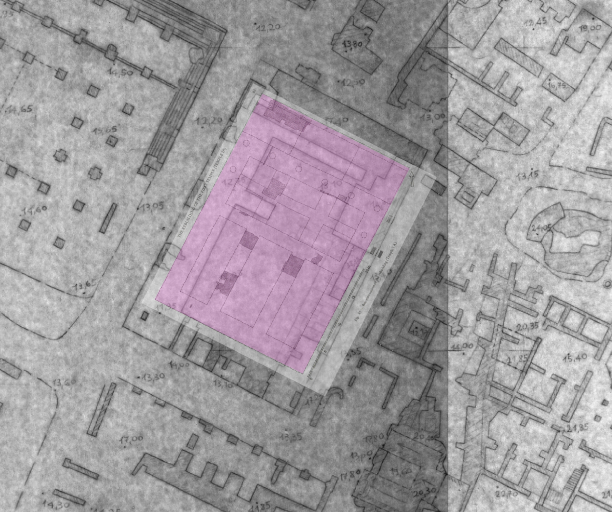
Sources
Plan: Nielen and Poulsen, Fig.61 p.83
Facade: see Tuscan temple rule documentation
Timeline
- 499/496 BCE: Temple is vowed
- 484 BCE: Temple is dedicated
- Between 200 and 117 BCE: Pronaos is reconstructed
- First half of 2nd century BCE: A tribunal is added
- 117 BCE: Temple is restored with the floor raised about 3 meters, but the size kept roughly the same. Tribunal is enlarged, connected to pronaos by stairs.
- 74 BCE: Temple is restored again
- 14/9 BCE: Temple is possibly burned by fire, but sources do not mention this.
- 6 CE: Temple is completely rebuilt by Tiberius. Raised 1 more meter in height. New dimensions of 32.1m x 49.5m. Smaller tribunal, replaced by a wide frontal staircase in Severan times.
- 4th century CE: Temple is ruined by this point.
Physical details
- Slightly sloping ground, 10 m. east of the Cloaca Maxima, roads on 3 sides.
- Visible remains mostly from the Augustan period
- Original temple’s podium partly preserved (27.5m x 37-40m)
- Etruscan style
- 3 rows of 4 columns for its pronaos.
- High podium, 5m up from west, 3.6m up from east.
- Temple oriented N-NE.
- Columns not of marble, since they were later stuccoed.
Literary sources
- Livy book 2 says that Postumius’ son vowed the temple after the Dioscuri appeared there.
- Cicero’s Verrine Orations refer to how Verres was charged with restoring the temple in 74 BCE.
- Cass. Dio 55.27.4
- Cic. nat. deor. 3.13; Scaur. 46; Verr. II 1.129-134, II 3.41, II 5.186
- Dion. Hal. ant. rom. 6.13
- Liv. 2.20.12, 2.42.5
- Mart. 1.70.3-6
- Plut. Cor. 3.4
- Suet. Tib. 20
Aedes Concordiae
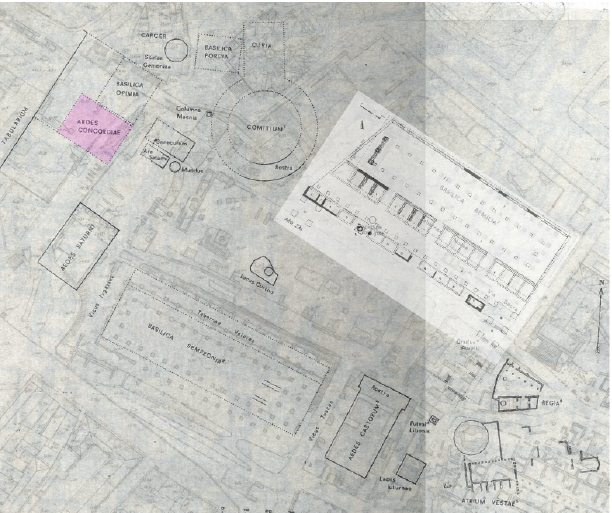
Sources
plan : LTUR II fig.153
facade: see Tuscan Temple rule documentation
Timeline
- 367 BCE: Temple is first vowed by Camillus in 367 BCE, but other structures under the temple date to this time.
- 304 BCE: A cult to Concord is attested, but likely before the temple’s construction.
- 121 BCE: Temple is remade (made?) by L. Opimius after the deaths of the Gracchi.
- 9 BCE: Temple is destroyed by fire or lightning
- 7 BCE-10 CE: Temple is restored (recovered materials confirm this date)
Physical details
- 4 meters in height are preserved, with the structure widening towards the base
\tLocation confirmed by an inscription (northeast area of Forum) - Rectangular room (43.4m x 22.7 m), preceded by a pronaos (25.6m x 14.8m)
- High podium (podio), with a wall around the perimeter in opera quadrata of red tufa
- Access to the temple itself might have been a ramp
Literary sources
- Cass. Dio 56.25.1
- Hist. Aug. Pert. 4.9
- Ov. fast. 1.637-644
- Plin. nat. 34.73, 80, 89, 90; 36.196
- Plut. Cam. 42.4-6
- Serv. Aen. 2.116
- Stat. silv. 1.1.31
- Suet. Tib. 20
- Varro ling. 5.156
- CIL VI 90-94, 2033, 3675a
Aedes Iovis Optimi Maximi
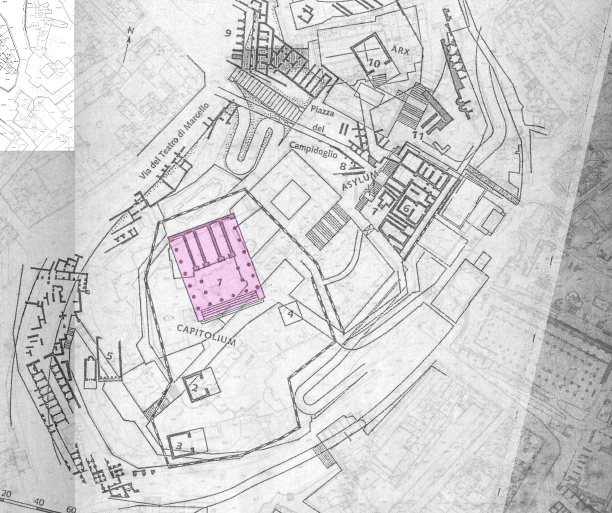
Sources
plan: Coarelli 2007
facade: see Tuscan Temple rule documentation
Timeline
- Reign of Tarquinius Priscus: Temple vowed
- Reign of Tarquinius Superbus: Temple completed
- 83 BCE: Temple burned in a great fire
- 76 BCE: Rebuilt by Q. Catulus
Physical Details
- Had an altar in front consecrated to Jupiter
- North side of the Area Capitolina
- Faced southwest, three rows of columns on the pronaos, one on the side.
- Original temple had a base of cappellaccio blocks, measuring 62.25m x 53.5m
- Oriented along a northeast-southwest axis
- Likely had a 3-layer roof
- Tripartite (Juno, Jupiter, Minerva)
- New temple was tetrastyle and was of the Tuscan order like the archaic temple
- Plin. nat. 36.45 refers to the use of the Corinthian-order marble columns from the peristyle of the Athenian Temple of Olympian Zeus, taken in the sack by Sulla, but the numismatic evidence does not support this.
- New temple had same dimensions and base as original
Literary sources
- App. bell. civ. 1.83
- Cic. Catil. 3.4.9, 3.9; de orat. 3.46.180, Verr. II 4.69
- Dion. Hal. 3.69.3-4, 4.62.5-6
- Liv. 1.38.7, 1.53.2-5 1.55.2-6
- Mart. 5.10.6
- Plin. nat. 33.16, 36.45
- Plut. Publ. 15.1-2
- Sall. Catil. 47.2
- Suet. Aug. 94.8; Jul. 15.1
- Tac. ann. 6.12.3; hist. 3.72.3
- Val. Max. 6.9.5
- Vitruvius 3.3.5
Aedes Iunonis Monetae
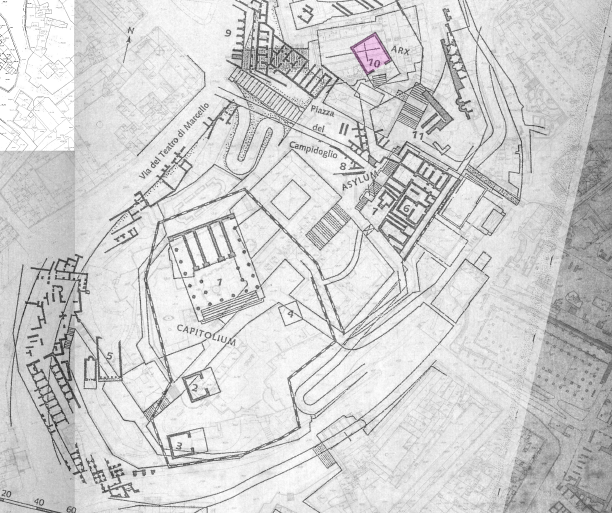
Sources
plan: Coarelli 2007
facade: see Tuscan Temple documentation
Timeline
- 6th century BCE: Initial date for temple?
- After 426 BCE: Second building phase
- 345 BCE: Temple is vowed by Camillus (literary tradition)
- 344 BCE: Temple is dedicated by the two consuls (literary tradition)
Physical Details
- The materials found in this location are of various types and from different eras
- Some leftovers are in opera quadrata
- One discovered wall suggests two building phases, one in cappellaccio, the other in tufo di Fidene. 29.6 meters of length are preserved.
- Altogether, the archaeological remains suggest a rectangle of 25 meters by 29.6 meters (and it is likely that these walls were for a temple rather than a fortification wall, as had previously been assumed).
- The cappellaccio suggests an initial date of the 6th century BCE, while the tufo suggests the second building phase was after 426 BCE (when the Romans conquered Fidene). The south side does not seem to have been changed, though the north side seems to have been lengthened.
- Internal cement suggests a third phase of reconstruction.
Literary Sources
- Cic. dom. 38.101
- Liv. 7.28.4-6 (source for dedication of the temple)
- Ov. fast. 6.183-185
Aedes Saturni
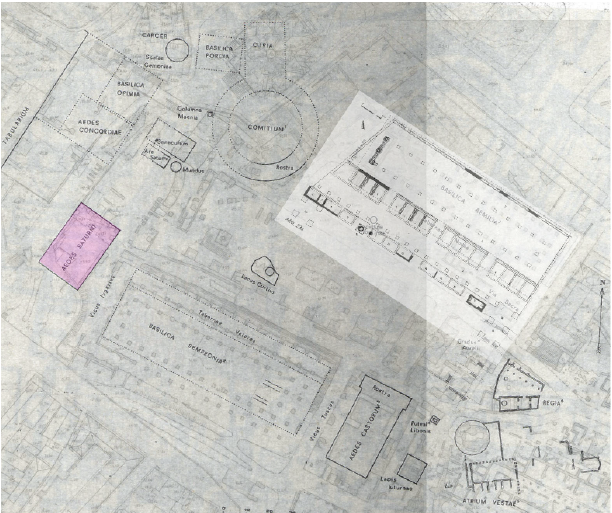
Sources:
plan: LTUR II fig. 153
facade: see Tuscan temple documentation (210 BC and 160 BC)
Timeline
- 501/498-497 BCE: Temple is built
- 381-370 BCE: Temple is restored following its destruction in the Gallic fire
- 174 BCE: Surrounding area is completely reworked
- 42 BCE: Further work done to the temple
- 2nd half of 4th century CE: A frontal colonnade is added
Physical Details
- The old dimensions (by 42 BCE) were at most 11m in height, and 24m x 33m at its base.
Literary Sources
- Dion. Hal. 6.1.4
- Liv. 2.21.1, 41.27.7
- Macr. Sat. 1.8.1
Aedes Veiovis
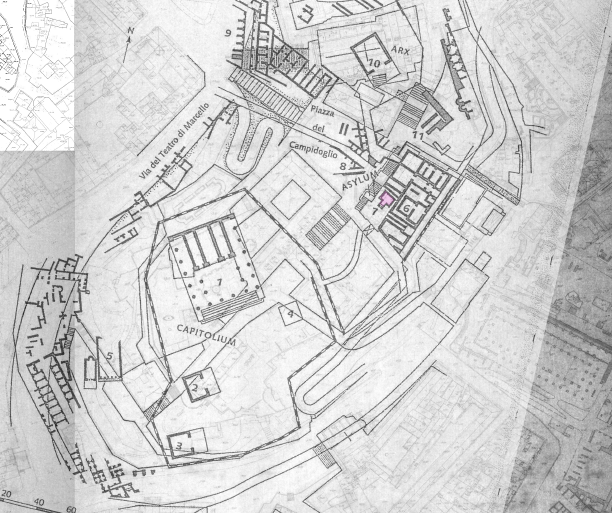
Sources
plan: Coarelli 2007
facade: see Tuscan Temple Documentation
Timeline
- 200-192 BCE: Temple is built
Physical Details
- Its existence is generally accepted.
- Its existence is based on an emendation to Livy (who otherwise has 2 temples dedicated to Jupiter in the same year)
- Ovid and Vitruvius refer to a temple of Jupiter that scholars often assume is this one.
Literary Sources
- Liv. 31.21.12, 34.53.7, 35.41.8
- Ov. fast. 1.289-294
- Vitruvius 3.2.3
Aedes Vestae
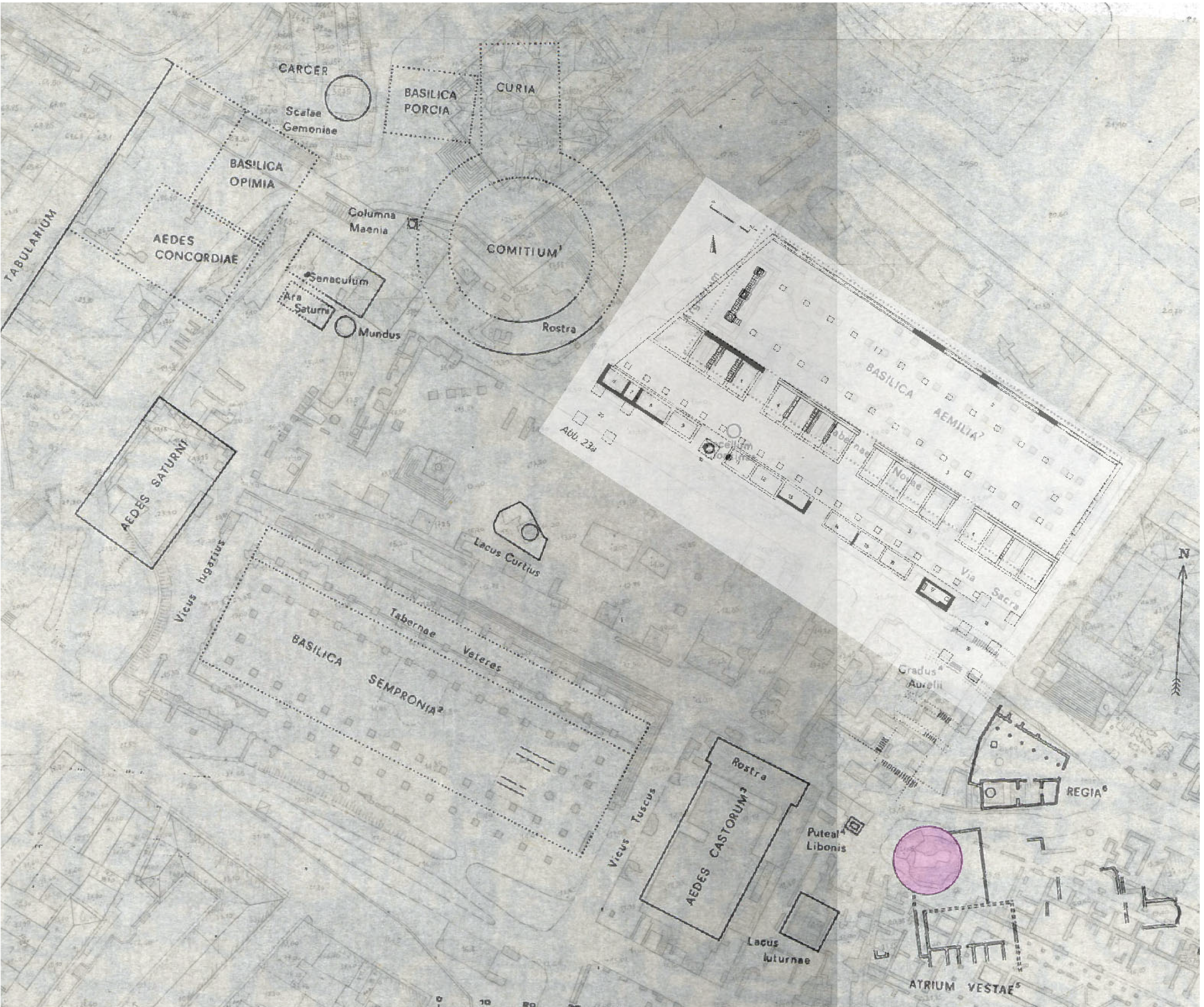
Sources
LTUR 153
Timeline
- Regal Period: Temple is built
- 241 BCE: Temple burns
- 210 BCE: Temple is further damaged by a fire
- Late 3rd/early 2nd century: Temple is restored
- 1st century BCE: The top of the temple is rebuilt
- 64 CE: Temple burns
- 191 CE: Temple is burned by another fire, though many elements seem to have survived based on reliefs and fragments of panels from Trajan’s time.
Physical evidence
- Eastern end of Roman forum.
- Circular form
- Ionic order (under Trajan and in 1st c. BCE)
- Remains of a podium of Aniene tuda (1.5m tall, perhaps)
- Consistent shape and location over all time periods. Height modified (increased in 1st c. BCE and under Trajan), as shown by elevation of podium.
Literary sources
- Dion. Hal. 2.64.5-66, 6.13
- Fest. 320 L
- Hor. sat. 1.9.1-43
- Liv. perioch. 19
- Ov. Fas. 6.297 (suggesting the shape was based on that of 8th-7th c. BCE huts)
- Mart. 1.70.3-4
- Plut. Numa 2
Basilica Fulvia-Aemilia
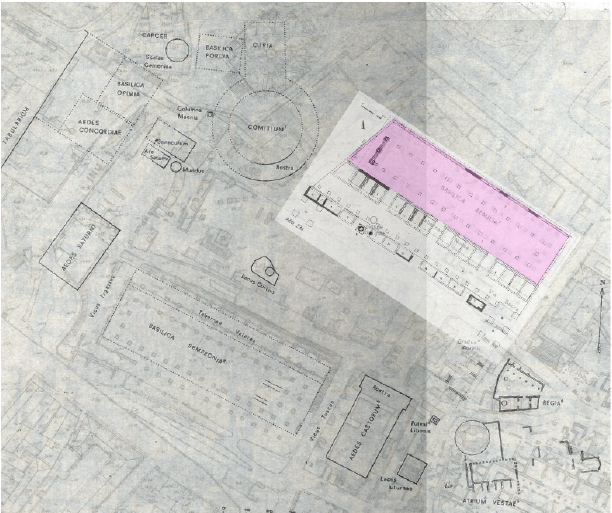
Sources
plan: Freyberger, Fig.23a
facade: Atlante di Roma, Tav. 24 and Brown, Fig. 70b.
See also documentation of the basilica rule.
Related Buildings
Tabernae Novae
Timeline
- 210-191 BCE: A basilica is build in the northeast location after the fire of 210.
- 179 BCE: Livy claims the Basilica is built
- 166 BCE: Latest possible date for construction of Basilica Fulvia if they are separate
- 159 BCE: Latest possible date for construction of Basilica Aemilia if they are separate
- 78 BCE: If separate, Basilica Aemilia may have been reconstructed
- 55 BCE: Basilica Fulvia constructed according to Plutarch
- 54/50 BCE: Work done on the building’s columns by L. Aemilius Paullus Lepidus
Physical evidence
- The Basilica Fulvia and Aemilia are associated together in part due to a quote from Varro (ling. 6.4), though the text is full of lacunae and may be corrupted. The double name could be because it was originally worked on by M. Fulvius Nobilior; after his death, his colleague M. Aemilius Lepidus took over.
- On the other hand, Plutarch Caes. 29 suggests that these were 2 distinct structures.
- See Fuchs, Architekturdarstellungen, 49, 50 for the Basilica Aemilia
- Building is a stoa with a double row of columns.
- Located in the northeast side of the Forum if a joint building
- If separate, the Basilica Aemilia was in the southeast corner, perhaps. Three long walls of the structure here are preserved
- Northeast building (Basilica Fulvia) had blocks of tufa; built on tabernae
Literary sources
- Cic. Att. 4.16.8 (suggests work done on the building by L. Aemilius Paullus Lepidus)
- Plut. Caes. 29
- Var. ling. 6.4
Basilica Porcia
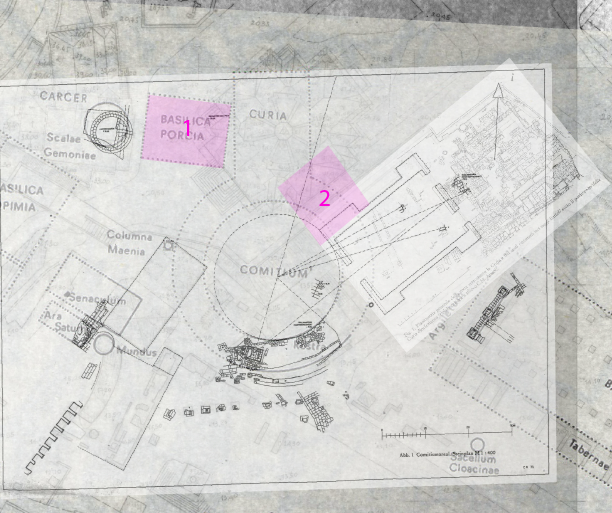
Sources
Plan:
Location 1: LTUR II fig. 153
Location 2: contingent on site of Curia Hostilia (location 2)
Facade: See basilica rule documentation
Timeline
- 184 BCE: Cato the Elder makes this building as a censorial monument
- Sullan era: hypothetical reconstruction
- Destroyed in the fire of 52 BCE
Physical evidence
- Built on top of the Curia, next to the Forum
- Digs have discovered extended framework running from north to south in opus incertum, with a column base preserved in the northeast corner.
- This may not be from the original structure but from a hypothetical Sullan reconstruction, however.
Literary sources
- Ascon. Mil. 2.34
- Liv. 39.44.7ff
- Plut. Cato mai. 19.3, Cato min. 5.1
Basilica Sempronia
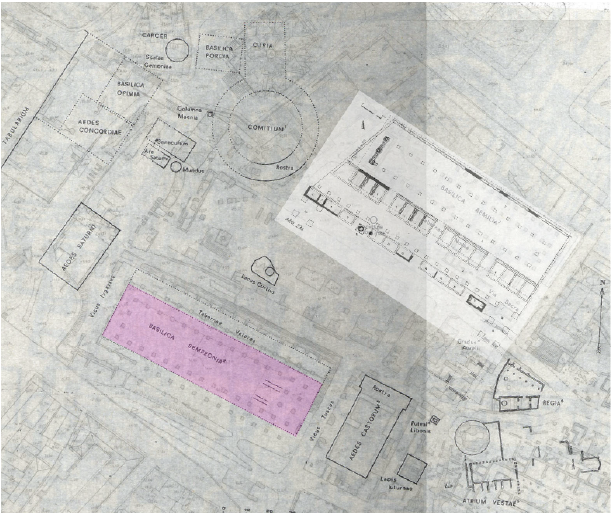
Sources
plan: LTUR II fig.153
facade: Atlante di Roma, Tav. 24 and Brown, Fig. 70b.
See also documentation of the basilica rule.
Timeline
- c. 169 BCE: Basilica built
- 46 BCE: Replaced with the Basilica Julia
Physical evidence
- Remains found under the Basilica Julia
- Foundation walls in opera quadrata of tufa from the Grotta Oscura
Literary sources
- Liv. 44.16.10
Related Buildings
Tabernae Veteres
Carcer
Curia Hostilia
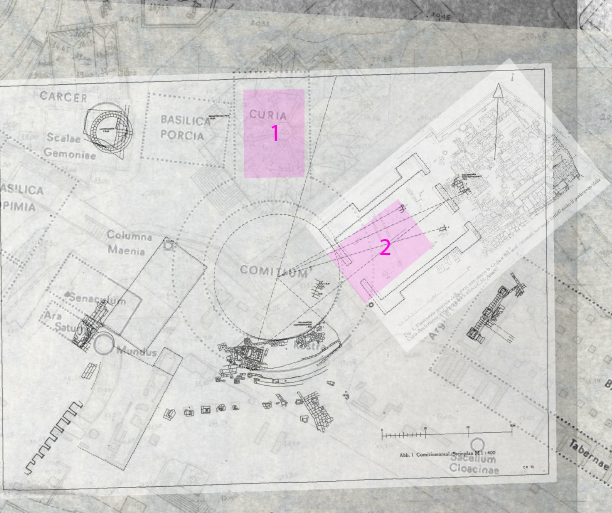
Sources
Location 1: LTUR II fig. 153
Location 2: Carafa-Krause, p.4; Amici 2007 Scavo – p.82
Timeline
- Reign of Tullus Hostilius: Temple is supposedly built
- 81 BCE: Reconstructed by Sulla to be larger
- 52 BCE: Reconstructed by Sulla’s son
- 43 BCE: Temporarily worked on by decree of Senate
Literary sources
- Cass. Dio 44.5, 45.17.8
- Cic. fin. 5.2, rep. 2.17.31
- Gell. 14.7.7
- Liv. 1.30
- Plin. nat. 7.212 (demonstrates the location of the Curia, probably based on Varro)
- Var. ling. 5.155 (for the origin of the name)
Domus
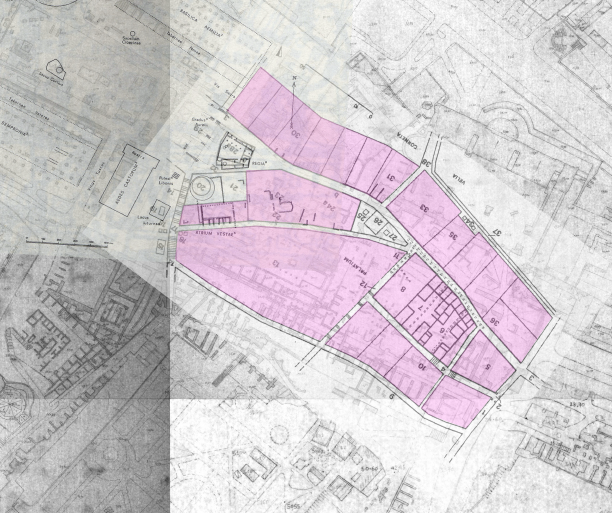
Rostra
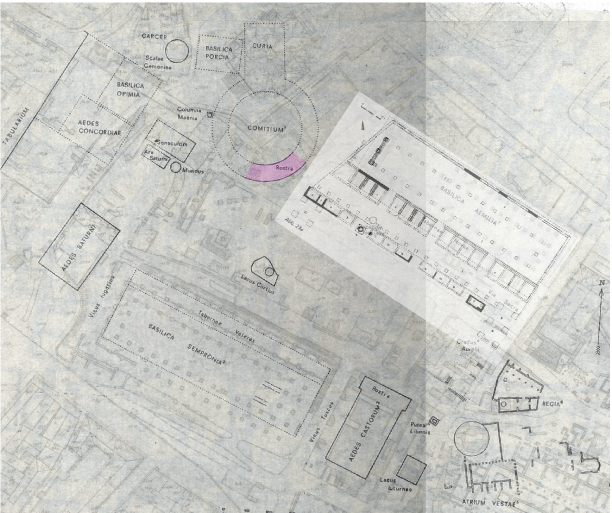
Source
LTUR II Fig 153
Timeline
- Late 6th/early 5th century: First building phase of this structure
- 338 BCE: Structure given its name
- 310-300 BCE: Second building phase
- c. 263 BCE: Comitium is changed, Rostra takes the shape of a circular arc.
- 80 BCE: Sulla raises the entire area with new paving and has a statue of himself placed on it or in front of it
- 45/44 BCE: Rostra is destroyed, reconstructed in a different position.
Physical evidence
- Statues were added of magistrates over time, generally those killed in violation of the ius gentium.
Literary sources
- Cic. Balb. 53
- Dion. Hal. 3.71.2
- Liv. 4.17.6, 8.14.12 (the former anachronistically uses the name Rostra to refer to the structure before it got its name, the latter tells the story of how the structure got its name)
- Plin. nat. 7.212
- Plut. Cato min. 44.1-4
- Varro ling. 5.155
Tabernae Novae
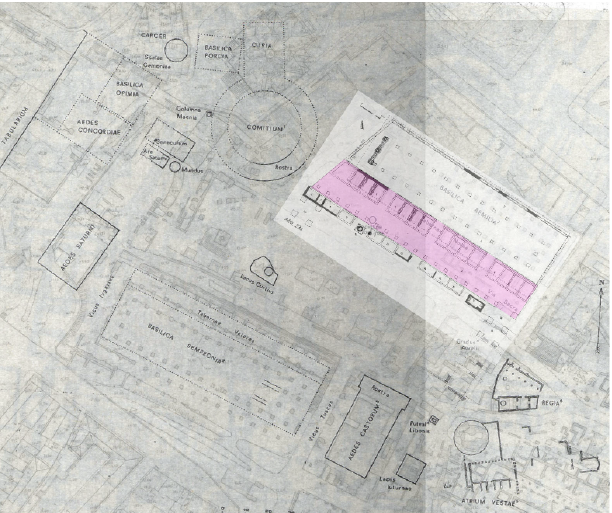
Sources
plan: Freyberger, Fig.23a
Related Buildings
Basilica Fulvia-Aemilia
Timeline
- 210 BCE: Fire destroys the Tabernae Argentariae
- 209 BCE: Likely rebuilt as the Tabernae Novae
- 192 BCE: Tabernae Novae rebuilt according to Ashby
Physical evidence
- The Tabernae Argentariae after they were restored from the fire of 210 BCE
- North side of the plaza near the Sacrum Cloacinae
- Right before the Basilica Fulvia(-Aemilia)
Literary sources
- Liv. 3.48.5, 26.27.2, 27.11.16
- Var. ling. 6.59
Tabernae Veteres
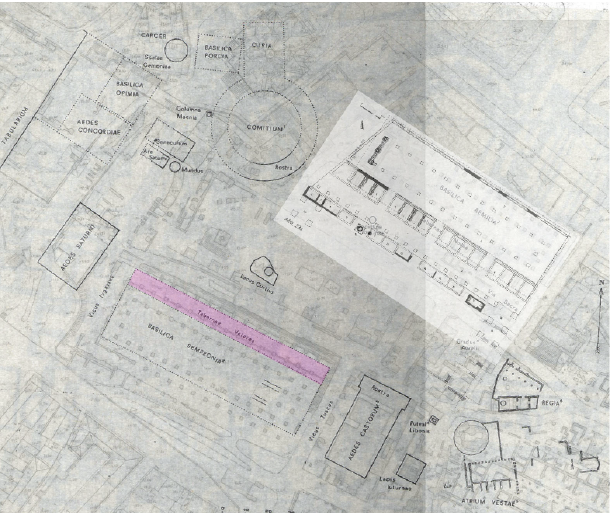
Sources
Plan: LTUR II fig.153
Related Buildings
Basilica Sempronia
Timeline
- Regal period: Tabernae Veteres likely built
- 54 BCE: Tabernae Veteres destroyed by this point by the building of the Basilica Iulia
Physical evidence
- A set of tabernae along the southern side of the Forum
- Located near the Basilica Sempronia
Literary sources
- Liv. 44.10.10-11
- Plaut. Curc. 480 (oldest mention)

Sources
Plan: Nielen and Poulsen, Fig.61 p.83
Facade: see Tuscan temple rule documentation
Timeline
- 499/496 BCE: Temple is vowed
- 484 BCE: Temple is dedicated
- Between 200 and 117 BCE: Pronaos is reconstructed
- First half of 2nd century BCE: A tribunal is added
- 117 BCE: Temple is restored with the floor raised about 3 meters, but the size kept roughly the same. Tribunal is enlarged, connected to pronaos by stairs.
- 74 BCE: Temple is restored again
- 14/9 BCE: Temple is possibly burned by fire, but sources do not mention this.
- 6 CE: Temple is completely rebuilt by Tiberius. Raised 1 more meter in height. New dimensions of 32.1m x 49.5m. Smaller tribunal, replaced by a wide frontal staircase in Severan times.
- 4th century CE: Temple is ruined by this point.
Physical details
- Slightly sloping ground, 10 m. east of the Cloaca Maxima, roads on 3 sides.
- Visible remains mostly from the Augustan period
- Original temple’s podium partly preserved (27.5m x 37-40m)
- Etruscan style
- 3 rows of 4 columns for its pronaos.
- High podium, 5m up from west, 3.6m up from east.
- Temple oriented N-NE.
- Columns not of marble, since they were later stuccoed.
Literary sources
- Livy book 2 says that Postumius’ son vowed the temple after the Dioscuri appeared there.
- Cicero’s Verrine Orations refer to how Verres was charged with restoring the temple in 74 BCE.
- Cass. Dio 55.27.4
- Cic. nat. deor. 3.13; Scaur. 46; Verr. II 1.129-134, II 3.41, II 5.186
- Dion. Hal. ant. rom. 6.13
- Liv. 2.20.12, 2.42.5
- Mart. 1.70.3-6
- Plut. Cor. 3.4
- Suet. Tib. 20
Aedes Concordiae
Sources
plan : LTUR II fig.153
facade: see Tuscan Temple rule documentation
Timeline
- 367 BCE: Temple is first vowed by Camillus in 367 BCE, but other structures under the temple date to this time.
- 304 BCE: A cult to Concord is attested, but likely before the temple’s construction.
- 121 BCE: Temple is remade (made?) by L. Opimius after the deaths of the Gracchi.
- 9 BCE: Temple is destroyed by fire or lightning
- 7 BCE-10 CE: Temple is restored (recovered materials confirm this date)
Physical details
- 4 meters in height are preserved, with the structure widening towards the base
\tLocation confirmed by an inscription (northeast area of Forum) - Rectangular room (43.4m x 22.7 m), preceded by a pronaos (25.6m x 14.8m)
- High podium (podio), with a wall around the perimeter in opera quadrata of red tufa
- Access to the temple itself might have been a ramp
Literary sources
- Cass. Dio 56.25.1
- Hist. Aug. Pert. 4.9
- Ov. fast. 1.637-644
- Plin. nat. 34.73, 80, 89, 90; 36.196
- Plut. Cam. 42.4-6
- Serv. Aen. 2.116
- Stat. silv. 1.1.31
- Suet. Tib. 20
- Varro ling. 5.156
- CIL VI 90-94, 2033, 3675a
Aedes Iovis Optimi Maximi
Sources
plan: Coarelli 2007
facade: see Tuscan Temple rule documentation
Timeline
- Reign of Tarquinius Priscus: Temple vowed
- Reign of Tarquinius Superbus: Temple completed
- 83 BCE: Temple burned in a great fire
- 76 BCE: Rebuilt by Q. Catulus
Physical Details
- Had an altar in front consecrated to Jupiter
- North side of the Area Capitolina
- Faced southwest, three rows of columns on the pronaos, one on the side.
- Original temple had a base of cappellaccio blocks, measuring 62.25m x 53.5m
- Oriented along a northeast-southwest axis
- Likely had a 3-layer roof
- Tripartite (Juno, Jupiter, Minerva)
- New temple was tetrastyle and was of the Tuscan order like the archaic temple
- Plin. nat. 36.45 refers to the use of the Corinthian-order marble columns from the peristyle of the Athenian Temple of Olympian Zeus, taken in the sack by Sulla, but the numismatic evidence does not support this.
- New temple had same dimensions and base as original
Literary sources
- App. bell. civ. 1.83
- Cic. Catil. 3.4.9, 3.9; de orat. 3.46.180, Verr. II 4.69
- Dion. Hal. 3.69.3-4, 4.62.5-6
- Liv. 1.38.7, 1.53.2-5 1.55.2-6
- Mart. 5.10.6
- Plin. nat. 33.16, 36.45
- Plut. Publ. 15.1-2
- Sall. Catil. 47.2
- Suet. Aug. 94.8; Jul. 15.1
- Tac. ann. 6.12.3; hist. 3.72.3
- Val. Max. 6.9.5
- Vitruvius 3.3.5
Aedes Iunonis Monetae
Sources
plan: Coarelli 2007
facade: see Tuscan Temple documentation
Timeline
- 6th century BCE: Initial date for temple?
- After 426 BCE: Second building phase
- 345 BCE: Temple is vowed by Camillus (literary tradition)
- 344 BCE: Temple is dedicated by the two consuls (literary tradition)
Physical Details
- The materials found in this location are of various types and from different eras
- Some leftovers are in opera quadrata
- One discovered wall suggests two building phases, one in cappellaccio, the other in tufo di Fidene. 29.6 meters of length are preserved.
- Altogether, the archaeological remains suggest a rectangle of 25 meters by 29.6 meters (and it is likely that these walls were for a temple rather than a fortification wall, as had previously been assumed).
- The cappellaccio suggests an initial date of the 6th century BCE, while the tufo suggests the second building phase was after 426 BCE (when the Romans conquered Fidene). The south side does not seem to have been changed, though the north side seems to have been lengthened.
- Internal cement suggests a third phase of reconstruction.
Literary Sources
- Cic. dom. 38.101
- Liv. 7.28.4-6 (source for dedication of the temple)
- Ov. fast. 6.183-185
Aedes Saturni
Sources:
plan: LTUR II fig. 153
facade: see Tuscan temple documentation (210 BC and 160 BC)
Timeline
- 501/498-497 BCE: Temple is built
- 381-370 BCE: Temple is restored following its destruction in the Gallic fire
- 174 BCE: Surrounding area is completely reworked
- 42 BCE: Further work done to the temple
- 2nd half of 4th century CE: A frontal colonnade is added
Physical Details
- The old dimensions (by 42 BCE) were at most 11m in height, and 24m x 33m at its base.
Literary Sources
- Dion. Hal. 6.1.4
- Liv. 2.21.1, 41.27.7
- Macr. Sat. 1.8.1
Aedes Veiovis
Sources
plan: Coarelli 2007
facade: see Tuscan Temple Documentation
Timeline
- 200-192 BCE: Temple is built
Physical Details
- Its existence is generally accepted.
- Its existence is based on an emendation to Livy (who otherwise has 2 temples dedicated to Jupiter in the same year)
- Ovid and Vitruvius refer to a temple of Jupiter that scholars often assume is this one.
Literary Sources
- Liv. 31.21.12, 34.53.7, 35.41.8
- Ov. fast. 1.289-294
- Vitruvius 3.2.3
Aedes Vestae
Sources
LTUR 153
Timeline
- Regal Period: Temple is built
- 241 BCE: Temple burns
- 210 BCE: Temple is further damaged by a fire
- Late 3rd/early 2nd century: Temple is restored
- 1st century BCE: The top of the temple is rebuilt
- 64 CE: Temple burns
- 191 CE: Temple is burned by another fire, though many elements seem to have survived based on reliefs and fragments of panels from Trajan’s time.
Physical evidence
- Eastern end of Roman forum.
- Circular form
- Ionic order (under Trajan and in 1st c. BCE)
- Remains of a podium of Aniene tuda (1.5m tall, perhaps)
- Consistent shape and location over all time periods. Height modified (increased in 1st c. BCE and under Trajan), as shown by elevation of podium.
Literary sources
- Dion. Hal. 2.64.5-66, 6.13
- Fest. 320 L
- Hor. sat. 1.9.1-43
- Liv. perioch. 19
- Ov. Fas. 6.297 (suggesting the shape was based on that of 8th-7th c. BCE huts)
- Mart. 1.70.3-4
- Plut. Numa 2
Basilica Fulvia-Aemilia
Sources
plan: Freyberger, Fig.23a
facade: Atlante di Roma, Tav. 24 and Brown, Fig. 70b.
See also documentation of the basilica rule.
Related Buildings
Tabernae Novae
Timeline
- 210-191 BCE: A basilica is build in the northeast location after the fire of 210.
- 179 BCE: Livy claims the Basilica is built
- 166 BCE: Latest possible date for construction of Basilica Fulvia if they are separate
- 159 BCE: Latest possible date for construction of Basilica Aemilia if they are separate
- 78 BCE: If separate, Basilica Aemilia may have been reconstructed
- 55 BCE: Basilica Fulvia constructed according to Plutarch
- 54/50 BCE: Work done on the building’s columns by L. Aemilius Paullus Lepidus
Physical evidence
- The Basilica Fulvia and Aemilia are associated together in part due to a quote from Varro (ling. 6.4), though the text is full of lacunae and may be corrupted. The double name could be because it was originally worked on by M. Fulvius Nobilior; after his death, his colleague M. Aemilius Lepidus took over.
- On the other hand, Plutarch Caes. 29 suggests that these were 2 distinct structures.
- See Fuchs, Architekturdarstellungen, 49, 50 for the Basilica Aemilia
- Building is a stoa with a double row of columns.
- Located in the northeast side of the Forum if a joint building
- If separate, the Basilica Aemilia was in the southeast corner, perhaps. Three long walls of the structure here are preserved
- Northeast building (Basilica Fulvia) had blocks of tufa; built on tabernae
Literary sources
- Cic. Att. 4.16.8 (suggests work done on the building by L. Aemilius Paullus Lepidus)
- Plut. Caes. 29
- Var. ling. 6.4
Basilica Porcia
Sources
Plan:
Location 1: LTUR II fig. 153
Location 2: contingent on site of Curia Hostilia (location 2)
Facade: See basilica rule documentation
Timeline
- 184 BCE: Cato the Elder makes this building as a censorial monument
- Sullan era: hypothetical reconstruction
- Destroyed in the fire of 52 BCE
Physical evidence
- Built on top of the Curia, next to the Forum
- Digs have discovered extended framework running from north to south in opus incertum, with a column base preserved in the northeast corner.
- This may not be from the original structure but from a hypothetical Sullan reconstruction, however.
Literary sources
- Ascon. Mil. 2.34
- Liv. 39.44.7ff
- Plut. Cato mai. 19.3, Cato min. 5.1
Basilica Sempronia
Sources
plan: LTUR II fig.153
facade: Atlante di Roma, Tav. 24 and Brown, Fig. 70b.
See also documentation of the basilica rule.
Timeline
- c. 169 BCE: Basilica built
- 46 BCE: Replaced with the Basilica Julia
Physical evidence
- Remains found under the Basilica Julia
- Foundation walls in opera quadrata of tufa from the Grotta Oscura
Literary sources
- Liv. 44.16.10
Related Buildings
Tabernae Veteres
Carcer
Curia Hostilia
Sources
Location 1: LTUR II fig. 153
Location 2: Carafa-Krause, p.4; Amici 2007 Scavo – p.82
Timeline
- Reign of Tullus Hostilius: Temple is supposedly built
- 81 BCE: Reconstructed by Sulla to be larger
- 52 BCE: Reconstructed by Sulla’s son
- 43 BCE: Temporarily worked on by decree of Senate
Literary sources
- Cass. Dio 44.5, 45.17.8
- Cic. fin. 5.2, rep. 2.17.31
- Gell. 14.7.7
- Liv. 1.30
- Plin. nat. 7.212 (demonstrates the location of the Curia, probably based on Varro)
- Var. ling. 5.155 (for the origin of the name)
Domus
Rostra
Source
LTUR II Fig 153
Timeline
- Late 6th/early 5th century: First building phase of this structure
- 338 BCE: Structure given its name
- 310-300 BCE: Second building phase
- c. 263 BCE: Comitium is changed, Rostra takes the shape of a circular arc.
- 80 BCE: Sulla raises the entire area with new paving and has a statue of himself placed on it or in front of it
- 45/44 BCE: Rostra is destroyed, reconstructed in a different position.
Physical evidence
- Statues were added of magistrates over time, generally those killed in violation of the ius gentium.
Literary sources
- Cic. Balb. 53
- Dion. Hal. 3.71.2
- Liv. 4.17.6, 8.14.12 (the former anachronistically uses the name Rostra to refer to the structure before it got its name, the latter tells the story of how the structure got its name)
- Plin. nat. 7.212
- Plut. Cato min. 44.1-4
- Varro ling. 5.155
Tabernae Novae
Sources
plan: Freyberger, Fig.23a
Related Buildings
Basilica Fulvia-Aemilia
Timeline
- 210 BCE: Fire destroys the Tabernae Argentariae
- 209 BCE: Likely rebuilt as the Tabernae Novae
- 192 BCE: Tabernae Novae rebuilt according to Ashby
Physical evidence
- The Tabernae Argentariae after they were restored from the fire of 210 BCE
- North side of the plaza near the Sacrum Cloacinae
- Right before the Basilica Fulvia(-Aemilia)
Literary sources
- Liv. 3.48.5, 26.27.2, 27.11.16
- Var. ling. 6.59
Tabernae Veteres
Sources
Plan: LTUR II fig.153
Related Buildings
Basilica Sempronia
Timeline
- Regal period: Tabernae Veteres likely built
- 54 BCE: Tabernae Veteres destroyed by this point by the building of the Basilica Iulia
Physical evidence
- A set of tabernae along the southern side of the Forum
- Located near the Basilica Sempronia
Literary sources
- Liv. 44.10.10-11
- Plaut. Curc. 480 (oldest mention)
Sources
plan : LTUR II fig.153
facade: see Tuscan Temple rule documentation
Timeline
- 367 BCE: Temple is first vowed by Camillus in 367 BCE, but other structures under the temple date to this time.
- 304 BCE: A cult to Concord is attested, but likely before the temple’s construction.
- 121 BCE: Temple is remade (made?) by L. Opimius after the deaths of the Gracchi.
- 9 BCE: Temple is destroyed by fire or lightning
- 7 BCE-10 CE: Temple is restored (recovered materials confirm this date)
Physical details
- 4 meters in height are preserved, with the structure widening towards the base
\tLocation confirmed by an inscription (northeast area of Forum) - Rectangular room (43.4m x 22.7 m), preceded by a pronaos (25.6m x 14.8m)
- High podium (podio), with a wall around the perimeter in opera quadrata of red tufa
- Access to the temple itself might have been a ramp
Literary sources
- Cass. Dio 56.25.1
- Hist. Aug. Pert. 4.9
- Ov. fast. 1.637-644
- Plin. nat. 34.73, 80, 89, 90; 36.196
- Plut. Cam. 42.4-6
- Serv. Aen. 2.116
- Stat. silv. 1.1.31
- Suet. Tib. 20
- Varro ling. 5.156
- CIL VI 90-94, 2033, 3675a
Aedes Iovis Optimi Maximi
Sources
plan: Coarelli 2007
facade: see Tuscan Temple rule documentation
Timeline
- Reign of Tarquinius Priscus: Temple vowed
- Reign of Tarquinius Superbus: Temple completed
- 83 BCE: Temple burned in a great fire
- 76 BCE: Rebuilt by Q. Catulus
Physical Details
- Had an altar in front consecrated to Jupiter
- North side of the Area Capitolina
- Faced southwest, three rows of columns on the pronaos, one on the side.
- Original temple had a base of cappellaccio blocks, measuring 62.25m x 53.5m
- Oriented along a northeast-southwest axis
- Likely had a 3-layer roof
- Tripartite (Juno, Jupiter, Minerva)
- New temple was tetrastyle and was of the Tuscan order like the archaic temple
- Plin. nat. 36.45 refers to the use of the Corinthian-order marble columns from the peristyle of the Athenian Temple of Olympian Zeus, taken in the sack by Sulla, but the numismatic evidence does not support this.
- New temple had same dimensions and base as original
Literary sources
- App. bell. civ. 1.83
- Cic. Catil. 3.4.9, 3.9; de orat. 3.46.180, Verr. II 4.69
- Dion. Hal. 3.69.3-4, 4.62.5-6
- Liv. 1.38.7, 1.53.2-5 1.55.2-6
- Mart. 5.10.6
- Plin. nat. 33.16, 36.45
- Plut. Publ. 15.1-2
- Sall. Catil. 47.2
- Suet. Aug. 94.8; Jul. 15.1
- Tac. ann. 6.12.3; hist. 3.72.3
- Val. Max. 6.9.5
- Vitruvius 3.3.5
Aedes Iunonis Monetae
Sources
plan: Coarelli 2007
facade: see Tuscan Temple documentation
Timeline
- 6th century BCE: Initial date for temple?
- After 426 BCE: Second building phase
- 345 BCE: Temple is vowed by Camillus (literary tradition)
- 344 BCE: Temple is dedicated by the two consuls (literary tradition)
Physical Details
- The materials found in this location are of various types and from different eras
- Some leftovers are in opera quadrata
- One discovered wall suggests two building phases, one in cappellaccio, the other in tufo di Fidene. 29.6 meters of length are preserved.
- Altogether, the archaeological remains suggest a rectangle of 25 meters by 29.6 meters (and it is likely that these walls were for a temple rather than a fortification wall, as had previously been assumed).
- The cappellaccio suggests an initial date of the 6th century BCE, while the tufo suggests the second building phase was after 426 BCE (when the Romans conquered Fidene). The south side does not seem to have been changed, though the north side seems to have been lengthened.
- Internal cement suggests a third phase of reconstruction.
Literary Sources
- Cic. dom. 38.101
- Liv. 7.28.4-6 (source for dedication of the temple)
- Ov. fast. 6.183-185
Aedes Saturni
Sources:
plan: LTUR II fig. 153
facade: see Tuscan temple documentation (210 BC and 160 BC)
Timeline
- 501/498-497 BCE: Temple is built
- 381-370 BCE: Temple is restored following its destruction in the Gallic fire
- 174 BCE: Surrounding area is completely reworked
- 42 BCE: Further work done to the temple
- 2nd half of 4th century CE: A frontal colonnade is added
Physical Details
- The old dimensions (by 42 BCE) were at most 11m in height, and 24m x 33m at its base.
Literary Sources
- Dion. Hal. 6.1.4
- Liv. 2.21.1, 41.27.7
- Macr. Sat. 1.8.1
Aedes Veiovis
Sources
plan: Coarelli 2007
facade: see Tuscan Temple Documentation
Timeline
- 200-192 BCE: Temple is built
Physical Details
- Its existence is generally accepted.
- Its existence is based on an emendation to Livy (who otherwise has 2 temples dedicated to Jupiter in the same year)
- Ovid and Vitruvius refer to a temple of Jupiter that scholars often assume is this one.
Literary Sources
- Liv. 31.21.12, 34.53.7, 35.41.8
- Ov. fast. 1.289-294
- Vitruvius 3.2.3
Aedes Vestae
Sources
LTUR 153
Timeline
- Regal Period: Temple is built
- 241 BCE: Temple burns
- 210 BCE: Temple is further damaged by a fire
- Late 3rd/early 2nd century: Temple is restored
- 1st century BCE: The top of the temple is rebuilt
- 64 CE: Temple burns
- 191 CE: Temple is burned by another fire, though many elements seem to have survived based on reliefs and fragments of panels from Trajan’s time.
Physical evidence
- Eastern end of Roman forum.
- Circular form
- Ionic order (under Trajan and in 1st c. BCE)
- Remains of a podium of Aniene tuda (1.5m tall, perhaps)
- Consistent shape and location over all time periods. Height modified (increased in 1st c. BCE and under Trajan), as shown by elevation of podium.
Literary sources
- Dion. Hal. 2.64.5-66, 6.13
- Fest. 320 L
- Hor. sat. 1.9.1-43
- Liv. perioch. 19
- Ov. Fas. 6.297 (suggesting the shape was based on that of 8th-7th c. BCE huts)
- Mart. 1.70.3-4
- Plut. Numa 2
Basilica Fulvia-Aemilia
Sources
plan: Freyberger, Fig.23a
facade: Atlante di Roma, Tav. 24 and Brown, Fig. 70b.
See also documentation of the basilica rule.
Related Buildings
Tabernae Novae
Timeline
- 210-191 BCE: A basilica is build in the northeast location after the fire of 210.
- 179 BCE: Livy claims the Basilica is built
- 166 BCE: Latest possible date for construction of Basilica Fulvia if they are separate
- 159 BCE: Latest possible date for construction of Basilica Aemilia if they are separate
- 78 BCE: If separate, Basilica Aemilia may have been reconstructed
- 55 BCE: Basilica Fulvia constructed according to Plutarch
- 54/50 BCE: Work done on the building’s columns by L. Aemilius Paullus Lepidus
Physical evidence
- The Basilica Fulvia and Aemilia are associated together in part due to a quote from Varro (ling. 6.4), though the text is full of lacunae and may be corrupted. The double name could be because it was originally worked on by M. Fulvius Nobilior; after his death, his colleague M. Aemilius Lepidus took over.
- On the other hand, Plutarch Caes. 29 suggests that these were 2 distinct structures.
- See Fuchs, Architekturdarstellungen, 49, 50 for the Basilica Aemilia
- Building is a stoa with a double row of columns.
- Located in the northeast side of the Forum if a joint building
- If separate, the Basilica Aemilia was in the southeast corner, perhaps. Three long walls of the structure here are preserved
- Northeast building (Basilica Fulvia) had blocks of tufa; built on tabernae
Literary sources
- Cic. Att. 4.16.8 (suggests work done on the building by L. Aemilius Paullus Lepidus)
- Plut. Caes. 29
- Var. ling. 6.4
Basilica Porcia
Sources
Plan:
Location 1: LTUR II fig. 153
Location 2: contingent on site of Curia Hostilia (location 2)
Facade: See basilica rule documentation
Timeline
- 184 BCE: Cato the Elder makes this building as a censorial monument
- Sullan era: hypothetical reconstruction
- Destroyed in the fire of 52 BCE
Physical evidence
- Built on top of the Curia, next to the Forum
- Digs have discovered extended framework running from north to south in opus incertum, with a column base preserved in the northeast corner.
- This may not be from the original structure but from a hypothetical Sullan reconstruction, however.
Literary sources
- Ascon. Mil. 2.34
- Liv. 39.44.7ff
- Plut. Cato mai. 19.3, Cato min. 5.1
Basilica Sempronia
Sources
plan: LTUR II fig.153
facade: Atlante di Roma, Tav. 24 and Brown, Fig. 70b.
See also documentation of the basilica rule.
Timeline
- c. 169 BCE: Basilica built
- 46 BCE: Replaced with the Basilica Julia
Physical evidence
- Remains found under the Basilica Julia
- Foundation walls in opera quadrata of tufa from the Grotta Oscura
Literary sources
- Liv. 44.16.10
Related Buildings
Tabernae Veteres
Carcer
Curia Hostilia
Sources
Location 1: LTUR II fig. 153
Location 2: Carafa-Krause, p.4; Amici 2007 Scavo – p.82
Timeline
- Reign of Tullus Hostilius: Temple is supposedly built
- 81 BCE: Reconstructed by Sulla to be larger
- 52 BCE: Reconstructed by Sulla’s son
- 43 BCE: Temporarily worked on by decree of Senate
Literary sources
- Cass. Dio 44.5, 45.17.8
- Cic. fin. 5.2, rep. 2.17.31
- Gell. 14.7.7
- Liv. 1.30
- Plin. nat. 7.212 (demonstrates the location of the Curia, probably based on Varro)
- Var. ling. 5.155 (for the origin of the name)
Domus
Rostra
Source
LTUR II Fig 153
Timeline
- Late 6th/early 5th century: First building phase of this structure
- 338 BCE: Structure given its name
- 310-300 BCE: Second building phase
- c. 263 BCE: Comitium is changed, Rostra takes the shape of a circular arc.
- 80 BCE: Sulla raises the entire area with new paving and has a statue of himself placed on it or in front of it
- 45/44 BCE: Rostra is destroyed, reconstructed in a different position.
Physical evidence
- Statues were added of magistrates over time, generally those killed in violation of the ius gentium.
Literary sources
- Cic. Balb. 53
- Dion. Hal. 3.71.2
- Liv. 4.17.6, 8.14.12 (the former anachronistically uses the name Rostra to refer to the structure before it got its name, the latter tells the story of how the structure got its name)
- Plin. nat. 7.212
- Plut. Cato min. 44.1-4
- Varro ling. 5.155
Tabernae Novae
Sources
plan: Freyberger, Fig.23a
Related Buildings
Basilica Fulvia-Aemilia
Timeline
- 210 BCE: Fire destroys the Tabernae Argentariae
- 209 BCE: Likely rebuilt as the Tabernae Novae
- 192 BCE: Tabernae Novae rebuilt according to Ashby
Physical evidence
- The Tabernae Argentariae after they were restored from the fire of 210 BCE
- North side of the plaza near the Sacrum Cloacinae
- Right before the Basilica Fulvia(-Aemilia)
Literary sources
- Liv. 3.48.5, 26.27.2, 27.11.16
- Var. ling. 6.59
Tabernae Veteres
Sources
Plan: LTUR II fig.153
Related Buildings
Basilica Sempronia
Timeline
- Regal period: Tabernae Veteres likely built
- 54 BCE: Tabernae Veteres destroyed by this point by the building of the Basilica Iulia
Physical evidence
- A set of tabernae along the southern side of the Forum
- Located near the Basilica Sempronia
Literary sources
- Liv. 44.10.10-11
- Plaut. Curc. 480 (oldest mention)
Sources
plan: Coarelli 2007
facade: see Tuscan Temple rule documentation
Timeline
- Reign of Tarquinius Priscus: Temple vowed
- Reign of Tarquinius Superbus: Temple completed
- 83 BCE: Temple burned in a great fire
- 76 BCE: Rebuilt by Q. Catulus
Physical Details
- Had an altar in front consecrated to Jupiter
- North side of the Area Capitolina
- Faced southwest, three rows of columns on the pronaos, one on the side.
- Original temple had a base of cappellaccio blocks, measuring 62.25m x 53.5m
- Oriented along a northeast-southwest axis
- Likely had a 3-layer roof
- Tripartite (Juno, Jupiter, Minerva)
- New temple was tetrastyle and was of the Tuscan order like the archaic temple
- Plin. nat. 36.45 refers to the use of the Corinthian-order marble columns from the peristyle of the Athenian Temple of Olympian Zeus, taken in the sack by Sulla, but the numismatic evidence does not support this.
- New temple had same dimensions and base as original
Literary sources
- App. bell. civ. 1.83
- Cic. Catil. 3.4.9, 3.9; de orat. 3.46.180, Verr. II 4.69
- Dion. Hal. 3.69.3-4, 4.62.5-6
- Liv. 1.38.7, 1.53.2-5 1.55.2-6
- Mart. 5.10.6
- Plin. nat. 33.16, 36.45
- Plut. Publ. 15.1-2
- Sall. Catil. 47.2
- Suet. Aug. 94.8; Jul. 15.1
- Tac. ann. 6.12.3; hist. 3.72.3
- Val. Max. 6.9.5
- Vitruvius 3.3.5
Aedes Iunonis Monetae
Sources
plan: Coarelli 2007
facade: see Tuscan Temple documentation
Timeline
- 6th century BCE: Initial date for temple?
- After 426 BCE: Second building phase
- 345 BCE: Temple is vowed by Camillus (literary tradition)
- 344 BCE: Temple is dedicated by the two consuls (literary tradition)
Physical Details
- The materials found in this location are of various types and from different eras
- Some leftovers are in opera quadrata
- One discovered wall suggests two building phases, one in cappellaccio, the other in tufo di Fidene. 29.6 meters of length are preserved.
- Altogether, the archaeological remains suggest a rectangle of 25 meters by 29.6 meters (and it is likely that these walls were for a temple rather than a fortification wall, as had previously been assumed).
- The cappellaccio suggests an initial date of the 6th century BCE, while the tufo suggests the second building phase was after 426 BCE (when the Romans conquered Fidene). The south side does not seem to have been changed, though the north side seems to have been lengthened.
- Internal cement suggests a third phase of reconstruction.
Literary Sources
- Cic. dom. 38.101
- Liv. 7.28.4-6 (source for dedication of the temple)
- Ov. fast. 6.183-185
Aedes Saturni
Sources:
plan: LTUR II fig. 153
facade: see Tuscan temple documentation (210 BC and 160 BC)
Timeline
- 501/498-497 BCE: Temple is built
- 381-370 BCE: Temple is restored following its destruction in the Gallic fire
- 174 BCE: Surrounding area is completely reworked
- 42 BCE: Further work done to the temple
- 2nd half of 4th century CE: A frontal colonnade is added
Physical Details
- The old dimensions (by 42 BCE) were at most 11m in height, and 24m x 33m at its base.
Literary Sources
- Dion. Hal. 6.1.4
- Liv. 2.21.1, 41.27.7
- Macr. Sat. 1.8.1
Aedes Veiovis
Sources
plan: Coarelli 2007
facade: see Tuscan Temple Documentation
Timeline
- 200-192 BCE: Temple is built
Physical Details
- Its existence is generally accepted.
- Its existence is based on an emendation to Livy (who otherwise has 2 temples dedicated to Jupiter in the same year)
- Ovid and Vitruvius refer to a temple of Jupiter that scholars often assume is this one.
Literary Sources
- Liv. 31.21.12, 34.53.7, 35.41.8
- Ov. fast. 1.289-294
- Vitruvius 3.2.3
Aedes Vestae
Sources
LTUR 153
Timeline
- Regal Period: Temple is built
- 241 BCE: Temple burns
- 210 BCE: Temple is further damaged by a fire
- Late 3rd/early 2nd century: Temple is restored
- 1st century BCE: The top of the temple is rebuilt
- 64 CE: Temple burns
- 191 CE: Temple is burned by another fire, though many elements seem to have survived based on reliefs and fragments of panels from Trajan’s time.
Physical evidence
- Eastern end of Roman forum.
- Circular form
- Ionic order (under Trajan and in 1st c. BCE)
- Remains of a podium of Aniene tuda (1.5m tall, perhaps)
- Consistent shape and location over all time periods. Height modified (increased in 1st c. BCE and under Trajan), as shown by elevation of podium.
Literary sources
- Dion. Hal. 2.64.5-66, 6.13
- Fest. 320 L
- Hor. sat. 1.9.1-43
- Liv. perioch. 19
- Ov. Fas. 6.297 (suggesting the shape was based on that of 8th-7th c. BCE huts)
- Mart. 1.70.3-4
- Plut. Numa 2
Basilica Fulvia-Aemilia
Sources
plan: Freyberger, Fig.23a
facade: Atlante di Roma, Tav. 24 and Brown, Fig. 70b.
See also documentation of the basilica rule.
Related Buildings
Tabernae Novae
Timeline
- 210-191 BCE: A basilica is build in the northeast location after the fire of 210.
- 179 BCE: Livy claims the Basilica is built
- 166 BCE: Latest possible date for construction of Basilica Fulvia if they are separate
- 159 BCE: Latest possible date for construction of Basilica Aemilia if they are separate
- 78 BCE: If separate, Basilica Aemilia may have been reconstructed
- 55 BCE: Basilica Fulvia constructed according to Plutarch
- 54/50 BCE: Work done on the building’s columns by L. Aemilius Paullus Lepidus
Physical evidence
- The Basilica Fulvia and Aemilia are associated together in part due to a quote from Varro (ling. 6.4), though the text is full of lacunae and may be corrupted. The double name could be because it was originally worked on by M. Fulvius Nobilior; after his death, his colleague M. Aemilius Lepidus took over.
- On the other hand, Plutarch Caes. 29 suggests that these were 2 distinct structures.
- See Fuchs, Architekturdarstellungen, 49, 50 for the Basilica Aemilia
- Building is a stoa with a double row of columns.
- Located in the northeast side of the Forum if a joint building
- If separate, the Basilica Aemilia was in the southeast corner, perhaps. Three long walls of the structure here are preserved
- Northeast building (Basilica Fulvia) had blocks of tufa; built on tabernae
Literary sources
- Cic. Att. 4.16.8 (suggests work done on the building by L. Aemilius Paullus Lepidus)
- Plut. Caes. 29
- Var. ling. 6.4
Basilica Porcia
Sources
Plan:
Location 1: LTUR II fig. 153
Location 2: contingent on site of Curia Hostilia (location 2)
Facade: See basilica rule documentation
Timeline
- 184 BCE: Cato the Elder makes this building as a censorial monument
- Sullan era: hypothetical reconstruction
- Destroyed in the fire of 52 BCE
Physical evidence
- Built on top of the Curia, next to the Forum
- Digs have discovered extended framework running from north to south in opus incertum, with a column base preserved in the northeast corner.
- This may not be from the original structure but from a hypothetical Sullan reconstruction, however.
Literary sources
- Ascon. Mil. 2.34
- Liv. 39.44.7ff
- Plut. Cato mai. 19.3, Cato min. 5.1
Basilica Sempronia
Sources
plan: LTUR II fig.153
facade: Atlante di Roma, Tav. 24 and Brown, Fig. 70b.
See also documentation of the basilica rule.
Timeline
- c. 169 BCE: Basilica built
- 46 BCE: Replaced with the Basilica Julia
Physical evidence
- Remains found under the Basilica Julia
- Foundation walls in opera quadrata of tufa from the Grotta Oscura
Literary sources
- Liv. 44.16.10
Related Buildings
Tabernae Veteres
Carcer
Curia Hostilia
Sources
Location 1: LTUR II fig. 153
Location 2: Carafa-Krause, p.4; Amici 2007 Scavo – p.82
Timeline
- Reign of Tullus Hostilius: Temple is supposedly built
- 81 BCE: Reconstructed by Sulla to be larger
- 52 BCE: Reconstructed by Sulla’s son
- 43 BCE: Temporarily worked on by decree of Senate
Literary sources
- Cass. Dio 44.5, 45.17.8
- Cic. fin. 5.2, rep. 2.17.31
- Gell. 14.7.7
- Liv. 1.30
- Plin. nat. 7.212 (demonstrates the location of the Curia, probably based on Varro)
- Var. ling. 5.155 (for the origin of the name)
Domus
Rostra
Source
LTUR II Fig 153
Timeline
- Late 6th/early 5th century: First building phase of this structure
- 338 BCE: Structure given its name
- 310-300 BCE: Second building phase
- c. 263 BCE: Comitium is changed, Rostra takes the shape of a circular arc.
- 80 BCE: Sulla raises the entire area with new paving and has a statue of himself placed on it or in front of it
- 45/44 BCE: Rostra is destroyed, reconstructed in a different position.
Physical evidence
- Statues were added of magistrates over time, generally those killed in violation of the ius gentium.
Literary sources
- Cic. Balb. 53
- Dion. Hal. 3.71.2
- Liv. 4.17.6, 8.14.12 (the former anachronistically uses the name Rostra to refer to the structure before it got its name, the latter tells the story of how the structure got its name)
- Plin. nat. 7.212
- Plut. Cato min. 44.1-4
- Varro ling. 5.155
Tabernae Novae
Sources
plan: Freyberger, Fig.23a
Related Buildings
Basilica Fulvia-Aemilia
Timeline
- 210 BCE: Fire destroys the Tabernae Argentariae
- 209 BCE: Likely rebuilt as the Tabernae Novae
- 192 BCE: Tabernae Novae rebuilt according to Ashby
Physical evidence
- The Tabernae Argentariae after they were restored from the fire of 210 BCE
- North side of the plaza near the Sacrum Cloacinae
- Right before the Basilica Fulvia(-Aemilia)
Literary sources
- Liv. 3.48.5, 26.27.2, 27.11.16
- Var. ling. 6.59
Tabernae Veteres
Sources
Plan: LTUR II fig.153
Related Buildings
Basilica Sempronia
Timeline
- Regal period: Tabernae Veteres likely built
- 54 BCE: Tabernae Veteres destroyed by this point by the building of the Basilica Iulia
Physical evidence
- A set of tabernae along the southern side of the Forum
- Located near the Basilica Sempronia
Literary sources
- Liv. 44.10.10-11
- Plaut. Curc. 480 (oldest mention)
Sources
plan: Coarelli 2007
facade: see Tuscan Temple documentation
Timeline
- 6th century BCE: Initial date for temple?
- After 426 BCE: Second building phase
- 345 BCE: Temple is vowed by Camillus (literary tradition)
- 344 BCE: Temple is dedicated by the two consuls (literary tradition)
Physical Details
- The materials found in this location are of various types and from different eras
- Some leftovers are in opera quadrata
- One discovered wall suggests two building phases, one in cappellaccio, the other in tufo di Fidene. 29.6 meters of length are preserved.
- Altogether, the archaeological remains suggest a rectangle of 25 meters by 29.6 meters (and it is likely that these walls were for a temple rather than a fortification wall, as had previously been assumed).
- The cappellaccio suggests an initial date of the 6th century BCE, while the tufo suggests the second building phase was after 426 BCE (when the Romans conquered Fidene). The south side does not seem to have been changed, though the north side seems to have been lengthened.
- Internal cement suggests a third phase of reconstruction.
Literary Sources
- Cic. dom. 38.101
- Liv. 7.28.4-6 (source for dedication of the temple)
- Ov. fast. 6.183-185
Aedes Saturni
Sources:
plan: LTUR II fig. 153
facade: see Tuscan temple documentation (210 BC and 160 BC)
Timeline
- 501/498-497 BCE: Temple is built
- 381-370 BCE: Temple is restored following its destruction in the Gallic fire
- 174 BCE: Surrounding area is completely reworked
- 42 BCE: Further work done to the temple
- 2nd half of 4th century CE: A frontal colonnade is added
Physical Details
- The old dimensions (by 42 BCE) were at most 11m in height, and 24m x 33m at its base.
Literary Sources
- Dion. Hal. 6.1.4
- Liv. 2.21.1, 41.27.7
- Macr. Sat. 1.8.1
Aedes Veiovis
Sources
plan: Coarelli 2007
facade: see Tuscan Temple Documentation
Timeline
- 200-192 BCE: Temple is built
Physical Details
- Its existence is generally accepted.
- Its existence is based on an emendation to Livy (who otherwise has 2 temples dedicated to Jupiter in the same year)
- Ovid and Vitruvius refer to a temple of Jupiter that scholars often assume is this one.
Literary Sources
- Liv. 31.21.12, 34.53.7, 35.41.8
- Ov. fast. 1.289-294
- Vitruvius 3.2.3
Aedes Vestae
Sources
LTUR 153
Timeline
- Regal Period: Temple is built
- 241 BCE: Temple burns
- 210 BCE: Temple is further damaged by a fire
- Late 3rd/early 2nd century: Temple is restored
- 1st century BCE: The top of the temple is rebuilt
- 64 CE: Temple burns
- 191 CE: Temple is burned by another fire, though many elements seem to have survived based on reliefs and fragments of panels from Trajan’s time.
Physical evidence
- Eastern end of Roman forum.
- Circular form
- Ionic order (under Trajan and in 1st c. BCE)
- Remains of a podium of Aniene tuda (1.5m tall, perhaps)
- Consistent shape and location over all time periods. Height modified (increased in 1st c. BCE and under Trajan), as shown by elevation of podium.
Literary sources
- Dion. Hal. 2.64.5-66, 6.13
- Fest. 320 L
- Hor. sat. 1.9.1-43
- Liv. perioch. 19
- Ov. Fas. 6.297 (suggesting the shape was based on that of 8th-7th c. BCE huts)
- Mart. 1.70.3-4
- Plut. Numa 2
Basilica Fulvia-Aemilia
Sources
plan: Freyberger, Fig.23a
facade: Atlante di Roma, Tav. 24 and Brown, Fig. 70b.
See also documentation of the basilica rule.
Related Buildings
Tabernae Novae
Timeline
- 210-191 BCE: A basilica is build in the northeast location after the fire of 210.
- 179 BCE: Livy claims the Basilica is built
- 166 BCE: Latest possible date for construction of Basilica Fulvia if they are separate
- 159 BCE: Latest possible date for construction of Basilica Aemilia if they are separate
- 78 BCE: If separate, Basilica Aemilia may have been reconstructed
- 55 BCE: Basilica Fulvia constructed according to Plutarch
- 54/50 BCE: Work done on the building’s columns by L. Aemilius Paullus Lepidus
Physical evidence
- The Basilica Fulvia and Aemilia are associated together in part due to a quote from Varro (ling. 6.4), though the text is full of lacunae and may be corrupted. The double name could be because it was originally worked on by M. Fulvius Nobilior; after his death, his colleague M. Aemilius Lepidus took over.
- On the other hand, Plutarch Caes. 29 suggests that these were 2 distinct structures.
- See Fuchs, Architekturdarstellungen, 49, 50 for the Basilica Aemilia
- Building is a stoa with a double row of columns.
- Located in the northeast side of the Forum if a joint building
- If separate, the Basilica Aemilia was in the southeast corner, perhaps. Three long walls of the structure here are preserved
- Northeast building (Basilica Fulvia) had blocks of tufa; built on tabernae
Literary sources
- Cic. Att. 4.16.8 (suggests work done on the building by L. Aemilius Paullus Lepidus)
- Plut. Caes. 29
- Var. ling. 6.4
Basilica Porcia
Sources
Plan:
Location 1: LTUR II fig. 153
Location 2: contingent on site of Curia Hostilia (location 2)
Facade: See basilica rule documentation
Timeline
- 184 BCE: Cato the Elder makes this building as a censorial monument
- Sullan era: hypothetical reconstruction
- Destroyed in the fire of 52 BCE
Physical evidence
- Built on top of the Curia, next to the Forum
- Digs have discovered extended framework running from north to south in opus incertum, with a column base preserved in the northeast corner.
- This may not be from the original structure but from a hypothetical Sullan reconstruction, however.
Literary sources
- Ascon. Mil. 2.34
- Liv. 39.44.7ff
- Plut. Cato mai. 19.3, Cato min. 5.1
Basilica Sempronia
Sources
plan: LTUR II fig.153
facade: Atlante di Roma, Tav. 24 and Brown, Fig. 70b.
See also documentation of the basilica rule.
Timeline
- c. 169 BCE: Basilica built
- 46 BCE: Replaced with the Basilica Julia
Physical evidence
- Remains found under the Basilica Julia
- Foundation walls in opera quadrata of tufa from the Grotta Oscura
Literary sources
- Liv. 44.16.10
Related Buildings
Tabernae Veteres
Carcer
Curia Hostilia
Sources
Location 1: LTUR II fig. 153
Location 2: Carafa-Krause, p.4; Amici 2007 Scavo – p.82
Timeline
- Reign of Tullus Hostilius: Temple is supposedly built
- 81 BCE: Reconstructed by Sulla to be larger
- 52 BCE: Reconstructed by Sulla’s son
- 43 BCE: Temporarily worked on by decree of Senate
Literary sources
- Cass. Dio 44.5, 45.17.8
- Cic. fin. 5.2, rep. 2.17.31
- Gell. 14.7.7
- Liv. 1.30
- Plin. nat. 7.212 (demonstrates the location of the Curia, probably based on Varro)
- Var. ling. 5.155 (for the origin of the name)
Domus
Rostra
Source
LTUR II Fig 153
Timeline
- Late 6th/early 5th century: First building phase of this structure
- 338 BCE: Structure given its name
- 310-300 BCE: Second building phase
- c. 263 BCE: Comitium is changed, Rostra takes the shape of a circular arc.
- 80 BCE: Sulla raises the entire area with new paving and has a statue of himself placed on it or in front of it
- 45/44 BCE: Rostra is destroyed, reconstructed in a different position.
Physical evidence
- Statues were added of magistrates over time, generally those killed in violation of the ius gentium.
Literary sources
- Cic. Balb. 53
- Dion. Hal. 3.71.2
- Liv. 4.17.6, 8.14.12 (the former anachronistically uses the name Rostra to refer to the structure before it got its name, the latter tells the story of how the structure got its name)
- Plin. nat. 7.212
- Plut. Cato min. 44.1-4
- Varro ling. 5.155
Tabernae Novae
Sources
plan: Freyberger, Fig.23a
Related Buildings
Basilica Fulvia-Aemilia
Timeline
- 210 BCE: Fire destroys the Tabernae Argentariae
- 209 BCE: Likely rebuilt as the Tabernae Novae
- 192 BCE: Tabernae Novae rebuilt according to Ashby
Physical evidence
- The Tabernae Argentariae after they were restored from the fire of 210 BCE
- North side of the plaza near the Sacrum Cloacinae
- Right before the Basilica Fulvia(-Aemilia)
Literary sources
- Liv. 3.48.5, 26.27.2, 27.11.16
- Var. ling. 6.59
Tabernae Veteres
Sources
Plan: LTUR II fig.153
Related Buildings
Basilica Sempronia
Timeline
- Regal period: Tabernae Veteres likely built
- 54 BCE: Tabernae Veteres destroyed by this point by the building of the Basilica Iulia
Physical evidence
- A set of tabernae along the southern side of the Forum
- Located near the Basilica Sempronia
Literary sources
- Liv. 44.10.10-11
- Plaut. Curc. 480 (oldest mention)
Sources:
plan: LTUR II fig. 153
facade: see Tuscan temple documentation (210 BC and 160 BC)
Timeline
- 501/498-497 BCE: Temple is built
- 381-370 BCE: Temple is restored following its destruction in the Gallic fire
- 174 BCE: Surrounding area is completely reworked
- 42 BCE: Further work done to the temple
- 2nd half of 4th century CE: A frontal colonnade is added
Physical Details
- The old dimensions (by 42 BCE) were at most 11m in height, and 24m x 33m at its base.
Literary Sources
- Dion. Hal. 6.1.4
- Liv. 2.21.1, 41.27.7
- Macr. Sat. 1.8.1
Aedes Veiovis
Sources
plan: Coarelli 2007
facade: see Tuscan Temple Documentation
Timeline
- 200-192 BCE: Temple is built
Physical Details
- Its existence is generally accepted.
- Its existence is based on an emendation to Livy (who otherwise has 2 temples dedicated to Jupiter in the same year)
- Ovid and Vitruvius refer to a temple of Jupiter that scholars often assume is this one.
Literary Sources
- Liv. 31.21.12, 34.53.7, 35.41.8
- Ov. fast. 1.289-294
- Vitruvius 3.2.3
Aedes Vestae
Sources
LTUR 153
Timeline
- Regal Period: Temple is built
- 241 BCE: Temple burns
- 210 BCE: Temple is further damaged by a fire
- Late 3rd/early 2nd century: Temple is restored
- 1st century BCE: The top of the temple is rebuilt
- 64 CE: Temple burns
- 191 CE: Temple is burned by another fire, though many elements seem to have survived based on reliefs and fragments of panels from Trajan’s time.
Physical evidence
- Eastern end of Roman forum.
- Circular form
- Ionic order (under Trajan and in 1st c. BCE)
- Remains of a podium of Aniene tuda (1.5m tall, perhaps)
- Consistent shape and location over all time periods. Height modified (increased in 1st c. BCE and under Trajan), as shown by elevation of podium.
Literary sources
- Dion. Hal. 2.64.5-66, 6.13
- Fest. 320 L
- Hor. sat. 1.9.1-43
- Liv. perioch. 19
- Ov. Fas. 6.297 (suggesting the shape was based on that of 8th-7th c. BCE huts)
- Mart. 1.70.3-4
- Plut. Numa 2
Basilica Fulvia-Aemilia
Sources
plan: Freyberger, Fig.23a
facade: Atlante di Roma, Tav. 24 and Brown, Fig. 70b.
See also documentation of the basilica rule.
Related Buildings
Tabernae Novae
Timeline
- 210-191 BCE: A basilica is build in the northeast location after the fire of 210.
- 179 BCE: Livy claims the Basilica is built
- 166 BCE: Latest possible date for construction of Basilica Fulvia if they are separate
- 159 BCE: Latest possible date for construction of Basilica Aemilia if they are separate
- 78 BCE: If separate, Basilica Aemilia may have been reconstructed
- 55 BCE: Basilica Fulvia constructed according to Plutarch
- 54/50 BCE: Work done on the building’s columns by L. Aemilius Paullus Lepidus
Physical evidence
- The Basilica Fulvia and Aemilia are associated together in part due to a quote from Varro (ling. 6.4), though the text is full of lacunae and may be corrupted. The double name could be because it was originally worked on by M. Fulvius Nobilior; after his death, his colleague M. Aemilius Lepidus took over.
- On the other hand, Plutarch Caes. 29 suggests that these were 2 distinct structures.
- See Fuchs, Architekturdarstellungen, 49, 50 for the Basilica Aemilia
- Building is a stoa with a double row of columns.
- Located in the northeast side of the Forum if a joint building
- If separate, the Basilica Aemilia was in the southeast corner, perhaps. Three long walls of the structure here are preserved
- Northeast building (Basilica Fulvia) had blocks of tufa; built on tabernae
Literary sources
- Cic. Att. 4.16.8 (suggests work done on the building by L. Aemilius Paullus Lepidus)
- Plut. Caes. 29
- Var. ling. 6.4
Basilica Porcia
Sources
Plan:
Location 1: LTUR II fig. 153
Location 2: contingent on site of Curia Hostilia (location 2)
Facade: See basilica rule documentation
Timeline
- 184 BCE: Cato the Elder makes this building as a censorial monument
- Sullan era: hypothetical reconstruction
- Destroyed in the fire of 52 BCE
Physical evidence
- Built on top of the Curia, next to the Forum
- Digs have discovered extended framework running from north to south in opus incertum, with a column base preserved in the northeast corner.
- This may not be from the original structure but from a hypothetical Sullan reconstruction, however.
Literary sources
- Ascon. Mil. 2.34
- Liv. 39.44.7ff
- Plut. Cato mai. 19.3, Cato min. 5.1
Basilica Sempronia
Sources
plan: LTUR II fig.153
facade: Atlante di Roma, Tav. 24 and Brown, Fig. 70b.
See also documentation of the basilica rule.
Timeline
- c. 169 BCE: Basilica built
- 46 BCE: Replaced with the Basilica Julia
Physical evidence
- Remains found under the Basilica Julia
- Foundation walls in opera quadrata of tufa from the Grotta Oscura
Literary sources
- Liv. 44.16.10
Related Buildings
Tabernae Veteres
Carcer
Curia Hostilia
Sources
Location 1: LTUR II fig. 153
Location 2: Carafa-Krause, p.4; Amici 2007 Scavo – p.82
Timeline
- Reign of Tullus Hostilius: Temple is supposedly built
- 81 BCE: Reconstructed by Sulla to be larger
- 52 BCE: Reconstructed by Sulla’s son
- 43 BCE: Temporarily worked on by decree of Senate
Literary sources
- Cass. Dio 44.5, 45.17.8
- Cic. fin. 5.2, rep. 2.17.31
- Gell. 14.7.7
- Liv. 1.30
- Plin. nat. 7.212 (demonstrates the location of the Curia, probably based on Varro)
- Var. ling. 5.155 (for the origin of the name)
Domus
Rostra
Source
LTUR II Fig 153
Timeline
- Late 6th/early 5th century: First building phase of this structure
- 338 BCE: Structure given its name
- 310-300 BCE: Second building phase
- c. 263 BCE: Comitium is changed, Rostra takes the shape of a circular arc.
- 80 BCE: Sulla raises the entire area with new paving and has a statue of himself placed on it or in front of it
- 45/44 BCE: Rostra is destroyed, reconstructed in a different position.
Physical evidence
- Statues were added of magistrates over time, generally those killed in violation of the ius gentium.
Literary sources
- Cic. Balb. 53
- Dion. Hal. 3.71.2
- Liv. 4.17.6, 8.14.12 (the former anachronistically uses the name Rostra to refer to the structure before it got its name, the latter tells the story of how the structure got its name)
- Plin. nat. 7.212
- Plut. Cato min. 44.1-4
- Varro ling. 5.155
Tabernae Novae
Sources
plan: Freyberger, Fig.23a
Related Buildings
Basilica Fulvia-Aemilia
Timeline
- 210 BCE: Fire destroys the Tabernae Argentariae
- 209 BCE: Likely rebuilt as the Tabernae Novae
- 192 BCE: Tabernae Novae rebuilt according to Ashby
Physical evidence
- The Tabernae Argentariae after they were restored from the fire of 210 BCE
- North side of the plaza near the Sacrum Cloacinae
- Right before the Basilica Fulvia(-Aemilia)
Literary sources
- Liv. 3.48.5, 26.27.2, 27.11.16
- Var. ling. 6.59
Tabernae Veteres
Sources
Plan: LTUR II fig.153
Related Buildings
Basilica Sempronia
Timeline
- Regal period: Tabernae Veteres likely built
- 54 BCE: Tabernae Veteres destroyed by this point by the building of the Basilica Iulia
Physical evidence
- A set of tabernae along the southern side of the Forum
- Located near the Basilica Sempronia
Literary sources
- Liv. 44.10.10-11
- Plaut. Curc. 480 (oldest mention)
Sources
plan: Coarelli 2007
facade: see Tuscan Temple Documentation
Timeline
- 200-192 BCE: Temple is built
Physical Details
- Its existence is generally accepted.
- Its existence is based on an emendation to Livy (who otherwise has 2 temples dedicated to Jupiter in the same year)
- Ovid and Vitruvius refer to a temple of Jupiter that scholars often assume is this one.
Literary Sources
- Liv. 31.21.12, 34.53.7, 35.41.8
- Ov. fast. 1.289-294
- Vitruvius 3.2.3
Aedes Vestae
Sources
LTUR 153
Timeline
- Regal Period: Temple is built
- 241 BCE: Temple burns
- 210 BCE: Temple is further damaged by a fire
- Late 3rd/early 2nd century: Temple is restored
- 1st century BCE: The top of the temple is rebuilt
- 64 CE: Temple burns
- 191 CE: Temple is burned by another fire, though many elements seem to have survived based on reliefs and fragments of panels from Trajan’s time.
Physical evidence
- Eastern end of Roman forum.
- Circular form
- Ionic order (under Trajan and in 1st c. BCE)
- Remains of a podium of Aniene tuda (1.5m tall, perhaps)
- Consistent shape and location over all time periods. Height modified (increased in 1st c. BCE and under Trajan), as shown by elevation of podium.
Literary sources
- Dion. Hal. 2.64.5-66, 6.13
- Fest. 320 L
- Hor. sat. 1.9.1-43
- Liv. perioch. 19
- Ov. Fas. 6.297 (suggesting the shape was based on that of 8th-7th c. BCE huts)
- Mart. 1.70.3-4
- Plut. Numa 2
Basilica Fulvia-Aemilia
Sources
plan: Freyberger, Fig.23a
facade: Atlante di Roma, Tav. 24 and Brown, Fig. 70b.
See also documentation of the basilica rule.
Related Buildings
Tabernae Novae
Timeline
- 210-191 BCE: A basilica is build in the northeast location after the fire of 210.
- 179 BCE: Livy claims the Basilica is built
- 166 BCE: Latest possible date for construction of Basilica Fulvia if they are separate
- 159 BCE: Latest possible date for construction of Basilica Aemilia if they are separate
- 78 BCE: If separate, Basilica Aemilia may have been reconstructed
- 55 BCE: Basilica Fulvia constructed according to Plutarch
- 54/50 BCE: Work done on the building’s columns by L. Aemilius Paullus Lepidus
Physical evidence
- The Basilica Fulvia and Aemilia are associated together in part due to a quote from Varro (ling. 6.4), though the text is full of lacunae and may be corrupted. The double name could be because it was originally worked on by M. Fulvius Nobilior; after his death, his colleague M. Aemilius Lepidus took over.
- On the other hand, Plutarch Caes. 29 suggests that these were 2 distinct structures.
- See Fuchs, Architekturdarstellungen, 49, 50 for the Basilica Aemilia
- Building is a stoa with a double row of columns.
- Located in the northeast side of the Forum if a joint building
- If separate, the Basilica Aemilia was in the southeast corner, perhaps. Three long walls of the structure here are preserved
- Northeast building (Basilica Fulvia) had blocks of tufa; built on tabernae
Literary sources
- Cic. Att. 4.16.8 (suggests work done on the building by L. Aemilius Paullus Lepidus)
- Plut. Caes. 29
- Var. ling. 6.4
Basilica Porcia
Sources
Plan:
Location 1: LTUR II fig. 153
Location 2: contingent on site of Curia Hostilia (location 2)
Facade: See basilica rule documentation
Timeline
- 184 BCE: Cato the Elder makes this building as a censorial monument
- Sullan era: hypothetical reconstruction
- Destroyed in the fire of 52 BCE
Physical evidence
- Built on top of the Curia, next to the Forum
- Digs have discovered extended framework running from north to south in opus incertum, with a column base preserved in the northeast corner.
- This may not be from the original structure but from a hypothetical Sullan reconstruction, however.
Literary sources
- Ascon. Mil. 2.34
- Liv. 39.44.7ff
- Plut. Cato mai. 19.3, Cato min. 5.1
Basilica Sempronia
Sources
plan: LTUR II fig.153
facade: Atlante di Roma, Tav. 24 and Brown, Fig. 70b.
See also documentation of the basilica rule.
Timeline
- c. 169 BCE: Basilica built
- 46 BCE: Replaced with the Basilica Julia
Physical evidence
- Remains found under the Basilica Julia
- Foundation walls in opera quadrata of tufa from the Grotta Oscura
Literary sources
- Liv. 44.16.10
Related Buildings
Tabernae Veteres
Carcer
Curia Hostilia
Sources
Location 1: LTUR II fig. 153
Location 2: Carafa-Krause, p.4; Amici 2007 Scavo – p.82
Timeline
- Reign of Tullus Hostilius: Temple is supposedly built
- 81 BCE: Reconstructed by Sulla to be larger
- 52 BCE: Reconstructed by Sulla’s son
- 43 BCE: Temporarily worked on by decree of Senate
Literary sources
- Cass. Dio 44.5, 45.17.8
- Cic. fin. 5.2, rep. 2.17.31
- Gell. 14.7.7
- Liv. 1.30
- Plin. nat. 7.212 (demonstrates the location of the Curia, probably based on Varro)
- Var. ling. 5.155 (for the origin of the name)
Domus
Rostra
Source
LTUR II Fig 153
Timeline
- Late 6th/early 5th century: First building phase of this structure
- 338 BCE: Structure given its name
- 310-300 BCE: Second building phase
- c. 263 BCE: Comitium is changed, Rostra takes the shape of a circular arc.
- 80 BCE: Sulla raises the entire area with new paving and has a statue of himself placed on it or in front of it
- 45/44 BCE: Rostra is destroyed, reconstructed in a different position.
Physical evidence
- Statues were added of magistrates over time, generally those killed in violation of the ius gentium.
Literary sources
- Cic. Balb. 53
- Dion. Hal. 3.71.2
- Liv. 4.17.6, 8.14.12 (the former anachronistically uses the name Rostra to refer to the structure before it got its name, the latter tells the story of how the structure got its name)
- Plin. nat. 7.212
- Plut. Cato min. 44.1-4
- Varro ling. 5.155
Tabernae Novae
Sources
plan: Freyberger, Fig.23a
Related Buildings
Basilica Fulvia-Aemilia
Timeline
- 210 BCE: Fire destroys the Tabernae Argentariae
- 209 BCE: Likely rebuilt as the Tabernae Novae
- 192 BCE: Tabernae Novae rebuilt according to Ashby
Physical evidence
- The Tabernae Argentariae after they were restored from the fire of 210 BCE
- North side of the plaza near the Sacrum Cloacinae
- Right before the Basilica Fulvia(-Aemilia)
Literary sources
- Liv. 3.48.5, 26.27.2, 27.11.16
- Var. ling. 6.59
Tabernae Veteres
Sources
Plan: LTUR II fig.153
Related Buildings
Basilica Sempronia
Timeline
- Regal period: Tabernae Veteres likely built
- 54 BCE: Tabernae Veteres destroyed by this point by the building of the Basilica Iulia
Physical evidence
- A set of tabernae along the southern side of the Forum
- Located near the Basilica Sempronia
Literary sources
- Liv. 44.10.10-11
- Plaut. Curc. 480 (oldest mention)
Sources
LTUR 153
Timeline
- Regal Period: Temple is built
- 241 BCE: Temple burns
- 210 BCE: Temple is further damaged by a fire
- Late 3rd/early 2nd century: Temple is restored
- 1st century BCE: The top of the temple is rebuilt
- 64 CE: Temple burns
- 191 CE: Temple is burned by another fire, though many elements seem to have survived based on reliefs and fragments of panels from Trajan’s time.
Physical evidence
- Eastern end of Roman forum.
- Circular form
- Ionic order (under Trajan and in 1st c. BCE)
- Remains of a podium of Aniene tuda (1.5m tall, perhaps)
- Consistent shape and location over all time periods. Height modified (increased in 1st c. BCE and under Trajan), as shown by elevation of podium.
Literary sources
- Dion. Hal. 2.64.5-66, 6.13
- Fest. 320 L
- Hor. sat. 1.9.1-43
- Liv. perioch. 19
- Ov. Fas. 6.297 (suggesting the shape was based on that of 8th-7th c. BCE huts)
- Mart. 1.70.3-4
- Plut. Numa 2
Basilica Fulvia-Aemilia
Sources
plan: Freyberger, Fig.23a
facade: Atlante di Roma, Tav. 24 and Brown, Fig. 70b.
See also documentation of the basilica rule.
Related Buildings
Tabernae Novae
Timeline
- 210-191 BCE: A basilica is build in the northeast location after the fire of 210.
- 179 BCE: Livy claims the Basilica is built
- 166 BCE: Latest possible date for construction of Basilica Fulvia if they are separate
- 159 BCE: Latest possible date for construction of Basilica Aemilia if they are separate
- 78 BCE: If separate, Basilica Aemilia may have been reconstructed
- 55 BCE: Basilica Fulvia constructed according to Plutarch
- 54/50 BCE: Work done on the building’s columns by L. Aemilius Paullus Lepidus
Physical evidence
- The Basilica Fulvia and Aemilia are associated together in part due to a quote from Varro (ling. 6.4), though the text is full of lacunae and may be corrupted. The double name could be because it was originally worked on by M. Fulvius Nobilior; after his death, his colleague M. Aemilius Lepidus took over.
- On the other hand, Plutarch Caes. 29 suggests that these were 2 distinct structures.
- See Fuchs, Architekturdarstellungen, 49, 50 for the Basilica Aemilia
- Building is a stoa with a double row of columns.
- Located in the northeast side of the Forum if a joint building
- If separate, the Basilica Aemilia was in the southeast corner, perhaps. Three long walls of the structure here are preserved
- Northeast building (Basilica Fulvia) had blocks of tufa; built on tabernae
Literary sources
- Cic. Att. 4.16.8 (suggests work done on the building by L. Aemilius Paullus Lepidus)
- Plut. Caes. 29
- Var. ling. 6.4
Basilica Porcia
Sources
Plan:
Location 1: LTUR II fig. 153
Location 2: contingent on site of Curia Hostilia (location 2)
Facade: See basilica rule documentation
Timeline
- 184 BCE: Cato the Elder makes this building as a censorial monument
- Sullan era: hypothetical reconstruction
- Destroyed in the fire of 52 BCE
Physical evidence
- Built on top of the Curia, next to the Forum
- Digs have discovered extended framework running from north to south in opus incertum, with a column base preserved in the northeast corner.
- This may not be from the original structure but from a hypothetical Sullan reconstruction, however.
Literary sources
- Ascon. Mil. 2.34
- Liv. 39.44.7ff
- Plut. Cato mai. 19.3, Cato min. 5.1
Basilica Sempronia
Sources
plan: LTUR II fig.153
facade: Atlante di Roma, Tav. 24 and Brown, Fig. 70b.
See also documentation of the basilica rule.
Timeline
- c. 169 BCE: Basilica built
- 46 BCE: Replaced with the Basilica Julia
Physical evidence
- Remains found under the Basilica Julia
- Foundation walls in opera quadrata of tufa from the Grotta Oscura
Literary sources
- Liv. 44.16.10
Related Buildings
Tabernae Veteres
Carcer
Curia Hostilia
Sources
Location 1: LTUR II fig. 153
Location 2: Carafa-Krause, p.4; Amici 2007 Scavo – p.82
Timeline
- Reign of Tullus Hostilius: Temple is supposedly built
- 81 BCE: Reconstructed by Sulla to be larger
- 52 BCE: Reconstructed by Sulla’s son
- 43 BCE: Temporarily worked on by decree of Senate
Literary sources
- Cass. Dio 44.5, 45.17.8
- Cic. fin. 5.2, rep. 2.17.31
- Gell. 14.7.7
- Liv. 1.30
- Plin. nat. 7.212 (demonstrates the location of the Curia, probably based on Varro)
- Var. ling. 5.155 (for the origin of the name)
Domus
Rostra
Source
LTUR II Fig 153
Timeline
- Late 6th/early 5th century: First building phase of this structure
- 338 BCE: Structure given its name
- 310-300 BCE: Second building phase
- c. 263 BCE: Comitium is changed, Rostra takes the shape of a circular arc.
- 80 BCE: Sulla raises the entire area with new paving and has a statue of himself placed on it or in front of it
- 45/44 BCE: Rostra is destroyed, reconstructed in a different position.
Physical evidence
- Statues were added of magistrates over time, generally those killed in violation of the ius gentium.
Literary sources
- Cic. Balb. 53
- Dion. Hal. 3.71.2
- Liv. 4.17.6, 8.14.12 (the former anachronistically uses the name Rostra to refer to the structure before it got its name, the latter tells the story of how the structure got its name)
- Plin. nat. 7.212
- Plut. Cato min. 44.1-4
- Varro ling. 5.155
Tabernae Novae
Sources
plan: Freyberger, Fig.23a
Related Buildings
Basilica Fulvia-Aemilia
Timeline
- 210 BCE: Fire destroys the Tabernae Argentariae
- 209 BCE: Likely rebuilt as the Tabernae Novae
- 192 BCE: Tabernae Novae rebuilt according to Ashby
Physical evidence
- The Tabernae Argentariae after they were restored from the fire of 210 BCE
- North side of the plaza near the Sacrum Cloacinae
- Right before the Basilica Fulvia(-Aemilia)
Literary sources
- Liv. 3.48.5, 26.27.2, 27.11.16
- Var. ling. 6.59
Tabernae Veteres
Sources
Plan: LTUR II fig.153
Related Buildings
Basilica Sempronia
Timeline
- Regal period: Tabernae Veteres likely built
- 54 BCE: Tabernae Veteres destroyed by this point by the building of the Basilica Iulia
Physical evidence
- A set of tabernae along the southern side of the Forum
- Located near the Basilica Sempronia
Literary sources
- Liv. 44.10.10-11
- Plaut. Curc. 480 (oldest mention)
Sources
plan: Freyberger, Fig.23a
facade: Atlante di Roma, Tav. 24 and Brown, Fig. 70b.
See also documentation of the basilica rule.
Related Buildings
Tabernae Novae
Timeline
- 210-191 BCE: A basilica is build in the northeast location after the fire of 210.
- 179 BCE: Livy claims the Basilica is built
- 166 BCE: Latest possible date for construction of Basilica Fulvia if they are separate
- 159 BCE: Latest possible date for construction of Basilica Aemilia if they are separate
- 78 BCE: If separate, Basilica Aemilia may have been reconstructed
- 55 BCE: Basilica Fulvia constructed according to Plutarch
- 54/50 BCE: Work done on the building’s columns by L. Aemilius Paullus Lepidus
Physical evidence
- The Basilica Fulvia and Aemilia are associated together in part due to a quote from Varro (ling. 6.4), though the text is full of lacunae and may be corrupted. The double name could be because it was originally worked on by M. Fulvius Nobilior; after his death, his colleague M. Aemilius Lepidus took over.
- On the other hand, Plutarch Caes. 29 suggests that these were 2 distinct structures.
- See Fuchs, Architekturdarstellungen, 49, 50 for the Basilica Aemilia
- Building is a stoa with a double row of columns.
- Located in the northeast side of the Forum if a joint building
- If separate, the Basilica Aemilia was in the southeast corner, perhaps. Three long walls of the structure here are preserved
- Northeast building (Basilica Fulvia) had blocks of tufa; built on tabernae
Literary sources
- Cic. Att. 4.16.8 (suggests work done on the building by L. Aemilius Paullus Lepidus)
- Plut. Caes. 29
- Var. ling. 6.4
Basilica Porcia
Sources
Plan:
Location 1: LTUR II fig. 153
Location 2: contingent on site of Curia Hostilia (location 2)
Facade: See basilica rule documentation
Timeline
- 184 BCE: Cato the Elder makes this building as a censorial monument
- Sullan era: hypothetical reconstruction
- Destroyed in the fire of 52 BCE
Physical evidence
- Built on top of the Curia, next to the Forum
- Digs have discovered extended framework running from north to south in opus incertum, with a column base preserved in the northeast corner.
- This may not be from the original structure but from a hypothetical Sullan reconstruction, however.
Literary sources
- Ascon. Mil. 2.34
- Liv. 39.44.7ff
- Plut. Cato mai. 19.3, Cato min. 5.1
Basilica Sempronia
Sources
plan: LTUR II fig.153
facade: Atlante di Roma, Tav. 24 and Brown, Fig. 70b.
See also documentation of the basilica rule.
Timeline
- c. 169 BCE: Basilica built
- 46 BCE: Replaced with the Basilica Julia
Physical evidence
- Remains found under the Basilica Julia
- Foundation walls in opera quadrata of tufa from the Grotta Oscura
Literary sources
- Liv. 44.16.10
Related Buildings
Tabernae Veteres
Carcer
Curia Hostilia
Sources
Location 1: LTUR II fig. 153
Location 2: Carafa-Krause, p.4; Amici 2007 Scavo – p.82
Timeline
- Reign of Tullus Hostilius: Temple is supposedly built
- 81 BCE: Reconstructed by Sulla to be larger
- 52 BCE: Reconstructed by Sulla’s son
- 43 BCE: Temporarily worked on by decree of Senate
Literary sources
- Cass. Dio 44.5, 45.17.8
- Cic. fin. 5.2, rep. 2.17.31
- Gell. 14.7.7
- Liv. 1.30
- Plin. nat. 7.212 (demonstrates the location of the Curia, probably based on Varro)
- Var. ling. 5.155 (for the origin of the name)
Domus
Rostra
Source
LTUR II Fig 153
Timeline
- Late 6th/early 5th century: First building phase of this structure
- 338 BCE: Structure given its name
- 310-300 BCE: Second building phase
- c. 263 BCE: Comitium is changed, Rostra takes the shape of a circular arc.
- 80 BCE: Sulla raises the entire area with new paving and has a statue of himself placed on it or in front of it
- 45/44 BCE: Rostra is destroyed, reconstructed in a different position.
Physical evidence
- Statues were added of magistrates over time, generally those killed in violation of the ius gentium.
Literary sources
- Cic. Balb. 53
- Dion. Hal. 3.71.2
- Liv. 4.17.6, 8.14.12 (the former anachronistically uses the name Rostra to refer to the structure before it got its name, the latter tells the story of how the structure got its name)
- Plin. nat. 7.212
- Plut. Cato min. 44.1-4
- Varro ling. 5.155
Tabernae Novae
Sources
plan: Freyberger, Fig.23a
Related Buildings
Basilica Fulvia-Aemilia
Timeline
- 210 BCE: Fire destroys the Tabernae Argentariae
- 209 BCE: Likely rebuilt as the Tabernae Novae
- 192 BCE: Tabernae Novae rebuilt according to Ashby
Physical evidence
- The Tabernae Argentariae after they were restored from the fire of 210 BCE
- North side of the plaza near the Sacrum Cloacinae
- Right before the Basilica Fulvia(-Aemilia)
Literary sources
- Liv. 3.48.5, 26.27.2, 27.11.16
- Var. ling. 6.59
Tabernae Veteres
Sources
Plan: LTUR II fig.153
Related Buildings
Basilica Sempronia
Timeline
- Regal period: Tabernae Veteres likely built
- 54 BCE: Tabernae Veteres destroyed by this point by the building of the Basilica Iulia
Physical evidence
- A set of tabernae along the southern side of the Forum
- Located near the Basilica Sempronia
Literary sources
- Liv. 44.10.10-11
- Plaut. Curc. 480 (oldest mention)
Sources
Plan:
Location 1: LTUR II fig. 153
Location 2: contingent on site of Curia Hostilia (location 2)
Facade: See basilica rule documentation
Timeline
- 184 BCE: Cato the Elder makes this building as a censorial monument
- Sullan era: hypothetical reconstruction
- Destroyed in the fire of 52 BCE
Physical evidence
- Built on top of the Curia, next to the Forum
- Digs have discovered extended framework running from north to south in opus incertum, with a column base preserved in the northeast corner.
- This may not be from the original structure but from a hypothetical Sullan reconstruction, however.
Literary sources
- Ascon. Mil. 2.34
- Liv. 39.44.7ff
- Plut. Cato mai. 19.3, Cato min. 5.1
Basilica Sempronia
Sources
plan: LTUR II fig.153
facade: Atlante di Roma, Tav. 24 and Brown, Fig. 70b.
See also documentation of the basilica rule.
Timeline
- c. 169 BCE: Basilica built
- 46 BCE: Replaced with the Basilica Julia
Physical evidence
- Remains found under the Basilica Julia
- Foundation walls in opera quadrata of tufa from the Grotta Oscura
Literary sources
- Liv. 44.16.10
Related Buildings
Tabernae Veteres
Carcer
Curia Hostilia
Sources
Location 1: LTUR II fig. 153
Location 2: Carafa-Krause, p.4; Amici 2007 Scavo – p.82
Timeline
- Reign of Tullus Hostilius: Temple is supposedly built
- 81 BCE: Reconstructed by Sulla to be larger
- 52 BCE: Reconstructed by Sulla’s son
- 43 BCE: Temporarily worked on by decree of Senate
Literary sources
- Cass. Dio 44.5, 45.17.8
- Cic. fin. 5.2, rep. 2.17.31
- Gell. 14.7.7
- Liv. 1.30
- Plin. nat. 7.212 (demonstrates the location of the Curia, probably based on Varro)
- Var. ling. 5.155 (for the origin of the name)
Domus
Rostra
Source
LTUR II Fig 153
Timeline
- Late 6th/early 5th century: First building phase of this structure
- 338 BCE: Structure given its name
- 310-300 BCE: Second building phase
- c. 263 BCE: Comitium is changed, Rostra takes the shape of a circular arc.
- 80 BCE: Sulla raises the entire area with new paving and has a statue of himself placed on it or in front of it
- 45/44 BCE: Rostra is destroyed, reconstructed in a different position.
Physical evidence
- Statues were added of magistrates over time, generally those killed in violation of the ius gentium.
Literary sources
- Cic. Balb. 53
- Dion. Hal. 3.71.2
- Liv. 4.17.6, 8.14.12 (the former anachronistically uses the name Rostra to refer to the structure before it got its name, the latter tells the story of how the structure got its name)
- Plin. nat. 7.212
- Plut. Cato min. 44.1-4
- Varro ling. 5.155
Tabernae Novae
Sources
plan: Freyberger, Fig.23a
Related Buildings
Basilica Fulvia-Aemilia
Timeline
- 210 BCE: Fire destroys the Tabernae Argentariae
- 209 BCE: Likely rebuilt as the Tabernae Novae
- 192 BCE: Tabernae Novae rebuilt according to Ashby
Physical evidence
- The Tabernae Argentariae after they were restored from the fire of 210 BCE
- North side of the plaza near the Sacrum Cloacinae
- Right before the Basilica Fulvia(-Aemilia)
Literary sources
- Liv. 3.48.5, 26.27.2, 27.11.16
- Var. ling. 6.59
Tabernae Veteres
Sources
Plan: LTUR II fig.153
Related Buildings
Basilica Sempronia
Timeline
- Regal period: Tabernae Veteres likely built
- 54 BCE: Tabernae Veteres destroyed by this point by the building of the Basilica Iulia
Physical evidence
- A set of tabernae along the southern side of the Forum
- Located near the Basilica Sempronia
Literary sources
- Liv. 44.10.10-11
- Plaut. Curc. 480 (oldest mention)
Sources
plan: LTUR II fig.153
facade: Atlante di Roma, Tav. 24 and Brown, Fig. 70b.
See also documentation of the basilica rule.
Timeline
- c. 169 BCE: Basilica built
- 46 BCE: Replaced with the Basilica Julia
Physical evidence
- Remains found under the Basilica Julia
- Foundation walls in opera quadrata of tufa from the Grotta Oscura
Literary sources
- Liv. 44.16.10
Related Buildings
Tabernae Veteres
Carcer
Curia Hostilia
Sources
Location 1: LTUR II fig. 153
Location 2: Carafa-Krause, p.4; Amici 2007 Scavo – p.82
Timeline
- Reign of Tullus Hostilius: Temple is supposedly built
- 81 BCE: Reconstructed by Sulla to be larger
- 52 BCE: Reconstructed by Sulla’s son
- 43 BCE: Temporarily worked on by decree of Senate
Literary sources
- Cass. Dio 44.5, 45.17.8
- Cic. fin. 5.2, rep. 2.17.31
- Gell. 14.7.7
- Liv. 1.30
- Plin. nat. 7.212 (demonstrates the location of the Curia, probably based on Varro)
- Var. ling. 5.155 (for the origin of the name)
Domus
Rostra
Source
LTUR II Fig 153
Timeline
- Late 6th/early 5th century: First building phase of this structure
- 338 BCE: Structure given its name
- 310-300 BCE: Second building phase
- c. 263 BCE: Comitium is changed, Rostra takes the shape of a circular arc.
- 80 BCE: Sulla raises the entire area with new paving and has a statue of himself placed on it or in front of it
- 45/44 BCE: Rostra is destroyed, reconstructed in a different position.
Physical evidence
- Statues were added of magistrates over time, generally those killed in violation of the ius gentium.
Literary sources
- Cic. Balb. 53
- Dion. Hal. 3.71.2
- Liv. 4.17.6, 8.14.12 (the former anachronistically uses the name Rostra to refer to the structure before it got its name, the latter tells the story of how the structure got its name)
- Plin. nat. 7.212
- Plut. Cato min. 44.1-4
- Varro ling. 5.155
Tabernae Novae
Sources
plan: Freyberger, Fig.23a
Related Buildings
Basilica Fulvia-Aemilia
Timeline
- 210 BCE: Fire destroys the Tabernae Argentariae
- 209 BCE: Likely rebuilt as the Tabernae Novae
- 192 BCE: Tabernae Novae rebuilt according to Ashby
Physical evidence
- The Tabernae Argentariae after they were restored from the fire of 210 BCE
- North side of the plaza near the Sacrum Cloacinae
- Right before the Basilica Fulvia(-Aemilia)
Literary sources
- Liv. 3.48.5, 26.27.2, 27.11.16
- Var. ling. 6.59
Tabernae Veteres
Sources
Plan: LTUR II fig.153
Related Buildings
Basilica Sempronia
Timeline
- Regal period: Tabernae Veteres likely built
- 54 BCE: Tabernae Veteres destroyed by this point by the building of the Basilica Iulia
Physical evidence
- A set of tabernae along the southern side of the Forum
- Located near the Basilica Sempronia
Literary sources
- Liv. 44.10.10-11
- Plaut. Curc. 480 (oldest mention)
Curia Hostilia
Sources
Location 1: LTUR II fig. 153
Location 2: Carafa-Krause, p.4; Amici 2007 Scavo – p.82
Timeline
- Reign of Tullus Hostilius: Temple is supposedly built
- 81 BCE: Reconstructed by Sulla to be larger
- 52 BCE: Reconstructed by Sulla’s son
- 43 BCE: Temporarily worked on by decree of Senate
Literary sources
- Cass. Dio 44.5, 45.17.8
- Cic. fin. 5.2, rep. 2.17.31
- Gell. 14.7.7
- Liv. 1.30
- Plin. nat. 7.212 (demonstrates the location of the Curia, probably based on Varro)
- Var. ling. 5.155 (for the origin of the name)
Domus
Rostra
Source
LTUR II Fig 153
Timeline
- Late 6th/early 5th century: First building phase of this structure
- 338 BCE: Structure given its name
- 310-300 BCE: Second building phase
- c. 263 BCE: Comitium is changed, Rostra takes the shape of a circular arc.
- 80 BCE: Sulla raises the entire area with new paving and has a statue of himself placed on it or in front of it
- 45/44 BCE: Rostra is destroyed, reconstructed in a different position.
Physical evidence
- Statues were added of magistrates over time, generally those killed in violation of the ius gentium.
Literary sources
- Cic. Balb. 53
- Dion. Hal. 3.71.2
- Liv. 4.17.6, 8.14.12 (the former anachronistically uses the name Rostra to refer to the structure before it got its name, the latter tells the story of how the structure got its name)
- Plin. nat. 7.212
- Plut. Cato min. 44.1-4
- Varro ling. 5.155
Tabernae Novae
Sources
plan: Freyberger, Fig.23a
Related Buildings
Basilica Fulvia-Aemilia
Timeline
- 210 BCE: Fire destroys the Tabernae Argentariae
- 209 BCE: Likely rebuilt as the Tabernae Novae
- 192 BCE: Tabernae Novae rebuilt according to Ashby
Physical evidence
- The Tabernae Argentariae after they were restored from the fire of 210 BCE
- North side of the plaza near the Sacrum Cloacinae
- Right before the Basilica Fulvia(-Aemilia)
Literary sources
- Liv. 3.48.5, 26.27.2, 27.11.16
- Var. ling. 6.59
Tabernae Veteres
Sources
Plan: LTUR II fig.153
Related Buildings
Basilica Sempronia
Timeline
- Regal period: Tabernae Veteres likely built
- 54 BCE: Tabernae Veteres destroyed by this point by the building of the Basilica Iulia
Physical evidence
- A set of tabernae along the southern side of the Forum
- Located near the Basilica Sempronia
Literary sources
- Liv. 44.10.10-11
- Plaut. Curc. 480 (oldest mention)
Sources
Location 1: LTUR II fig. 153
Location 2: Carafa-Krause, p.4; Amici 2007 Scavo – p.82
Timeline
- Reign of Tullus Hostilius: Temple is supposedly built
- 81 BCE: Reconstructed by Sulla to be larger
- 52 BCE: Reconstructed by Sulla’s son
- 43 BCE: Temporarily worked on by decree of Senate
Literary sources
- Cass. Dio 44.5, 45.17.8
- Cic. fin. 5.2, rep. 2.17.31
- Gell. 14.7.7
- Liv. 1.30
- Plin. nat. 7.212 (demonstrates the location of the Curia, probably based on Varro)
- Var. ling. 5.155 (for the origin of the name)
Domus
Rostra
Source
LTUR II Fig 153
Timeline
- Late 6th/early 5th century: First building phase of this structure
- 338 BCE: Structure given its name
- 310-300 BCE: Second building phase
- c. 263 BCE: Comitium is changed, Rostra takes the shape of a circular arc.
- 80 BCE: Sulla raises the entire area with new paving and has a statue of himself placed on it or in front of it
- 45/44 BCE: Rostra is destroyed, reconstructed in a different position.
Physical evidence
- Statues were added of magistrates over time, generally those killed in violation of the ius gentium.
Literary sources
- Cic. Balb. 53
- Dion. Hal. 3.71.2
- Liv. 4.17.6, 8.14.12 (the former anachronistically uses the name Rostra to refer to the structure before it got its name, the latter tells the story of how the structure got its name)
- Plin. nat. 7.212
- Plut. Cato min. 44.1-4
- Varro ling. 5.155
Tabernae Novae
Sources
plan: Freyberger, Fig.23a
Related Buildings
Basilica Fulvia-Aemilia
Timeline
- 210 BCE: Fire destroys the Tabernae Argentariae
- 209 BCE: Likely rebuilt as the Tabernae Novae
- 192 BCE: Tabernae Novae rebuilt according to Ashby
Physical evidence
- The Tabernae Argentariae after they were restored from the fire of 210 BCE
- North side of the plaza near the Sacrum Cloacinae
- Right before the Basilica Fulvia(-Aemilia)
Literary sources
- Liv. 3.48.5, 26.27.2, 27.11.16
- Var. ling. 6.59
Tabernae Veteres
Sources
Plan: LTUR II fig.153
Related Buildings
Basilica Sempronia
Timeline
- Regal period: Tabernae Veteres likely built
- 54 BCE: Tabernae Veteres destroyed by this point by the building of the Basilica Iulia
Physical evidence
- A set of tabernae along the southern side of the Forum
- Located near the Basilica Sempronia
Literary sources
- Liv. 44.10.10-11
- Plaut. Curc. 480 (oldest mention)
Rostra
Source
LTUR II Fig 153
Timeline
- Late 6th/early 5th century: First building phase of this structure
- 338 BCE: Structure given its name
- 310-300 BCE: Second building phase
- c. 263 BCE: Comitium is changed, Rostra takes the shape of a circular arc.
- 80 BCE: Sulla raises the entire area with new paving and has a statue of himself placed on it or in front of it
- 45/44 BCE: Rostra is destroyed, reconstructed in a different position.
Physical evidence
- Statues were added of magistrates over time, generally those killed in violation of the ius gentium.
Literary sources
- Cic. Balb. 53
- Dion. Hal. 3.71.2
- Liv. 4.17.6, 8.14.12 (the former anachronistically uses the name Rostra to refer to the structure before it got its name, the latter tells the story of how the structure got its name)
- Plin. nat. 7.212
- Plut. Cato min. 44.1-4
- Varro ling. 5.155
Tabernae Novae
Sources
plan: Freyberger, Fig.23a
Related Buildings
Basilica Fulvia-Aemilia
Timeline
- 210 BCE: Fire destroys the Tabernae Argentariae
- 209 BCE: Likely rebuilt as the Tabernae Novae
- 192 BCE: Tabernae Novae rebuilt according to Ashby
Physical evidence
- The Tabernae Argentariae after they were restored from the fire of 210 BCE
- North side of the plaza near the Sacrum Cloacinae
- Right before the Basilica Fulvia(-Aemilia)
Literary sources
- Liv. 3.48.5, 26.27.2, 27.11.16
- Var. ling. 6.59
Tabernae Veteres
Sources
Plan: LTUR II fig.153
Related Buildings
Basilica Sempronia
Timeline
- Regal period: Tabernae Veteres likely built
- 54 BCE: Tabernae Veteres destroyed by this point by the building of the Basilica Iulia
Physical evidence
- A set of tabernae along the southern side of the Forum
- Located near the Basilica Sempronia
Literary sources
- Liv. 44.10.10-11
- Plaut. Curc. 480 (oldest mention)
Source
LTUR II Fig 153
Timeline
- Late 6th/early 5th century: First building phase of this structure
- 338 BCE: Structure given its name
- 310-300 BCE: Second building phase
- c. 263 BCE: Comitium is changed, Rostra takes the shape of a circular arc.
- 80 BCE: Sulla raises the entire area with new paving and has a statue of himself placed on it or in front of it
- 45/44 BCE: Rostra is destroyed, reconstructed in a different position.
Physical evidence
- Statues were added of magistrates over time, generally those killed in violation of the ius gentium.
Literary sources
- Cic. Balb. 53
- Dion. Hal. 3.71.2
- Liv. 4.17.6, 8.14.12 (the former anachronistically uses the name Rostra to refer to the structure before it got its name, the latter tells the story of how the structure got its name)
- Plin. nat. 7.212
- Plut. Cato min. 44.1-4
- Varro ling. 5.155
Tabernae Novae
Sources
plan: Freyberger, Fig.23a
Related Buildings
Basilica Fulvia-Aemilia
Timeline
- 210 BCE: Fire destroys the Tabernae Argentariae
- 209 BCE: Likely rebuilt as the Tabernae Novae
- 192 BCE: Tabernae Novae rebuilt according to Ashby
Physical evidence
- The Tabernae Argentariae after they were restored from the fire of 210 BCE
- North side of the plaza near the Sacrum Cloacinae
- Right before the Basilica Fulvia(-Aemilia)
Literary sources
- Liv. 3.48.5, 26.27.2, 27.11.16
- Var. ling. 6.59
Tabernae Veteres
Sources
Plan: LTUR II fig.153
Related Buildings
Basilica Sempronia
Timeline
- Regal period: Tabernae Veteres likely built
- 54 BCE: Tabernae Veteres destroyed by this point by the building of the Basilica Iulia
Physical evidence
- A set of tabernae along the southern side of the Forum
- Located near the Basilica Sempronia
Literary sources
- Liv. 44.10.10-11
- Plaut. Curc. 480 (oldest mention)
Sources
plan: Freyberger, Fig.23a
Related Buildings
Basilica Fulvia-Aemilia
Timeline
- 210 BCE: Fire destroys the Tabernae Argentariae
- 209 BCE: Likely rebuilt as the Tabernae Novae
- 192 BCE: Tabernae Novae rebuilt according to Ashby
Physical evidence
- The Tabernae Argentariae after they were restored from the fire of 210 BCE
- North side of the plaza near the Sacrum Cloacinae
- Right before the Basilica Fulvia(-Aemilia)
Literary sources
- Liv. 3.48.5, 26.27.2, 27.11.16
- Var. ling. 6.59
Tabernae Veteres
Sources
Plan: LTUR II fig.153
Related Buildings
Basilica Sempronia
Timeline
- Regal period: Tabernae Veteres likely built
- 54 BCE: Tabernae Veteres destroyed by this point by the building of the Basilica Iulia
Physical evidence
- A set of tabernae along the southern side of the Forum
- Located near the Basilica Sempronia
Literary sources
- Liv. 44.10.10-11
- Plaut. Curc. 480 (oldest mention)
Sources
Plan: LTUR II fig.153
Related Buildings
Basilica Sempronia
Timeline
- Regal period: Tabernae Veteres likely built
- 54 BCE: Tabernae Veteres destroyed by this point by the building of the Basilica Iulia
Physical evidence
- A set of tabernae along the southern side of the Forum
- Located near the Basilica Sempronia
Literary sources
- Liv. 44.10.10-11
- Plaut. Curc. 480 (oldest mention)